空天母舰

Search documents
空天母舰和星际战舰雏形:马斯克5000吨星舰第十次发射成功 ——今年的3大科技成果
Sou Hu Cai Jing· 2025-08-31 03:06
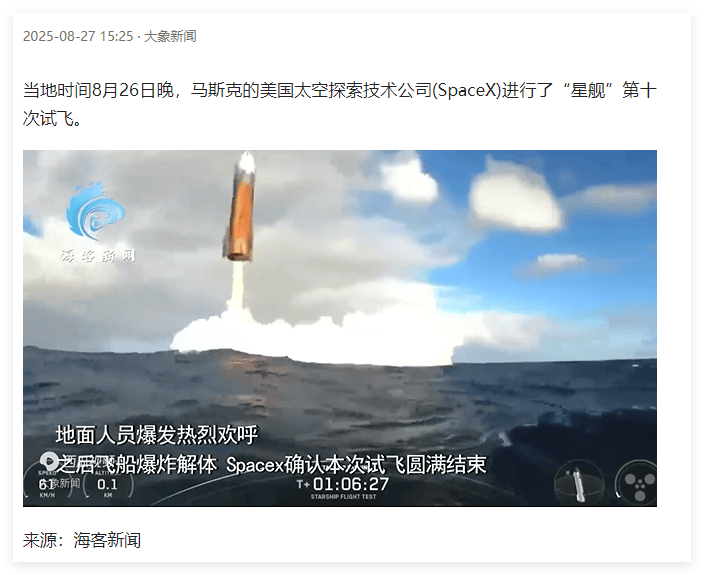
Group 1 - The core achievement of the year includes NVIDIA's foundational advancements in AI, which encompass a range of powerful chips, world models, digital twins, and new-generation robotics hardware and software, significantly pushing the AI ecosystem forward [1][2] - OpenAI's release of GPT-5 marks a significant step towards general artificial intelligence (AGI), showcasing versatility across multiple disciplines such as mathematics, physics, and programming, indicating a competitive landscape for AGI development [2][4] - SpaceX's successful test flight of the Starship, after nine previous failures, demonstrates progress in space exploration technology, with plans for future missions to Mars [4][6] Group 2 - The Starship rocket, measuring approximately 120 meters in length and weighing 5,000 tons, consists of a two-stage design that is fully reusable, with future iterations expected to increase in weight [6][8] - SpaceX aims to launch an unmanned Starship to Mars by the end of 2026, with plans for potential manned missions and infrastructure development on Mars by 2028 [8][9] - The successful test flight of the Starship not only represents a step towards interstellar travel but also hints at the emergence of concepts like "space aircraft carriers" and advanced aerospace technologies [9][11] Group 3 - The development of new nuclear energy technologies and advancements in AI and robotics are expected to facilitate the creation of large-scale space vehicles capable of operating beyond the atmosphere [11][13] - Within the next decade, the industry anticipates the emergence of massive space carriers, potentially exceeding tens of thousands of tons, revolutionizing space travel and exploration [13]