空空中转

Search documents
2025年西藏航空口岸出入境航班、旅客均大增
Xin Lang Cai Jing· 2026-02-05 14:06
Core Insights - The article highlights the significant growth in air traffic and passenger numbers at Lhasa Gonggar International Airport, indicating a robust recovery and expansion in international connectivity for Tibet [1][2] - The customs authority is actively enhancing the airport's capacity and quality, supporting new international routes, and implementing advanced technology for passenger and cargo processing [1][2] Group 1: Air Traffic and Passenger Growth - In 2025, customs supervision recorded 776 inbound and outbound flights and 16,909 passengers, representing a year-on-year increase of 237.4% and 103.8% respectively [1] - The airport serves as the only international air port in Tibet, connecting the region to the world [1] Group 2: Infrastructure and Technology Enhancements - The customs authority has supported the addition of two new international routes, bringing the total to four, thereby strengthening air links with South Asia and Hong Kong [1] - Advanced technology measures such as "smart boarding" and pre-inspection of incoming luggage have been implemented to optimize the passenger experience [1] Group 3: Cargo Operations and Future Development - The first international cargo station at the airport has commenced operations, facilitating efficient handling of import and export goods with a value exceeding 10 million RMB in 2025 [1] - The customs authority is exploring "air-to-air transfer" business models to enhance the smooth flow of goods [1][2] - Future initiatives will focus on supporting foreign trade enterprises and enhancing the high-quality development of the airport [2]
出口渠道拓宽!改革创新助力湖南跨境电商出口提质发展
Sou Hu Cai Jing· 2026-01-08 11:05
Core Insights - Cross-border e-commerce has become a significant engine for foreign trade innovation and a key driver for economic growth in Changsha [3] Group 1: Growth and Efficiency - The cross-border e-commerce export transshipment business at Changsha Huanghua International Airport has seen significant growth, with transshipment cargo volume exceeding 2,900 tons from January to November 2025, doubling compared to the same period in 2024 [1] - The logistics efficiency is highlighted by the rapid processing of goods, with items arriving from Guangdong and being shipped to Africa or other regions on the same day [1][3] Group 2: Operational Mechanisms - The airport has established three efficient transshipment routes: via Guangzhou to Southeast Asia, via Beijing Capital Airport to East Asia, and via Beijing Daxing Airport to Europe, America, and Central Asia [4] - The "air-to-air transshipment" model has emerged as an important supplement to export capacity, optimizing resource allocation and reducing overall transportation costs [3][4] Group 3: Customs and Regulatory Framework - Customs at Changsha Huanghua Airport operates a 24/7 appointment system to ensure rapid inspection and release of goods, with most items cleared for export on the same day or early the next morning [5] - A smooth communication mechanism has been established between customs, logistics companies, and airlines to address any issues during the transportation and inspection process [5] Group 4: Future Prospects - In 2025, Changsha was approved as an airport-based national logistics hub, providing new opportunities for the development of cross-border e-commerce [5] - The focus will be on enhancing logistics facilitation and implementing strategic actions to promote integrated development between the zone and the port, aiming to establish Changsha as a regional distribution center for cross-border e-commerce in Central and Western China [5]


前11月杭州空港国际货运量创新高
Mei Ri Shang Bao· 2025-12-11 06:45
Core Insights - Hangzhou Xiaoshan International Airport has achieved a record high in cargo throughput, with a total of 230,400 tons in the first 11 months of the year, marking a year-on-year increase of 10.41% and surpassing the total expected for 2024 by one month [1] Group 1: Cross-Border E-commerce Growth - Cross-border e-commerce has emerged as a key driver for export growth, with cargo volume reaching 140,700 tons, a year-on-year increase of approximately 23.66%, accounting for 70% of the total export volume from the airport [1] - The airport has implemented efficient operations with seven inbound channels and automated sorting equipment, enhancing the speed of processing cross-border e-commerce packages [1] Group 2: Expansion of Air Cargo Network - The airport has expanded its international cargo routes, adding flights to Uzbekistan and the Czech Republic, and increasing capacity to Latin America, with weekly flights to Mexico City now carrying over 400 tons [2] - A total of 28 international cargo routes have been established, with approximately 120 cargo flights operating weekly, creating a comprehensive air corridor to major global trade markets [2] Group 3: Enhanced Customs Efficiency - Customs efficiency has improved significantly, with a 20% increase in processing speed due to the implementation of 24/7 customs clearance and smart regulatory measures [2] - The establishment of a dedicated service officer system has allowed for better alignment with businesses' peak demand during promotional periods [2] Group 4: Fresh Produce Imports - The import of fresh produce from ASEAN countries has surged, with 177.91 tons of aquatic products imported in the first 11 months, a year-on-year increase of 134.49% [3] - The airport has implemented a "green channel" for fresh produce, allowing for pre-declaration of goods during transit, which has reduced overall clearance time by approximately one hour [3] Group 5: Innovative Logistics Models - The "air-to-air transfer" model has become a new growth point for international cargo, allowing for seamless transfer of goods without the need for repackaging, reducing logistics costs by about 35% [5][6] - The airport has facilitated the regular operation of this model since September, enhancing the efficiency of cargo transfer and achieving a year-on-year increase of 6.9% in air-to-air transfer cargo [6]
浙江杭州:织密航线网络,助力跨境电商“加速跑”
Sou Hu Cai Jing· 2025-08-08 00:15
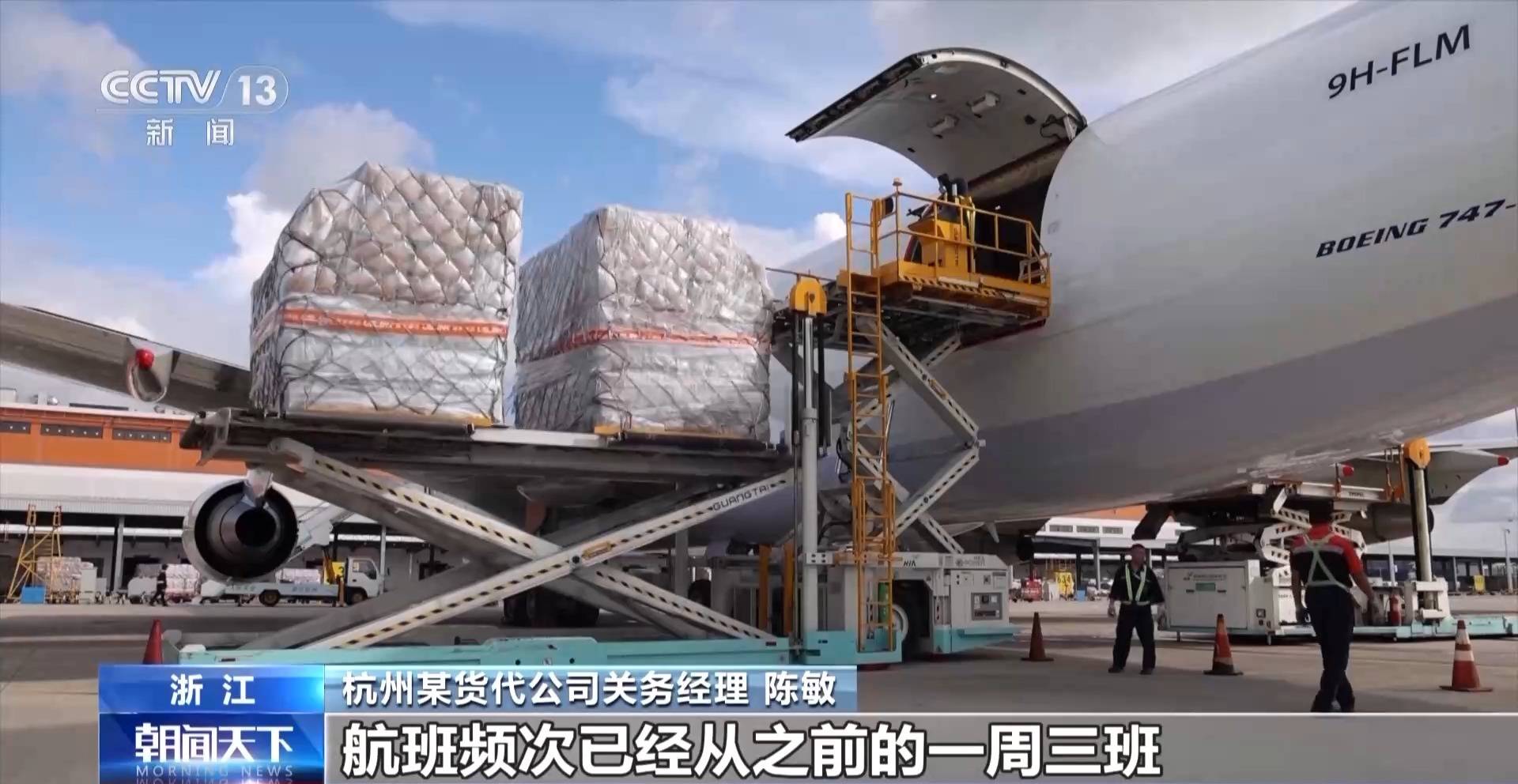
Core Insights - Hangzhou is the first city in China to establish a comprehensive pilot zone for cross-border e-commerce, serving as a major export origin for domestic cross-border e-commerce platforms [1] - The volume of cross-border cargo has been steadily increasing, becoming a new driving force for foreign trade growth [1] Group 1: Cross-Border E-Commerce Growth - The international cargo station at Hangzhou Xiaoshan International Airport is witnessing a significant increase in cross-border e-commerce exports, with over 100 tons of goods being shipped to Derby, UK [1] - Since May, the frequency of flights to East Midlands Airport in the UK has increased from three to six flights per week, indicating a strong demand for cross-border shipping [3] Group 2: New International Routes - This year, Hangzhou has launched three new international cargo routes to Tokyo, Tashkent, and Ostrava, enhancing the capacity for rapid cross-border e-commerce exports [5] - Customs has introduced various "air-to-air transfer" services to optimize the use of overseas route capacity, significantly reducing transit times [5] Group 3: Cost Efficiency - The "air-to-air transfer" method allows for connections between airports without direct flights, utilizing a third airport, which generally results in lower costs, reducing operational expenses by approximately one-third [7] Group 4: Cargo Volume Statistics - Since the beginning of the year, the import and export cargo volume at Hangzhou's air port has exceeded 110,000 tons, with cross-border e-commerce goods accounting for over 70% of the total air export volume [9]