算力自由

Search documents
平头哥AI芯片内供转外销
经济观察报· 2026-02-11 07:53
Core Viewpoint - The article emphasizes the significance of Alibaba's in-house chip company, Pingtouge, in the context of AI model training and application, highlighting its competitive edge against external chip suppliers like Nvidia [1][9]. Group 1: Pingtouge's Development and Market Position - Pingtouge, a subsidiary of Alibaba, has developed the high-end AI chip "Zhenwu 810E," which directly competes with Nvidia's H20, achieving a shipment volume of several hundred thousand units [2][7]. - The company has transitioned from being viewed as a cost center for Alibaba to potentially becoming a profit center, especially if it successfully goes public [3]. - Pingtouge's chips, including the "Zhenwu 810E," have gained traction in the market, with over 400 external clients, including major companies like State Grid and Xpeng Motors [9][11]. Group 2: Strategic Importance of Chip Development - Alibaba's chip development strategy is driven by the need for computational freedom, as the company faces high demand for AI capabilities across its vast ecosystem [5]. - The establishment of Pingtouge aligns with Alibaba's broader AI strategy, which includes significant investments in AI and chip technology, amounting to 380 billion yuan [11]. - The launch of the "Zhenwu 810E" marks a pivotal moment for Pingtouge, indicating its readiness to compete in the commercial market and signaling a shift in its operational focus [11][12]. Group 3: Competitive Landscape and Future Outlook - The AI chip market is expected to see a shift in market share, with local Chinese manufacturers, including Pingtouge, anticipated to increase their presence significantly by 2026 [11]. - Despite the promising developments, Pingtouge faces challenges related to advanced manufacturing processes, which could impact its growth and market positioning [12]. - The article suggests that Pingtouge's ability to build a robust ecosystem around its PPU architecture will be crucial for its survival and success in the competitive landscape [12].



平头哥AI芯片内供转外销
Jing Ji Guan Cha Wang· 2026-02-11 06:29
Core Insights - The article discusses the emergence of Alibaba's semiconductor company, Pingtouge, and its development of high-performance AI chips, particularly the "Zhenwu 810E," which directly competes with Nvidia's H20 [3][7][9] - Pingtouge's transition from being viewed as a cost center to a potential profit center for Alibaba is highlighted, especially with rumors of an upcoming IPO [4][12] - The strategic necessity for Alibaba to develop its own chips is emphasized, driven by the need for cost-effective computing power to support its vast ecosystem [5][11] Company Developments - Pingtouge launched the "Zhenwu 810E" AI chip in January 2026, with reported shipments reaching several hundred thousand units [3][12] - The company has been operating independently under Alibaba's DAMO Academy since its establishment, focusing on cloud-integrated chips [6][11] - The PPU (Parallel Processing Unit) development was kept secret for years, with its public reveal occurring in September 2025 during a CCTV news segment [8][10] Market Position and Strategy - Pingtouge's chips are primarily supplied to Alibaba, allowing for optimized performance tailored to internal applications, which is seen as a competitive advantage [10][11] - The company aims to capitalize on the growing demand for AI chips in the domestic market, with predictions of significant market share growth for local manufacturers [13][14] - The strategic positioning of Pingtouge within Alibaba's broader AI strategy, which includes substantial investments in AI and chip development, is noted [13][15]
奇瑞尹同跃:对标特斯拉FSD,更要实现“算力自由”;全球最大汽车供应商预警利润跌破2%丨汽车交通日报
创业邦· 2026-01-18 10:23
Group 1 - Chery is benchmarking against Tesla's FSD and aims to achieve "computing power freedom" by rapidly closing the gap in autonomous driving technology [2] - Chery's AI strategy has entered the 2.0 (AI+) era, showcasing core AI achievements such as the super AI assistant "Xiao Qi," Falcon Intelligent Driving, Lingxi Smart Cabin, and Mocha Robot [2] - The Falcon Intelligent Driving series is set to evolve and plans to be equipped in over 35 models by 2026, accelerating the adoption of advanced intelligent driving [2] Group 2 - Bosch, the world's largest automotive parts supplier, has warned of a profit margin dropping below 2% in 2025, significantly below expectations [2] - Bosch's operating profit margin is projected to decline from 4.8% in 2023 to 3.5% in 2024, primarily due to restructuring costs of €3.1 billion, which accounts for approximately 3.5% of sales [2] - Bosch's revenue for 2025 is estimated at €91 billion, slightly above €90 billion in 2024, with growth largely attributed to the acquisition of Johnson Controls-Hitachi, contributing around €4 billion [2] Group 3 - Li Auto released its 2025 travel report, indicating a user activity rate of 99.5% and a total driving distance exceeding 6 billion kilometers [2] - The report highlights that Li Auto's assisted driving system has accumulated 1.505 million users and recorded 3.07 billion kilometers driven in the past year [2] - Notable metrics include 36,643 instances of daily assisted driving exceeding 1,000 kilometers and a maximum individual user driving distance of 119,000 kilometers [2]

奇瑞尹同跃:对标特斯拉FSD,更要实现“算力自由”
第一财经· 2026-01-18 09:44
Core Viewpoint - Chery Automobile is actively benchmarking against Tesla's FSD and Grok models to identify gaps and accelerate its development in AI and intelligent driving technologies [3]. Group 1: AI Strategy and Development - Chery has introduced a comprehensive AI strategy, showcasing core technologies such as the AI intelligent body "Xiao Qi," Falcon Intelligent Driving, Lingxi Intelligent Cabin, and Mocha Robot [3]. - The company claims to have entered the 2.0 (AI+) era, transitioning from a "technology Chery" to a "global AI technology company" [3]. - The "Falcon Intelligent Driving" series is set to evolve continuously, with plans to equip over 35 models with advanced intelligent driving capabilities by 2026 [3]. Group 2: Challenges in AI Integration - Chery's CEO identified three major challenges in the integration of AI with the automotive industry: safety, legal and ethical considerations, and quality management [4]. - Safety is the primary concern, as automobiles are products that carry life safety [4]. - Establishing an AI governance framework that aligns with human values is a critical issue that the industry must address [4]. - A new quality management logic must be developed to ensure the stability and traceability of AI systems throughout their lifecycle [4]. Group 3: Energy and Chip Development - The rapid growth of global computing power necessitates significant energy demands and new infrastructure in China [5]. - Chery has established a chip research institute and a green energy company to support AI development and energy supply [5]. - The company envisions a shift from pursuing mobility freedom to seeking computing and energy freedom, positioning automobiles as key players in shaping future civilization [5].

奇瑞尹同跃:对标特斯拉FSD,更要实现“算力自由”
Di Yi Cai Jing· 2026-01-18 06:47
Core Viewpoint - Chery Automobile is transitioning from a focus on mobility freedom to pursuing computational and energy freedom, emphasizing the importance of AI in reshaping industries, particularly the automotive sector [1][2] Group 1: AI Strategy and Development - Chery is actively benchmarking against Tesla's FSD and Grok models to identify gaps and accelerate its AI capabilities [1] - The company showcased its full AI strategy at the 2026 AI Night, introducing key AI technologies such as the super AI entity "Xiao Qi," Falcon Intelligent Driving, Lingxi Smart Cabin, and Mocha Robot [1] - Chery's AI initiative has entered the 2.0 (AI+) era, aiming to evolve from a "technology Chery" to a "global AI technology company" [1] - The "Falcon Intelligent Driving" series is set to evolve and be equipped in over 35 models by 2026, promoting the widespread adoption of advanced intelligent driving [1] Group 2: Challenges in AI Integration - The integration of AI in the automotive industry faces three main challenges: safety verification, legal and ethical governance, and quality management for AI systems [2] - Ensuring the safety of AI in vehicles is paramount due to the life-critical nature of automotive products [2] - Establishing a governance framework that aligns with human values is a key industry challenge [2] - A new quality management logic must be developed to ensure the stability and traceability of AI systems throughout their lifecycle [2] Group 3: Energy and Computational Needs - The explosive growth of global computational power will lead to significant energy demands and new infrastructure needs in China [2] - Chery has established a chip research institute and a green energy company to support AI development and energy supply for computational needs [2] - The company envisions a future where the automotive industry plays a crucial role in shaping new forms of civilization, emphasizing the importance of technology benefiting the public and fostering a prosperous and equitable society [2]
DeepSeek V3到V3.1,走向国产算力自由
虎嗅APP· 2025-08-24 09:02
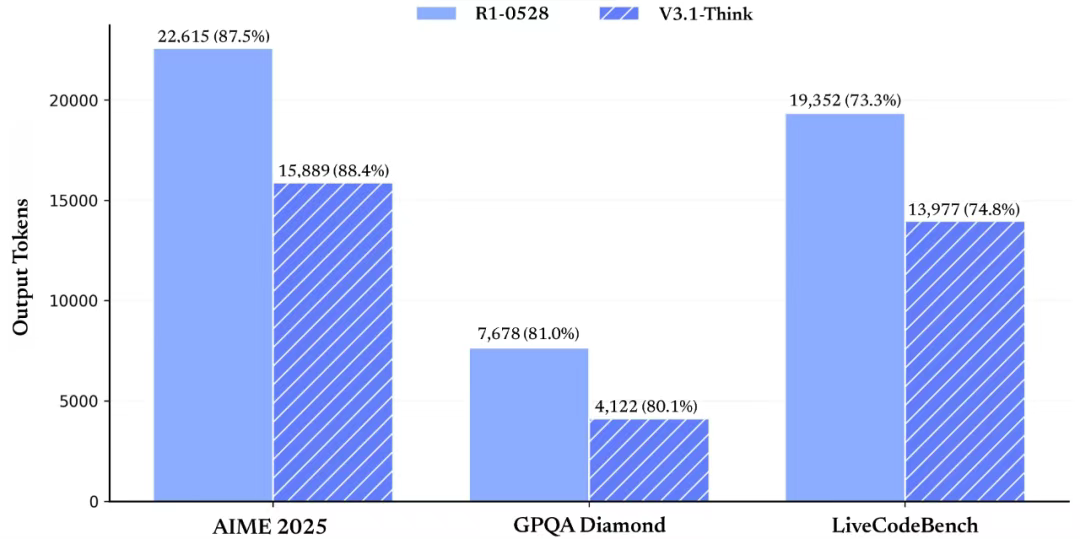
Core Insights - DeepSeek is advancing towards a "computing power freedom" path with its V3.1 release, optimizing the use of NVIDIA GPU power while adapting to domestic chips, potentially reducing memory usage by up to 75% [4][27]. - The V3.1 upgrade enhances DeepSeek's efficiency in reasoning and tool usage, positioning it competitively against international AI firms [8][9]. Group 1: Technological Advancements - DeepSeek V3.1 introduces a hybrid reasoning architecture, supporting both thinking and non-thinking modes, which improves efficiency and reduces token consumption [6][8]. - The model has undergone extensive retraining with an additional 840 billion tokens, achieving a context length of 128k, which enhances performance while lowering costs [8][9]. - The API Beta interface now supports strict function calling, improving reliability and usability in enterprise applications, making it easier to replace existing solutions like GPT/Claude [9]. Group 2: Market Positioning - DeepSeek's V3.1 is a significant milestone in its transition to the Agent era, allowing for better integration into the enterprise market, particularly with support for Anthropic API formats [9][30]. - The shift towards using UE8M0 FP8 scale data format allows DeepSeek to efficiently run large models on domestic AI chips, reducing reliance on imported GPUs [12][27]. - The potential decline in demand for NVIDIA's H20/B30 chips in China is noted, as domestic chips become more capable of handling large models with the new low-precision training methods [29][30]. Group 3: Competitive Landscape - NVIDIA's long-standing use of low-precision formats has set a benchmark, but DeepSeek's innovations may accelerate the development of domestic chips, creating a more independent AI ecosystem in China [16][32]. - Despite the advancements by DeepSeek, NVIDIA retains advantages in bandwidth, interconnectivity, and a robust software ecosystem, which may still attract international firms [32].


DeepSeek V3到V3.1,走向国产算力自由
Hu Xiu· 2025-08-24 00:33
Core Insights - DeepSeek is leveraging NVIDIA's GPU capabilities while adapting to domestic chips, potentially reducing memory usage by up to 75% and decreasing reliance on imported advanced GPU chips [1][34][39] - The release of DeepSeek V3.1 marks a significant step towards the Agent era, showcasing a hybrid reasoning architecture that supports both thinking and non-thinking modes [3][10] - The upgrade enhances DeepSeek's efficiency, allowing it to answer questions using fewer tokens and less time, improving user experience and economic considerations [4][6] Technical Developments - DeepSeek V3.1 utilizes UE8M0 FP8 scale parameter precision, which significantly reduces memory and bandwidth requirements, thus improving training and inference efficiency [11][15][30] - The model has undergone extensive retraining with an additional 840 billion tokens, achieving a context length of 128k [7][10] - The API Beta interface now supports strict function calling, enhancing reliability and usability in enterprise applications, aligning with trends seen in other major AI companies [8][9] Market Implications - The advancements in DeepSeek's technology are expected to invigorate the Chinese capital market, reflecting a growing focus on technological self-sufficiency [2] - As domestic GPU manufacturers adopt FP8 precision, the demand for NVIDIA's H20/B30 chips may decline, especially if the next generation of domestic GPUs can efficiently run large models [36][38] - The shift towards UE8M0 and ultra-low precision training could lead to a gradual reduction in reliance on NVIDIA's ecosystem, fostering a more independent Chinese AI chip and model landscape [42] Competitive Landscape - Despite the innovations from DeepSeek, NVIDIA maintains its competitive edge with superior bandwidth, interconnect capabilities, and a robust software ecosystem [40][41] - The ongoing evolution of low-precision digital representation technology, as exemplified by DeepSeek's UE8M0, may accelerate the development of next-generation domestic chips [39][42] - The industry is witnessing a potential shift where companies may prioritize domestic solutions over NVIDIA's offerings, particularly in cost-sensitive scenarios [38][42]