算力-能源

Search documents
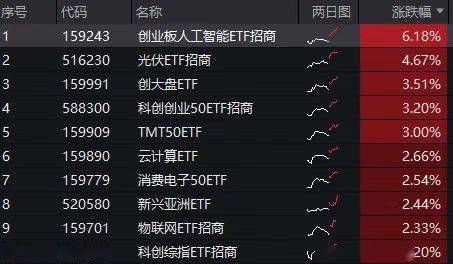
黄仁勋盖章“8年周期”,马斯克预言“太空能源”,创业板人工智能ETF招商(159243)应声飙涨6.37%
Sou Hu Cai Jing· 2026-02-09 03:38
Core Insights - The recent surge in technology stocks in the A-share market was triggered by Nvidia CEO Jensen Huang's declaration of the "largest infrastructure cycle in history," which has led to a significant increase in AI-related investments [1][2] - Elon Musk's vision of space becoming the primary site for AI infrastructure within the next 30 months has catalyzed a boom in the photovoltaic sector, highlighting the intersection of energy and AI computing [1][3] Group 1: Market Reactions - The ChiNext AI ETF (159243) surged by 6.37%, becoming the strongest performer in the market [1] - The photovoltaic ETF (516230) rose by 4.27%, reflecting the growing interest in energy solutions as part of the AI infrastructure [1] - Overall market enthusiasm is directed towards "AI computing power" and "space energy," as defined by industry leaders [2] Group 2: Industry Leadership Insights - Jensen Huang's assertion that the current AI capital expenditure is "appropriate and necessary" is supported by the fact that prices for second-hand GPUs sold six years ago are rising, indicating a critical shortage of global computing power [1][3] - Huang emphasized that this is the early to mid-stage of a construction cycle that will last for 7-8 years, marking a long-term certainty in AI investment [1] - The profitability of companies like OpenAI and Anthropic, constrained by computing power, provides a solid commercial validation for ongoing capital expenditures [1] Group 3: Future Projections - Musk's prediction that space will become the preferred site for AI infrastructure integrates solar energy, robotics, chip manufacturing, and AI into a complete closed loop [3] - This vision suggests that future AI supercomputing will require vast amounts of computing power supported by abundant and inexpensive space energy, linking the photovoltaic and AI sectors [3] - The current market dynamics indicate a shift from fragmented concept speculation to long-term strategic allocation around the core conflicts of "computing power-energy" [3]