创业板人工智能ETF招商

Search documents
先抑后扬!AI主题基金净值波动加剧
证券时报· 2026-03-19 04:47
Core Viewpoint - The article discusses the significant volatility in AI-themed fund net values following the NVIDIA GTC 2026 conference, highlighting the impact of market reactions to key announcements made during the event [1][3]. Group 1: AI Fund Volatility - AI-themed funds experienced sharp fluctuations in net value, particularly around the NVIDIA GTC 2026 conference held from March 16 to 19, 2026 [1][2]. - On the opening day of the conference, NVIDIA's stock price surged before retreating, leading to notable declines in related A-share stocks, with many AI-themed funds seeing a drop of over 5% on March 17 [3][4]. - The market rebounded quickly on March 18, with the CSI Artificial Intelligence Industry Index rising by 3.81%, indicating a rapid recovery in fund values [3][4]. Group 2: Key Announcements from NVIDIA - The GTC 2026 conference revealed several critical developments, including the introduction of the Oberon system and the anticipated release of the Feynman computing platform in 2028, with a revenue target of $1 trillion by 2027 [3][4]. - NVIDIA's strategic shift towards the concept of an "AI factory" was emphasized, indicating a broader role in AI infrastructure beyond just chip provision [6]. Group 3: Market Analysis and Future Outlook - Analysts noted that while there are concerns about a potential AI bubble, the underlying demand and ongoing investments in AI suggest a more stable growth trajectory [4][8]. - Emerging sectors such as reasoning chips and AI agents are viewed as undervalued, presenting opportunities for significant growth despite volatility in traditional AI stocks [8]. - The market is expected to refocus on performance fundamentals in 2026, with a recommendation for investors to strategically position themselves in technology growth sectors [8].



先抑后扬!AI主题基金净值波动加剧
券商中国· 2026-03-18 23:19
Core Viewpoint - The recent fluctuations in AI-themed fund net values are significantly influenced by the Nvidia GTC 2026 conference, which highlighted key advancements in AI technology and market expectations, leading to volatility in related stocks and funds [1][2]. Group 1: Market Reactions - Nvidia's stock experienced a sharp rise and subsequent fall on the opening day of the GTC conference, impacting A-share related stocks, particularly in the optical module and chip sectors, which saw declines exceeding 5% [2]. - The China Securities Artificial Intelligence Industry Index dropped by 2.73% on the same day, with numerous AI-themed funds also reporting declines of over 5% [2]. - Following the initial downturn, there was a rapid recovery in the market, with the index rebounding by 3.81% on March 18, leading to a recovery in the net values of related funds [2][3]. Group 2: Key Developments from the Conference - The GTC conference introduced significant technological advancements, including the Oberon system and the anticipated Feynman computing platform, which is expected to launch in 2028, alongside Nvidia's ambitious revenue target of reaching $1 trillion by 2027 [2][3]. - Nvidia's strategic shift towards the concept of "AI factories" was emphasized, indicating a transformation from merely providing chips to offering comprehensive systemic solutions [4][5]. Group 3: Industry Insights - Analysts suggest that while there are concerns about short-term volatility and potential bubbles in the AI sector, the underlying fundamentals driven by real demand and ongoing investments support a long-term growth narrative for AI technologies [3][5]. - The advancements in AI infrastructure and technology are expected to benefit the entire AI industry, including sectors such as telecommunications, semiconductors, and software [5]. - Despite some traditional sectors facing high valuations, emerging areas like inference chips and AI agents are viewed as having low valuations with significant growth potential [6].

黄仁勋盖章“8年周期”,马斯克预言“太空能源”,创业板人工智能ETF招商(159243)应声飙涨6.37%
Sou Hu Cai Jing· 2026-02-09 03:38
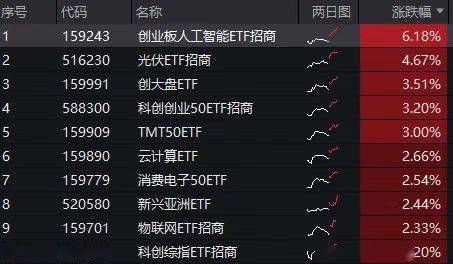
Core Insights - The recent surge in technology stocks in the A-share market was triggered by Nvidia CEO Jensen Huang's declaration of the "largest infrastructure cycle in history," which has led to a significant increase in AI-related investments [1][2] - Elon Musk's vision of space becoming the primary site for AI infrastructure within the next 30 months has catalyzed a boom in the photovoltaic sector, highlighting the intersection of energy and AI computing [1][3] Group 1: Market Reactions - The ChiNext AI ETF (159243) surged by 6.37%, becoming the strongest performer in the market [1] - The photovoltaic ETF (516230) rose by 4.27%, reflecting the growing interest in energy solutions as part of the AI infrastructure [1] - Overall market enthusiasm is directed towards "AI computing power" and "space energy," as defined by industry leaders [2] Group 2: Industry Leadership Insights - Jensen Huang's assertion that the current AI capital expenditure is "appropriate and necessary" is supported by the fact that prices for second-hand GPUs sold six years ago are rising, indicating a critical shortage of global computing power [1][3] - Huang emphasized that this is the early to mid-stage of a construction cycle that will last for 7-8 years, marking a long-term certainty in AI investment [1] - The profitability of companies like OpenAI and Anthropic, constrained by computing power, provides a solid commercial validation for ongoing capital expenditures [1] Group 3: Future Projections - Musk's prediction that space will become the preferred site for AI infrastructure integrates solar energy, robotics, chip manufacturing, and AI into a complete closed loop [3] - This vision suggests that future AI supercomputing will require vast amounts of computing power supported by abundant and inexpensive space energy, linking the photovoltaic and AI sectors [3] - The current market dynamics indicate a shift from fragmented concept speculation to long-term strategic allocation around the core conflicts of "computing power-energy" [3]

AI概念股早盘走强,创业板人工智能相关ETF涨超3%
Sou Hu Cai Jing· 2026-02-03 02:06
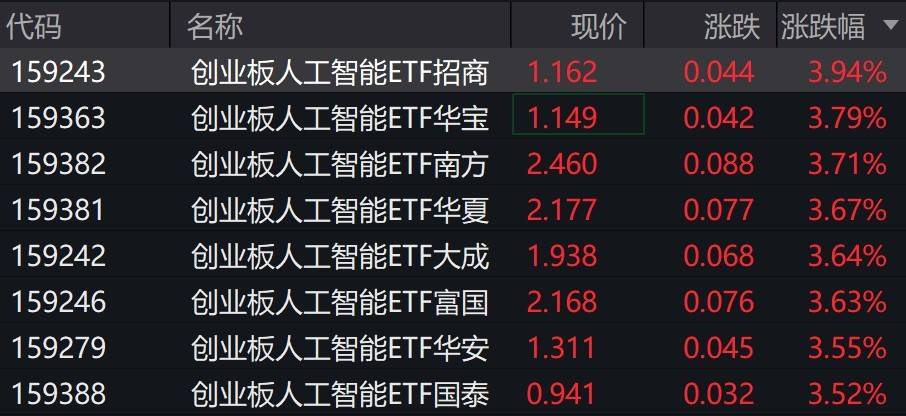
Group 1 - AI concept stocks showed strong performance in early trading, with Tianfu Communication and Changxin Bochuang rising over 10%, Beijing Junzheng and Kunlun Wanwei increasing over 4%, and Zhongji Xuchuang up over 3% [1] - The ChiNext AI-related ETFs rose by more than 3% due to market influence [1] Group 2 - Various ChiNext AI ETFs reported significant gains, with the following price changes: - ETF Zhaoshang increased by 3.94% to 1.162 - ETF Huabao rose by 3.79% to 1.149 - ETF Nanfang climbed by 3.71% to 2.460 - ETF Huaxia grew by 3.67% to 2.177 - ETF Dacheng increased by 3.64% to 1.938 - ETF Fuguo rose by 3.63% to 2.168 - ETF Hu'an increased by 3.55% to 1.311 - ETF Guotai grew by 3.52% to 0.941 [2] Group 3 - Analysts indicate that AI is the core driving force of a new technological revolution, with its greatest value lying not in efficiency enhancement but in creating new possibilities and promoting the intelligent transformation of various industries [2] - The development of large model technology is profoundly reshaping the global industrial landscape, with potential to bring incremental commercial value worth trillions of yuan to the financial industry, transitioning from efficiency improvement to value creation [2] - The iterative development of large models faces challenges such as technological bottlenecks, high investment costs, and the need to balance with regulatory frameworks [2]
创业板午后走强,创业板人工智能ETF招商(159243)暴涨近3%,致尚科技涨停、太辰光紧随其后
Sou Hu Cai Jing· 2026-01-30 06:25
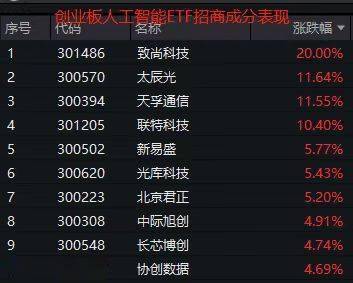
Group 1 - The ChiNext index showed strength in the afternoon of January 30, with the AI ETF from招商 rising by 2.38%, peaking at 2.99% [1] - Key performing stocks included 致尚科技, 太辰光, 天孚通信, 联特科技, and 新易盛, with 太辰光 and 天孚通信 experiencing significant gains of 11.64% and 11.55% respectively [2] Group 2 - According to Lightcounting, the global Ethernet optical module market is expected to grow rapidly, with a projected increase of 35% to reach $18.9 billion by 2026, and maintaining double-digit growth from 2027 to 2030, potentially exceeding $35 billion by 2030 [2] - The primary growth drivers include strong demand for Ethernet switches and high-speed optical modules due to AI infrastructure development, as well as the promotion of optical interconnect technology in AI scale-up networks [2] Group 3 - 长城证券 indicated that the demand for optical modules driven by data center traffic explosion remains the core driver of optical module development [3] - The rapid increase in data volume from domestic and international large model inference, driven by AIGC development, is expected to further catalyze a significant rise in optical module computing power demand [3]

A股ETF开年火热,32只主题ETF涨超20%
3 6 Ke· 2026-01-15 12:03
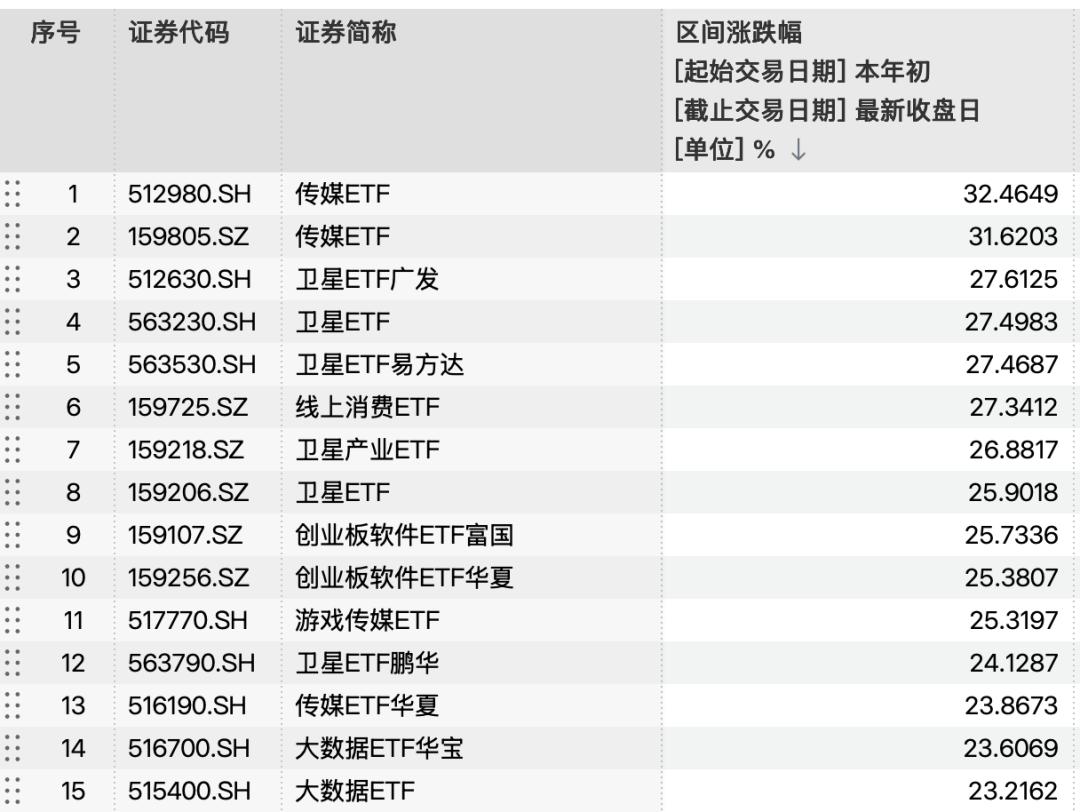
Core Viewpoint - The A-share market has experienced a "spring surge" at the beginning of 2026, with ETFs showing significant growth and a rare trend of "limit-up" occurrences in multiple products [1][5]. Group 1: ETF Market Overview - The total scale of ETFs in the market has increased from 6 trillion yuan to 6.24 trillion yuan, a growth of over 2245.82 billion yuan since the beginning of the year [2][3]. - Stock ETFs have been the main contributors to this growth, with an increase of over 2000 billion yuan, surpassing the 4 trillion yuan mark, reaching 4.05 trillion yuan [2][3]. - In contrast, bond ETFs have seen a decline of 761.53 billion yuan, and money market ETFs have decreased by 196.98 billion yuan [2]. Group 2: Performance of ETFs - The net value performance of various industry-themed ETFs has significantly outperformed major indices, with the media, satellite, and defense sectors showing notable gains [3][4]. - As of January 14, 2026, the media sector ETFs, such as the GF Media ETF and Penghua Media ETF, have recorded increases of 32.46% and 31.62%, respectively [4]. - Satellite-themed ETFs have also performed well, with the GF Satellite ETF leading with a 27.61% increase [3][4]. Group 3: Fund Flow Dynamics - There is a clear divergence in fund flows, with broad-based ETFs like the CSI A500 experiencing a net outflow of nearly 180 billion yuan, while thematic ETFs in sectors like non-ferrous metals and cross-border investments are attracting capital [7][8]. - The trend of passive investment is increasing, with more investors shifting from public funds to thematic ETFs, indicating a growing interest in sector-specific investments [7][9]. Group 4: Institutional Activity - Institutional investors are actively participating in the ETF market, with public funds moving away from homogeneous competition to focus on niche themes, resulting in the approval of 14 new ETF products since the beginning of 2026 [9]. - Leading fund management companies, such as Huaxia Fund, have seen significant growth in ETF management scale, surpassing 1 trillion yuan, indicating a trend towards increased concentration in the ETF management industry [9].
20余只ETF涨停 这个赛道为何疯狂?
Guo Ji Jin Rong Bao· 2026-01-12 23:54
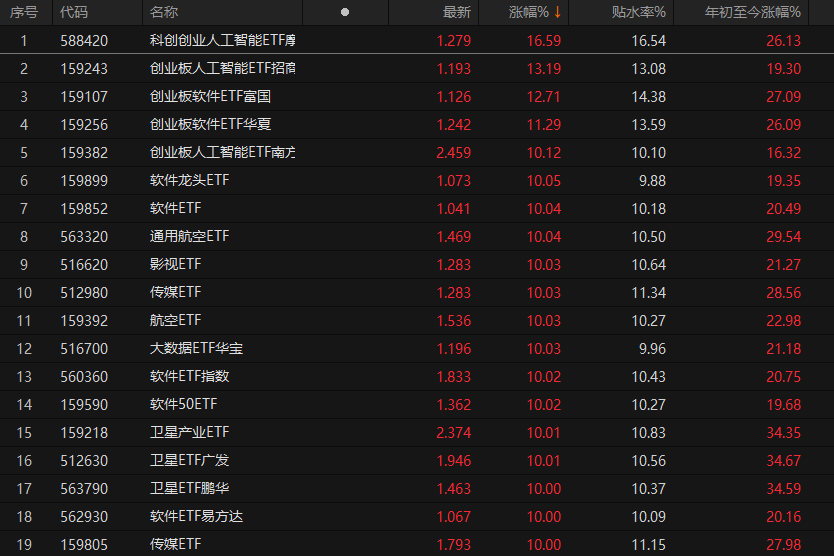
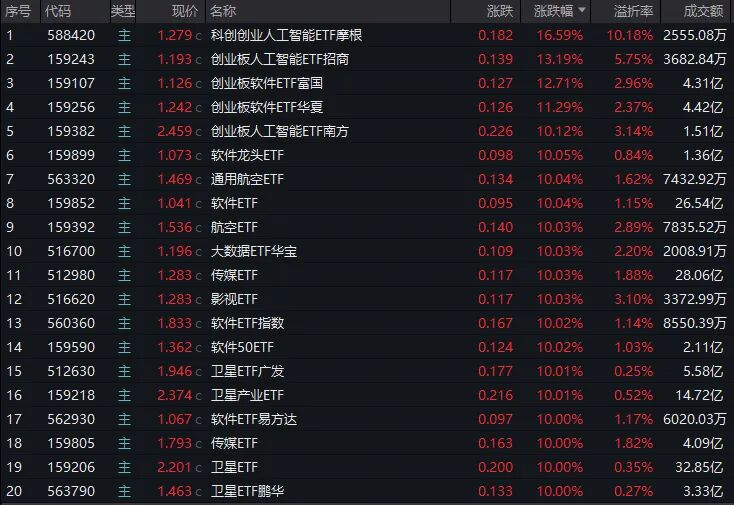
Core Viewpoint - The A-share market experienced a record trading volume on January 12, with a surge in various industry sectors leading to a significant number of ETFs reaching their daily price limits. Group 1: Market Performance - On January 12, the total trading volume in the A-share market exceeded 3.6 trillion yuan, surpassing the previous record set on October 8, 2024, with 201 individual stocks hitting their daily limit [2] - A total of 27 stock ETFs reached their daily limit, with 20 ETFs rising over 10% in a single day, indicating a rare surge in the ETF market [4][5] - The leading sectors included satellite, media, aviation, artificial intelligence, and software, with notable performances from specific ETFs such as the Morgan Science and Technology Innovation ETF, which surged by 16.59% [3][4] Group 2: Sector Highlights - The commercial aerospace concept has gained significant traction, with six satellite-themed ETFs showing over 30% growth year-to-date, leading the market [6] - Multiple aviation-themed ETFs have also performed well, with some rising over 20% in the same period, reflecting strong investor interest in these sectors [6] - The media and software sectors also saw substantial gains, with several ETFs in these categories achieving over 10% increases [4][5] Group 3: Investor Sentiment and Market Dynamics - Industry experts noted that the surge in ETF prices reflects investor confidence in the Chinese economy and stock market, driven by favorable policies and high industry growth rates [5] - The rapid increase in ETF prices is attributed to a lack of selling pressure from arbitrage opportunities and strong expectations for future net asset value increases [5] - The current market sentiment indicates a shift towards specific industry trends rather than broad market rallies, with investors showing a willingness to pursue high-growth sectors like satellites and media [7]
里程碑!A股成交创历史新高 华夏基金成首家万亿级ETF管理公司
Cai Jing Wang· 2026-01-12 23:27
Core Viewpoint - The A-share market has seen a significant increase in trading volume, with the total reaching 3.64 trillion yuan, surpassing the previous record of 3.49 trillion yuan set during the "924 market" [1] Group 1: ETF Market Overview - The total trading volume of ETFs reached 427.88 billion yuan, with the Shanghai Stock Exchange accounting for 246.39 billion yuan and the Shenzhen Stock Exchange for 181.56 billion yuan [1] - The trading volume of stock-type ETFs was 236.09 billion yuan, while bond-type ETFs reached 105.94 billion yuan, and currency-type ETFs totaled 27.60 billion yuan [2] - The total scale of ETFs in China reached 6.19 trillion yuan as of January 12, 2026, marking a growth of 2.29 trillion yuan from the end of 2024 [2] Group 2: Growth of ETF Products - As of the end of 2025, the total number of ETFs in China exceeded 1,381, covering various asset classes including broad-based, industry themes, cross-border, commodities, and bonds [2] - 华夏基金 has established a comprehensive ETF ecosystem with 117 products, reflecting a strong commitment to index investment since the launch of the first domestic ETF in December 2004 [3] - The number of clients holding 华夏基金 ETFs reached 3.74 million by mid-2025, indicating high trust from both individual and institutional investors [3] Group 3: Competitive Landscape - As of January 12, 2026, 16 fund managers have ETF assets exceeding 100 billion yuan, with 华夏基金 leading at over 1.1 trillion yuan [4] - 易方达基金 follows closely with ETF assets exceeding 920 billion yuan, while 华泰柏瑞基金 has surpassed 650 billion yuan [4] - 华夏基金 offers 83 ETF products with the lowest fee rates among similar products, enhancing the investment experience for holders [3]
20余只ETF涨停,这个赛道为何疯狂?
Guo Ji Jin Rong Bao· 2026-01-12 15:43
Core Viewpoint - The A-share market experienced a record trading volume on January 12, with a significant surge in various industry sectors, particularly in ETFs, driven by strong investor sentiment and favorable policies [1][3][8]. Trading Performance - On January 12, the total trading volume in the A-share market exceeded 3.6 trillion yuan, surpassing previous records, with 201 stocks hitting the daily limit [3]. - A total of 27 stock ETFs reached their daily limit, with 20 ETFs rising over 10% in a single day [2][6]. Sector Highlights - The leading sectors included satellite, media, aviation, artificial intelligence, and software, with notable performances from satellite-themed ETFs, which saw an average increase of over 30% year-to-date [1][10]. - The top-performing ETF was the Morgan Science and Technology Innovation ETF, which surged by 16.59% on the same day [5]. Investor Sentiment - Analysts noted that the surge in ETF prices reflects strong investor confidence in the Chinese economy and stock market, with increasing interest from both institutional and individual investors [8]. - The rise in specific industry-themed ETFs indicates a positive shift in market sentiment and a willingness to invest in high-potential sectors like satellite and media [8][10]. Market Dynamics - The commercial aerospace and AI application sectors have emerged as key market drivers, with several ETFs in these categories achieving remarkable short-term gains [10]. - The current phase of the commercial aerospace industry is characterized by initial infrastructure development, with strong policy support and visible order visibility, particularly in rocket launch and satellite manufacturing [10]. Risk Considerations - Despite the positive market trends, analysts caution against potential risks such as valuation overextension, technology validation, and short-term speculative trading [11].
多只ETF涨停
Shang Hai Zheng Quan Bao· 2026-01-12 09:17
Core Viewpoint - Multiple ETFs have experienced significant gains and inflows, particularly in technology sectors, indicating a positive outlook for the market driven by policy support, technological breakthroughs, and industry trends. 2026 is anticipated to be a pivotal year for accelerated development in these fields [1][4]. ETF Performance - As of January 12, several ETFs, including the Sci-Tech Innovation AI ETF and the Growth Enterprise AI ETF, have shown substantial year-to-date gains, with increases of 16.59%, 13.19%, 12.71%, and 11.29% respectively [1][2]. - Year-to-date, multiple ETFs have attracted over 20 billion yuan in net inflows, with notable mentions including the Non-ferrous Metals ETF and the CSI 500 ETF, each exceeding 30 billion yuan in inflows [2][3]. Industry Insights - The Ministry of Industry and Information Technology has outlined a plan for the "AI + Manufacturing" initiative, aiming for significant advancements in AI technology and industry scale by 2027 [3]. - The AI sector is expected to transition from concept validation to large-scale practical applications by 2026, driven by major tech companies and increasing commercialization of AI applications [4][5]. Commercial Aerospace Sector - The commercial aerospace sector is poised for rapid growth, with SpaceX leading in satellite launches and user base expansion, while other countries like India and Russia are also advancing in this field [5][6]. - The investment drivers in the commercial aerospace sector include policy benefits, technological advancements, and global demand, suggesting a high level of certainty for long-term investments despite short-term valuation risks [6].