算法迭代

Search documents
无人驾驶赛道“波涛汹涌”,小马智行能否安然渡过盈利这条河?
Ge Long Hui· 2025-12-30 09:49
Core Viewpoint - The focus of competition in China's new energy vehicle sector is shifting from electrification to intelligence, particularly with the recent approval of L3-level conditional autonomous driving models, paving the way for future L4-level Robotaxi operations [1] Market Potential - By 2030, the market size for Robotaxi in China is expected to reach 158.3 billion yuan, with an estimated fleet size of 400,000 vehicles [1] - Currently, the Robotaxi market has not yet experienced a large-scale explosion, and commercial monetization is still in the exploratory phase [3] Company Overview - Xiaoma Zhixing (Pony.ai) was founded in 2016 and focuses on providing autonomous driving technology and solutions for transportation and logistics [5] - The company has established R&D centers in multiple locations, including Silicon Valley, Beijing, and Guangzhou, and aims to expand its product and business layout in Europe, the Middle East, and Asia [5] Financial Performance - In the first three quarters of 2025, Xiaoma Zhixing reported revenues of $60.88 million, a year-on-year increase of 54.1%, but a net loss of $157 million, widening from a loss of $93 million in the same period of 2024 [10] - The company's R&D expenses reached $157 million in the first three quarters of 2025, representing 257.74% of its revenue [12][13] Business Segments - The main sources of revenue for Xiaoma Zhixing in the first three quarters of 2025 were from autonomous driving trucks (43%) and technology licensing (39%), while Robotaxi services accounted for only 10% of total revenue [13] Competitive Landscape - The global Robotaxi industry has evolved into a multi-dimensional competitive landscape, with players like Tesla and Xiaoma Zhixing focusing on integrated models, while traditional ride-hailing platforms leverage user data [5] - Xiaoma Zhixing's unique technology moat is its "world model" (PonyWorld), which can simulate 10 billion kilometers of testing scenarios weekly, significantly enhancing AI training efficiency [6] IPO and Market Reaction - Xiaoma Zhixing's recent dual listing on NASDAQ and the Hong Kong Stock Exchange is seen as a necessary step to secure funding amid ongoing operational losses [7][8] - The stock price of Xiaoma Zhixing fell by 9.28% on its first day of trading, reflecting market concerns over the long-term profitability of L4 autonomous driving companies [10] Future Outlook - Xiaoma Zhixing plans to use approximately 50% of the net proceeds from its IPO to advance its market entry strategy and promote the large-scale commercialization of L4 autonomous driving technology over the next five years [15]


L3上路带动智驾爆发,佑驾创新:舱驾协同和算法迭代效率是关键
Zheng Quan Shi Bao Wang· 2025-12-16 08:45
Group 1 - The core point of the news is the historic breakthrough in the intelligent driving industry with the approval of China's first L3 level conditional autonomous driving vehicles by the Ministry of Industry and Information Technology, marking China as the second country globally to greenlight L3 after Germany, and potentially the first to implement large-scale trials [1][9] - The approval of L3 vehicles is not just a single policy action but a systemic signal indicating the maturity and reliability of the entire industry chain [1] - The consensus among industry leaders emphasizes that safety is the lifeline of L3 technology and the core direction for technological iteration, highlighting the importance of safety in the context of L3 [1][2] Group 2 - The distinction between L2 and L3 lies in the transition of the intelligent driving system from a mere "assistance tool" to a "responsible participant" in specific scenarios, which has been a significant barrier to the rollout of L3 [2] - The two approved models face strict regulatory requirements to validate safety through limited scenario testing, providing empirical evidence for future regulatory improvements and responsibility definitions [2] - The efficient iteration of algorithms is crucial in defining the safety ceiling for L3, with the demand for higher standards from manufacturers driving the continuous improvement of algorithms [2][6] Group 3 - Driver Monitoring Systems (DMS) are identified as a key element in addressing safety challenges for L3, with regulations mandating DMS as a necessary feature for L3 certification [4] - The entry and future proliferation of L3 vehicles necessitate a systematic upgrade in technical requirements for automotive and intelligent driving companies, requiring deep technical accumulation in both intelligent driving and smart cockpit technologies [5] - A differentiated technical path is being pursued by companies like Youjia Innovation, which aims to leverage L4 technology and L2 data to establish a foundation for L3, breaking down technical barriers between different levels of autonomous driving [6][7] Group 4 - The strategic value of this layout is becoming clearer with supportive policies, as the government has opened L3 vehicle approvals and selected nine cities for initial trials, including Shenzhen, where Youjia Innovation is headquartered [7] - Shenzhen is actively promoting the scenario validation and regulatory improvement for L3, indicating that large-scale implementation of L3 is approaching [8] - The approval of L3 vehicles is seen as the starting point for the era of full-scene intelligent driving, serving as a concentrated test of the maturity of the entire smart automotive industry [9]
摩根大通、华鑫证券给予评级,文远知行第一季度财报亮点频出
Jin Tou Wang· 2025-05-26 01:57
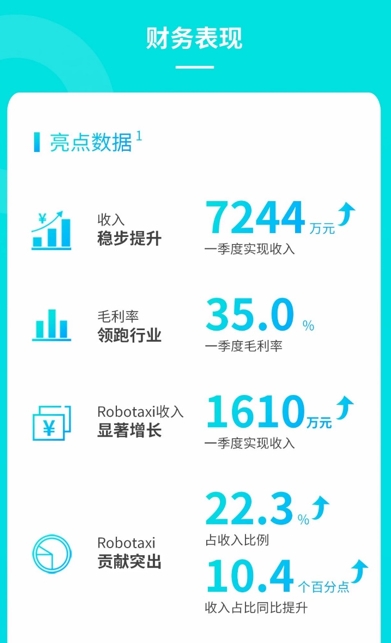
Group 1 - The core viewpoint of the articles highlights the strong performance and strategic positioning of the company, Wenyan Zhixing, in the Robotaxi sector, supported by positive ratings from Huaxin Securities and JPMorgan [1][6] - Wenyan Zhixing's Q1 2025 financial report shows a total revenue of 72.44 million yuan, with a gross margin of 35.0%, indicating robust growth and industry leadership [1][6] - The company has significantly increased its Robotaxi revenue to 16.1 million yuan, accounting for 22.3% of total revenue, and has deepened its strategic partnership with Uber, securing an additional $100 million equity investment [1][4] Group 2 - The period of 2025-2026 is predicted to be a critical window for the scaling of Robotaxi operations, with operational efficiency being key to commercial success [3] - Wenyan Zhixing has made significant advancements in the Robotaxi field, including a partnership with Uber and the Dubai Roads and Transport Authority to launch Robotaxi services in Dubai by the end of the year [3][4] - The company has also established a 24-hour autonomous driving service network in Guangzhou and plans to launch the first fully unmanned Robotaxi fleet in the Middle East by Q2 2025 [4][6] Group 3 - The combination of strong financial performance, strategic partnerships, and a focus on global expansion is creating a competitive barrier for Wenyan Zhixing in the Robotaxi market [6] - The company's early preparations for the upcoming scaling window and its advantages in technology iteration and market layout are expected to enhance its leading position in the industry [6]