精准脱钩

Search documents
美国已经追不上中国?华尔街巨头得出结论:中国的重心正在改变
Sou Hu Cai Jing· 2025-11-12 02:57
Core Insights - The narrative surrounding China's economic growth has shifted, with trade with Belt and Road Initiative countries now accounting for nearly half of China's total trade, up from just over 30% a few years ago [2] - China's export growth is increasingly driven by emerging markets, with a significant transformation in export structure from low-value products to electric vehicles, photovoltaic equipment, energy storage products, and AI software systems [4][6] - The Regional Comprehensive Economic Partnership (RCEP) has led to a significant reduction in tariffs, boosting trade within the region to over 2.5 trillion RMB [7] Trade Dynamics - U.S. companies are facing challenges in reducing reliance on China, as many products shipped from Southeast Asia and Mexico are still produced by Chinese firms operating overseas [9] - China has shifted its soybean imports from the U.S. to Brazil and Argentina, highlighting the strategic importance of its agricultural and technological sectors [11] - China's semiconductor self-sufficiency is projected to reach over 30% by 2025, as the country accelerates its domestic R&D efforts [11] Economic Resilience - China's economy is showing resilience through internal vitality, with GDP growth of 5.2% year-on-year in the first three quarters of the year [15] - The manufacturing sector is evolving, with high-tech manufacturing accounting for 16.7% of industrial value added, and green energy consumption increasing by approximately 1.7 percentage points [17] - The "new economy" (new industries, new business models) is becoming a significant growth engine, with a projected growth rate of 6.7% in 2024, outpacing overall GDP growth [19] Global Economic Landscape - The global economic landscape is undergoing a transformation, with the dominance of the U.S. dollar gradually weakening, while China's manufacturing and market potential become more pronounced [21] - China's competitive edge is bolstered by its manufacturing resilience, renewable energy advantages, and market potential, positioning it as a leader in the new global economic arena [21]


美国人能听懂“玩火者必自焚”吗?
Hu Xiu· 2025-10-21 23:40
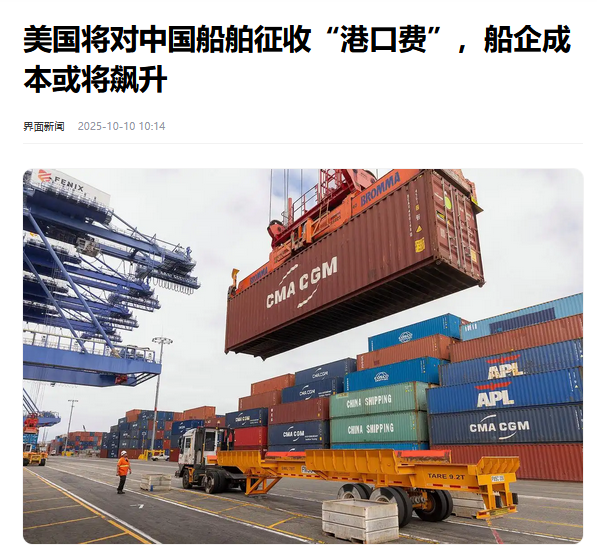
Group 1 - The U.S. has implemented port fees targeting Chinese vessels, charging $50 per net ton for Chinese-owned or operated ships, effective from October 14, with fees set to increase annually [1] - The U.S. will impose a 100% additional tariff on specific Chinese-manufactured port equipment starting November 9 [1] - In response, China has introduced special port fees for U.S.-flagged and U.S.-owned vessels, starting at 400 RMB per net ton, while exempting Chinese-built ships to protect its shipbuilding industry [4][6] Group 2 - The symmetrical nature of the fees ($50 per net ton vs. 400 RMB per net ton) is seen as a direct counter to U.S. attempts to revive its shipbuilding industry through foreign enterprises [6] - China's Customs spokesperson characterized the response as a "necessary defensive action" aimed at maintaining fair competition in international shipping [6] - The trade friction has expanded from traditional tariff disputes to broader strategic industries like shipping and shipbuilding [6][11] Group 3 - The U.S. strategy appears to aim at weakening China's international trade advantages, which has led to self-inflicted economic harm [7] - The ongoing trade war reflects a shift from a rules-based order to a power-based rules system, where international rules are defined through the dynamics of great power competition [11][25] - The recent sanctions and counter-sanctions highlight a significant transformation in the international economic landscape, moving away from a unipolar to a multipolar framework [25][26]