系统智能

Search documents
联想创投王光熙:2026年投资更趋理性,“硅基智能”仍是长期主线丨创投贺新春
Sou Hu Cai Jing· 2026-02-17 12:30
Core Insights - Despite macroeconomic challenges, Lenovo Venture Capital has maintained a clear strategic focus, achieving significant investment milestones in 2025 [3] - The company invested in over 40 new enterprises and facilitated nearly 100 portfolio companies in securing new rounds of financing, with total investment transactions exceeding 60, 80% of which were directed towards sectors closely related to the "silicon-based ecosystem" [3] - The total number of portfolio companies has surpassed 300, with 25 successfully going public, including leading firms like CATL, Cambricon, and Haiguang Information, each valued over 500 billion [3] Industry Outlook - The industry faces a gap between technological ideals and commercial realities, particularly in fields like embodied intelligence, where establishing scalable business models is a key challenge [3] - High-quality vertical data is expected to become a core barrier for industrial AI, with China's complete industrial chain and rich scenarios providing unique advantages for incubating breakthrough technologies [3] Future Investment Strategy - Looking ahead to 2026, investments are expected to become more rational, with "silicon-based intelligence" remaining a long-term focus [4] - The company plans to deepen its investment in three main areas: the evolution of AI towards "system intelligence," focusing on intelligent agents and AI-native hardware; the commercialization of machine intelligence, leveraging the benefits of autonomous driving technology; and forward-looking investments in disruptive computing architectures such as integrated storage and computing and RISC-V [4]




行业聚焦:全球精密运动系统行业头部企业市场份额及排名情况(附厂商名单)
QYResearch· 2025-11-25 02:49
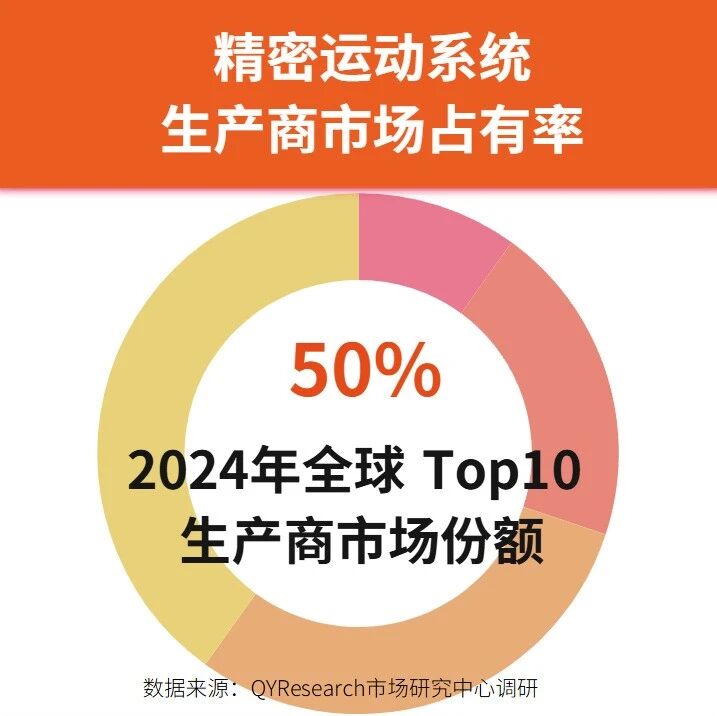
Core Insights - The global precision motion systems market is projected to reach $1.99 billion by 2031, with a compound annual growth rate (CAGR) of 8.77% in the coming years [5] - The industry is characterized by a dual structure of "oligopoly stability + accelerated local differentiation," with top manufacturers holding significant market shares [9] Market Size and Trends - The precision motion systems market is expected to grow significantly, driven by advancements in semiconductor manufacturing and optical device production [5][13] - The market is shifting from single-axis standard products to multi-axis collaborative and intelligent control systems [13] Competitive Landscape - The top three manufacturers account for approximately 26% of the market share, while the top ten account for about 50%, indicating high market concentration and significant entry barriers [9] - Major players like MKS (Newport), Physik Instrumente (PI), and THK dominate the high-end market through vertical integration and comprehensive system solutions [9] Product Segmentation - Precision motion platforms can be categorized into linear, rotary, and composite platforms, with linear platforms representing over 60% of total demand [11] - The demand for high precision and high rigidity in semiconductor wafer transport and optical measurement drives the market for linear platforms [11] Application Structure - The semiconductor and flat panel display sectors are the largest downstream applications, accounting for about 40% of the market [13] - The demand for precision motion systems is evolving towards more complex applications, including multi-axis coordination and intelligent control systems [13] Supply Chain Analysis - Key upstream components include linear motors, rotary motors, and air bearings, which are crucial for determining the precision and stability of motion platforms [19] - Major suppliers like THK and NSK dominate the high-precision linear guide and ball screw markets, while domestic companies are making strides in mid-to-high-end segments [19] Industry Development Trends - The precision motion systems industry is witnessing a trend towards sub-micron precision and the acceleration of breakthroughs in nano-level precision [23] - Modularization and customization are becoming prevalent, allowing for faster delivery and integration while meeting stringent requirements in high-end applications [24] Driving Factors - Long-term demand from the semiconductor and precision optics sectors is driving the need for high-end platforms capable of nano-level positioning [28] - The expansion of laser processing applications and the increasing demand for high bandwidth are pushing advancements in precision motion technology [28]