
繁荣

Search documents
美银1月基金经理调查 除了乐观还是乐观【播客】
Datayes· 2026-01-21 10:54
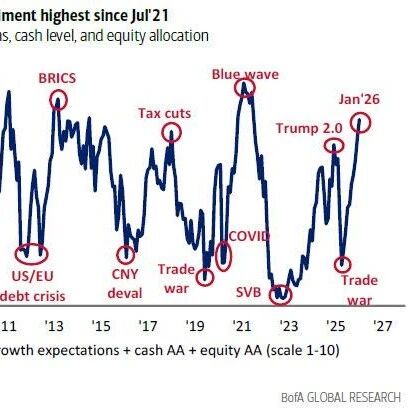
Core Insights - The sentiment among fund managers is extremely optimistic, with a significant shift in macroeconomic expectations from "recession" to "prosperity" [1][2] - Global growth expectations have risen to 38%, an increase of 20 percentage points, marking the highest level since July 2021, while the probability of recession has dropped to 9%, the lowest since January 2022 [1] - Profit expectations are also high, with a net 44% of managers optimistic about EPS over the next 12 months, the highest since July 2021 [2] - Concerns about stagflation have decreased from 58% to 39%, with 34% anticipating a "prosperity" scenario and 18% a "golden age" [3] - Inflation expectations driven by tariffs have significantly declined, with a net 3% believing CPI will decrease [4] Asset Allocation - There is a strong preference for equities and commodities, while bonds are being abandoned [5] - Stock allocation is at a net overweight of 48%, the highest since December 2024, and commodity allocation is at 26%, the highest since June 2022, while bond allocation is at a net underweight of 35%, the highest since September 2022 [12] - The banking sector has become the most overweight industry, while consumer staples are at their largest underweight since February 2014 [12] - High-yield bonds are expected to outperform investment-grade bonds for the first time [12] - The most crowded trade is long gold, with 51% of managers favoring it, surpassing the "Seven Sisters" trade at 27% [12] Risk Landscape - The primary risks identified are geopolitical tensions and the potential for an AI bubble, with geopolitical conflict cited by 28% of respondents and AI bubble concerns by 27% [5][6] - Credit events are anticipated to be triggered by private equity/private credit (39%) and large-scale capital expenditures in AI (35%) [6] - Political expectations for the 2026 midterm elections are nearly evenly split between "red wave" and "blue wave" scenarios [7] - There is a notable division regarding AI stocks, with 55% believing they are "not in a bubble" [8] Market Sentiment - The bull-bear indicator stands at 9.4, indicating a deep "sell" zone, with cash levels at 3.2%, a historical low [11] - A record 48% of respondents are "zero hedged" against market downturns, the highest since January 2018 [11] - Risk appetite is above normal by 16%, the highest in four years, with 49% of managers expecting an "impossible landing" scenario for the global economy [11] Strategic Insights - Michael Hartnett warns that in a world filled with good news, low hedging may seem harmless, but any unexpected negative turn could amplify impacts, highlighting current market fragility [9]

国际最新研究:六大洲逾20万人调查数据揭示全球繁荣状态
Zhong Guo Xin Wen Wang· 2025-04-30 14:31
Core Insights - The series of social science papers published by Springer Nature focuses on global prosperity research, analyzing data from over 200,000 individuals across 22 countries and regions to explore the state of "prosperity" worldwide [1][2] Group 1: Research Objectives and Methodology - The "Global Prosperity Research" project aims to study the distribution and determinants of happiness, enhancing the understanding of the concept of prosperity and identifying culturally specific and universal patterns [1] - The research includes annual survey data collected from 2022 to 2027, covering factors such as health, happiness, meaning, character, relationships, and financial stability [1] Group 2: Key Findings on Demographics and Prosperity - The flagship paper published in "Nature Mental Health" reveals that prosperity levels tend to increase with age in countries like Brazil, Australia, and the USA, while in Japan and Kenya, a U-shaped relationship is observed [2] - The study indicates that many countries show no significant gender differences in prosperity, although Brazil's males report higher prosperity than females, and in Japan, females report higher prosperity than males [2] - Higher education levels correlate with increased prosperity in most countries, except for Hong Kong and Australia, where the opposite is true [2] Group 3: Impact of Childhood Experiences - Respondents who experienced poverty, abuse, and poor health in childhood report lower levels of prosperity in adulthood, with Germany being an exception where poor childhood health predicts higher adult prosperity [3] - The research highlights a limitation in the current global prosperity study due to the lack of data from low-income countries and potential cultural differences in understanding survey questions [3] Group 4: Recommendations for Policy and Future Research - The commentary in "Nature" emphasizes the need for governments to establish mechanisms for collecting detailed data on public happiness to formulate effective policies promoting human prosperity [3] - It calls for rigorous research to track populations and guide understanding of the determinants of prosperity, stressing the importance of high-quality prosperity data across different cultures and countries [3]