红利类权益资产

Search documents
华夏红利量化选股股票A:2025年第四季度利润21.08万元 净值增长率2.47%
Sou Hu Cai Jing· 2026-01-23 01:29
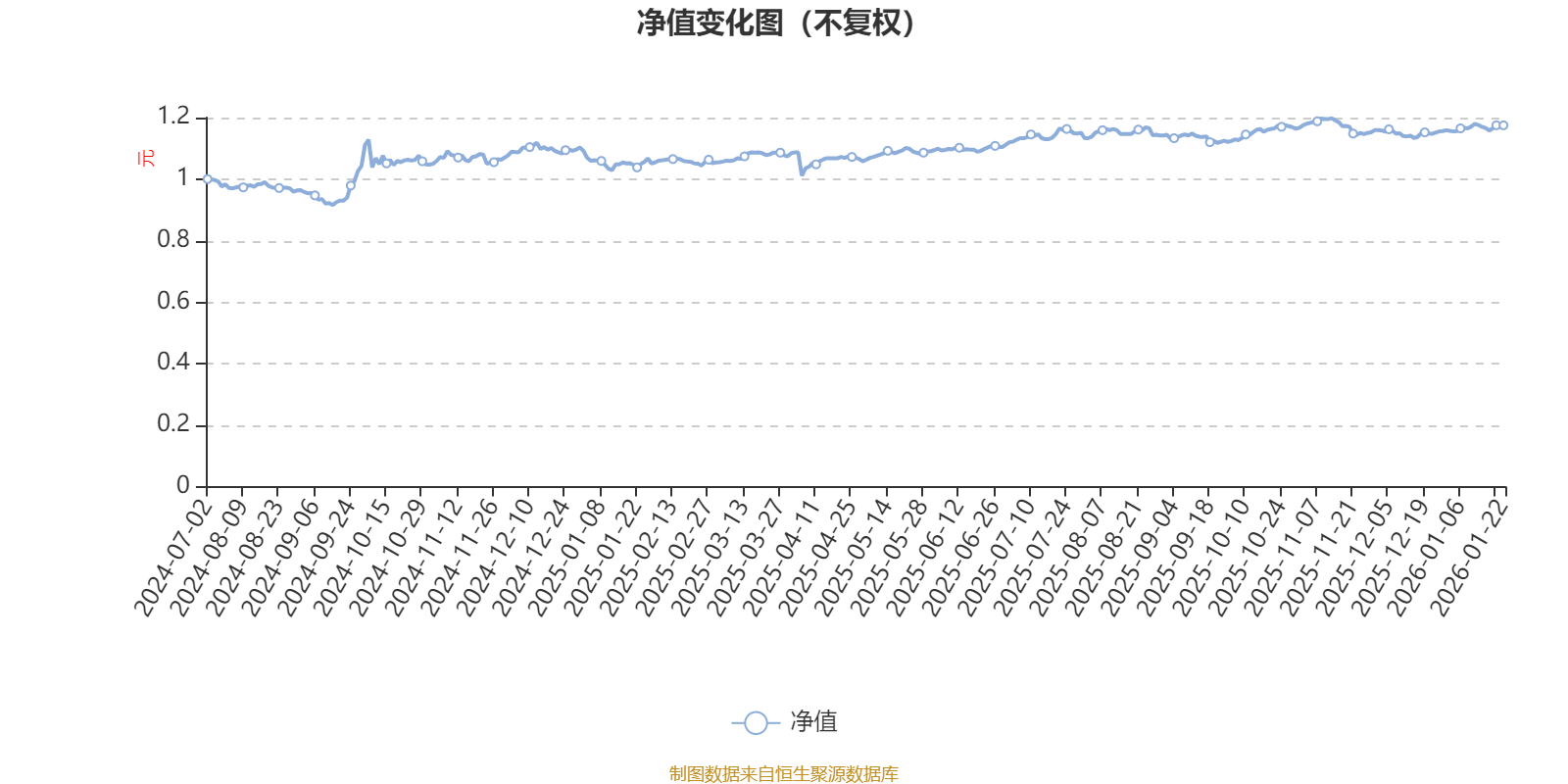
Core Viewpoint - The AI Fund Huaxia Dividend Quantitative Stock A (021570) reported a profit of 210,800 yuan for Q4 2025, with a weighted average profit per fund share of 0.0185 yuan. The fund's net value growth rate was 2.47%, and the fund size reached 13.5884 million yuan by the end of Q4 2025 [3][14]. Fund Performance - As of January 22, the unit net value was 1.175 yuan. The fund manager, Sun Ranyue, oversees 9 funds. The Huaxia Growth Enterprise Composite ETF had the highest one-year growth rate at 50.28%, while Huaxia Dingchun Bond A had the lowest at 3.06% [3]. - The fund's net value growth rates over different periods are as follows: 0.82% over the last three months (ranked 106 out of 121), 0.86% over the last six months (ranked 113 out of 121), and 13.16% over the last year (ranked 108 out of 119) [3]. Market Conditions - In Q4, the A-share market stabilized with significant structural trends. Industries such as telecommunications, oil and petrochemicals, and non-ferrous metals performed relatively well, while real estate, media, and computing sectors lagged. The overall performance of dividend equity assets was flat, aligning with market growth, and the fund maintained a balanced allocation in dividend assets [3]. Risk Metrics - As of December 31, the fund's Sharpe ratio since inception was 0.8335 [7]. - The maximum drawdown since inception was 10.34%, with the largest quarterly drawdown occurring in Q2 2025 at 6.93% [9]. Investment Strategy - The average stock position since inception was 88.82%, slightly above the peer average of 88.34%. The fund reached a peak stock position of 92.48% at the end of Q3 2025 and a low of 75.04% at the end of Q3 2024 [13]. Top Holdings - As of Q4 2025, the fund's top ten holdings included China COSCO Shipping, Shanghai Bank, Jiangsu Bank, Shaanxi Coal and Chemical Industry, Nanjing High-Tech, Nanjing Bank, Xiamen Xiangyu, Baosteel, Ningbo Huaxiang, and Bank of Communications [17].

险资万亿布局,稳守银行股
Huan Qiu Wang· 2025-11-17 07:37
Core Viewpoint - Insurance funds have shown strong market entry momentum in the first three quarters of 2025, with a significant increase in stock holdings and a proactive asset allocation strategy in the current market environment [1][2]. Group 1: Insurance Fund Performance - By the end of Q3, the book balance of stocks held by insurance funds surged by 1.19 trillion yuan compared to the end of last year, marking an increase of nearly 50%, reaching 3.62 trillion yuan [1]. - When including securities investment funds, the core equity asset scale has approached 5.6 trillion yuan, reflecting a growth of approximately 1.5 trillion yuan since the beginning of the year [1]. - In Q3 alone, the core equity asset scale increased by 864 billion yuan, with stocks contributing 552.4 billion yuan to this growth [1]. Group 2: Factors Driving Increased Holdings - Multiple factors are driving the recent significant increase in insurance fund holdings, including favorable policy guidance, the need for stable returns in a low-interest-rate environment, and the positive trend in the capital market, particularly the "slow bull" market in A-shares [2]. Group 3: Investment Preferences - Insurance funds have a clear investment path, with bank stocks being a major focus, accounting for 51.92% of the total market value of nearly 640 billion yuan in heavy holdings [4]. - In addition to traditional defensive sectors, insurance funds have also increased holdings in cyclical and consumer sectors such as steel, telecommunications, agriculture, and food and beverage [4]. - The investment strategy reflects a "dividend stocks + growth stocks" approach, with a broad coverage in sectors like electronics, pharmaceuticals, power equipment, machinery, and automobiles [4]. Group 4: Stock Selection Strategy - Insurance funds prioritize high-dividend stocks with stable earnings as a "ballast" in their portfolios to fill the net investment income gap in a low-interest-rate environment, while also selecting quality growth companies in emerging industries for excess returns [5]. - There are differences in stock selection preferences between life insurance and property insurance companies, with life insurers favoring low price-to-book ratio, high-dividend large-cap stocks, while property insurers tend to prefer higher price-to-earnings ratios and lower dividend yields [5]. - Equity investment has become a decisive factor in the profitability of insurance companies, with expectations for improved A-share market conditions to enhance the investment ecosystem for insurance funds [5].