数字考古

Search documents
开年首批!6 项考古领域重大成果发布
Xin Lang Cai Jing· 2026-01-16 10:50
Group 1 - The China Academy of Social Sciences held a major achievement release conference, presenting six significant findings in archaeological and cultural heritage research [1][2] - A new integrated work paradigm for archaeological excavation and artifact protection was proposed, focusing on detailed excavation, emergency protection, and restoration research, leading to the scientific restoration of several precious artifacts [1] - Research established China's historical position as a major origin of the classical textile technique of warp-dyed fabric, based on findings from the Tang Dynasty [1] Group 2 - The identification of the earliest known ancient bayberry tree in China, dating back to the Liangzhu culture period around 2520 BC, was confirmed through scientific methods [2] - Innovative technologies such as satellite remote sensing and drone photography were utilized to study prehistoric water management systems, revealing how ancient civilizations managed water resources in response to climate change [2]
数字考古揭秘中国5000年前水利工程 史前治水是普遍模式
Xin Lang Cai Jing· 2026-01-14 13:25
Core Viewpoint - The research highlights the advanced water management systems developed by prehistoric Chinese civilizations around 5000 years ago, pushing back the timeline of large-scale water engineering in China by nearly 3000 years [1][3]. Group 1: Research Findings - The study indicates that early Chinese civilizations in the Yangtze River basin developed large-scale water management systems to combat seasonal flooding and droughts, which were critical for agricultural stability [3][4]. - The research utilized cutting-edge technologies such as satellite remote sensing, drone photography, and 3D reconstruction to analyze significant prehistoric settlement sites, integrating archaeological findings with digital elevation models [3][4]. - The findings reveal a new paradigm in understanding the relationship between prehistoric humans and their environment, emphasizing the role of water management in the establishment of complex societies [4][6]. Group 2: Historical Context - The research identifies that prehistoric communities began with simple water storage methods and evolved to construct complex water management systems tailored to local climatic conditions [6][7]. - The study fills gaps in the understanding of the relationship between prehistoric water management and settlement patterns, with evidence found in various archaeological sites such as the Liangzhu ancient city and the Qujialing site [6][7]. - The research draws parallels with other early civilizations globally, which also developed in river basins and faced similar environmental challenges, underscoring the universal importance of water management in the rise of early societies [6][7].

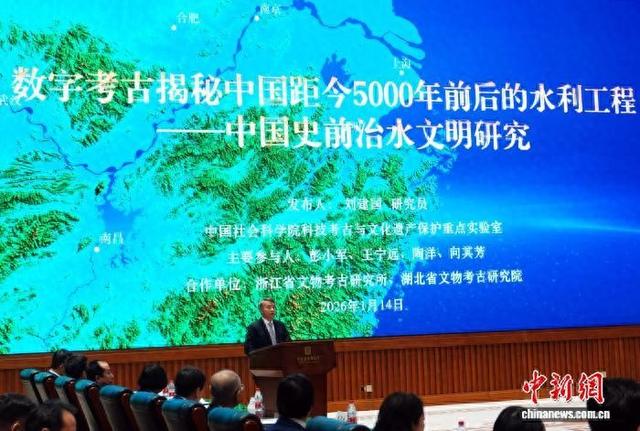
万年农业、最早杨梅、史前治水等6项考古领域重大成果发布
Xin Jing Bao· 2026-01-14 12:26
Core Insights - The Chinese Academy of History and the Key Laboratory of Technological Archaeology and Cultural Heritage Protection of the Chinese Academy of Social Sciences announced six significant achievements in archaeological research [1] Group 1: Major Achievements - Achievement 1: Establishment of a globally leading technological archaeological resource standard database, specifically the China Animal Resource Specimen Database [1] - Achievement 2: Innovation in field archaeology excavation and cultural relic protection paradigms, exemplified by the 2018 Xuewei No. 1 Tomb laboratory protection project [1] - Achievement 3: Restoration and research of Tang Dynasty woven fabrics dyed with zha jing, marking a new advancement in textile archaeology experimental research [1] Group 2: New Discoveries - Achievement 4: New findings in the technological archaeology of the agricultural cultural history in northern China, detailing three stages of early dry farming in the Yanshan region [1] - Achievement 5: Archaeological discovery of the earliest ancient bayberry tree in China, focusing on the research of ancient bayberry remains from the Liangzhu culture period at the Shian site [1] - Achievement 6: Digital archaeology revealing China's water conservancy projects from around 5000 years ago, contributing to the study of prehistoric water management civilization [1]
首届中亚数字考古人才培训班结业
Xin Lang Cai Jing· 2025-12-29 14:07
Core Viewpoint - The first Central Asia Digital Archaeology Training Course was successfully held in Xi'an, focusing on practical, efficient, and scalable digital archaeology techniques and methods for young scholars from five Central Asian countries [1][7]. Group 1: Training Program Overview - The training lasted for 10 days, where participants experienced China's archaeological achievements and the charm of Shaanxi archaeology from a digital archaeology perspective [1]. - The program integrated high-quality resources from Northwest University in archaeology, remote sensing, and GIS, featuring a teaching team of renowned experts from universities, research institutes, and technology companies [1][3]. Group 2: Teaching Methodology - The course employed a "theory + case study + practical operation" teaching method, covering topics such as digital photography, remote sensing archaeology, and archaeological GIS applications [3]. - Hands-on training was supported by well-known technology companies in the digital archaeology field, utilizing a three-in-one teaching model of "theory foundation - practical training - scenario empowerment" [3][5]. Group 3: Practical Experience - Participants engaged in real-world applications, including rapid 3D modeling and digital management of archaeological sites, using a self-developed platform called "Easy Archaeology" [5]. - The training included immersive experiences with virtual displays of cultural heritage and interactive methods to observe artifacts and site characteristics closely [5][7]. Group 4: Conclusion and Future Applications - At the graduation ceremony, certificates were awarded to participants, emphasizing the importance of the Silk Road in enhancing cultural exchange and understanding [7]. - Graduates expressed their intention to apply the knowledge gained in archaeological and cultural heritage protection work along the Silk Road and welcomed further collaboration with Chinese experts [7].
北大团队让AI学会考古!全球首个古希腊陶罐3D视觉问答数据集发布,还配了专用模型
量子位· 2025-11-06 13:22
Core Insights - The article discusses a groundbreaking research initiative from Peking University that has developed the world's first 3D visual question-answering dataset focused on ancient Greek pottery, named VaseVQA-3D, along with a specialized visual language model called VaseVLM [1][5]. Group 1: AI Development in Cultural Heritage - AI is evolving from being merely an image recognition tool to becoming a "cultural archaeology agent" capable of understanding complex cultural artifacts [2]. - Traditional visual language models (VLMs) like GPT-4V and Gemini struggle with cultural heritage objects due to limitations in training data and semantic modeling capabilities [3][6]. Group 2: VaseVQA-3D Dataset and Model - The VaseVQA-3D dataset includes over 30,000 2D images of ancient Greek pottery, which were transformed into 664 high-fidelity 3D models using TripoSG technology [11]. - The dataset also features 4,460 pairs of questions and answers related to the pottery, enhancing the AI's ability to provide detailed descriptions and answers [11][17]. Group 3: Model Training and Performance - The VaseVLM model was trained using a two-phase reinforcement learning approach, focusing on six semantic dimensions related to pottery [18]. - VaseVLM significantly outperformed existing models in various visual question-answering tasks, achieving a 12.8% increase in R@1 accuracy and a 6.6% improvement in vocabulary similarity [20]. Group 4: Future Prospects - The project aims to expand into more cultural heritage areas and establish improved digital heritage display methods, providing a new technological pathway for digital archaeology [22].