结合采样与学习的动态全身操作

Search documents
波士顿动力狗gogo回来了,“五条腿”协同发力
3 6 Ke· 2025-10-15 13:02
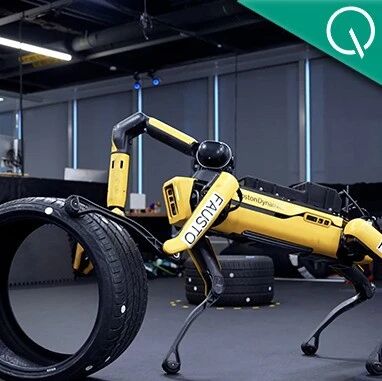
Core Insights - Boston Dynamics' Spot robot can lift a 15 kg tire in just 3.7 seconds, showcasing advanced dynamic whole-body manipulation techniques [1][11] - The robot's performance exceeds traditional static assumptions, demonstrating the ability to coordinate movements effectively beyond its maximum lifting capacity [13] Group 1: Dynamic Whole-Body Manipulation - The method combines sampling and learning to enable the robot to perform tasks requiring coordination of arms, legs, and torso [1][2] - A hierarchical control approach divides the control problem into two layers: low-level control for balance and stability, and high-level control for task-specific strategies [2][14] Group 2: Control Strategies - The low-level control uses reinforcement learning to manage motor torque for stability, while high-level control employs sampling-based strategies for tasks like tire alignment and stacking [2][7] - The sampling controller simulates multiple future scenarios in parallel to identify the most effective actions for task completion [3][5] Group 3: Performance Metrics - The robot achieved an average time of 5.9 seconds per tire, nearly matching human operational speed [11] - The dynamic coordination allows the robot to handle weights significantly exceeding its peak lifting capabilities, expanding its operational range [13][14] Group 4: Learning and Adaptation - The training process incorporates randomization of object properties to bridge the gap between simulation and real-world application [10] - The use of an asymmetric actor-critic architecture for training enhances the robot's ability to adapt to complex dynamics and contact mechanics [8][10]


波士顿动力狗gogo回来了!“五条腿”协同发力
量子位· 2025-10-15 10:20
Core Insights - The article discusses the advancements in Boston Dynamics' Spot robot, which can lift and manipulate a tire weighing 15 kg in just 3.7 seconds, showcasing its dynamic whole-body manipulation capabilities [3][31]. Group 1: Dynamic Whole-Body Manipulation - The method combines sampling and learning for dynamic whole-body manipulation, utilizing reinforcement learning and sampling-based control to enable coordinated tasks involving arms, legs, and torso [11][12]. - A hierarchical control approach is employed, dividing control problems into two complementary layers: a low layer for direct motor torque control and a high layer for task-specific strategies [12][13]. Group 2: Task Execution and Control Strategies - For tasks like tire alignment and stacking, the system uses sampling-based control to simulate potential future scenarios and discover optimal strategies [14]. - Reinforcement learning is applied to maintain stability during rolling tasks, capturing the necessary dynamic features and reactive control mechanisms [15][26]. Group 3: Performance and Efficiency - The Spot robot's performance in tire manipulation exceeds traditional static assumptions, demonstrating the ability to handle weights beyond its peak lifting capacity of 11 kg [35]. - The robot's dynamic coordination of movements allows it to efficiently perform tasks that were previously limited to slower, static methods [36][33]. Group 4: Simplification of Control Problems - Separating high-level and low-level control significantly simplifies the control challenges, allowing the high-level controller to focus on task completion without needing to reason about joint torques or stability constraints [37][38]. - The learned motion abstractions enable the high-level controller to operate in a simplified action space, enhancing computational feasibility and task execution efficiency [38].