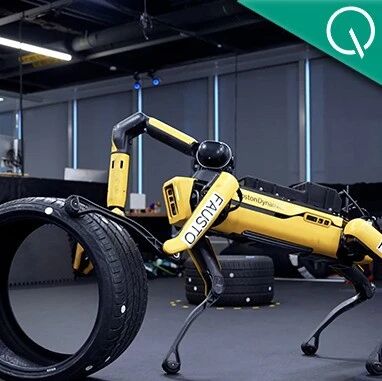
机器狗Spot

Search documents
快讯|人形机器人首登十五运会开幕式;首届机器人辩论大赛冠军诞生;波士顿动力在阿联酋部署机器狗等
机器人大讲堂· 2025-11-10 04:07
Group 1 - The opening ceremony of the 15th National Games featured humanoid robots from UBTECH, marking the first time humanoid robots served as opening guests at a national sports event and played ancient bronze ritual music [3][4] - The first China (International) Robot Debate Competition concluded with the "Xiao Nuo Team" from Songyan Power winning the championship, highlighting advancements in AI's capabilities in natural language processing and logical reasoning [6][7] - Boston Dynamics partnered with Analog Studios to deploy the Spot robot in the UAE, focusing on applications such as park inspections and environmental monitoring, enhancing urban livability [8][9] Group 2 - Morgan Stanley predicts that Apple's next flagship product may be a humanoid robot, with potential revenue exceeding $133 billion by 2040, supported by Apple's strong hardware ecosystem and recent organizational restructuring [11][12] - Gole Robotics won three innovation awards at CES 2026 for its AI and robotic solutions designed for construction environments, showcasing advancements in material transport and project monitoring [14][15]


波士顿动力狗gogo回来了,“五条腿”协同发力
3 6 Ke· 2025-10-15 13:02
Core Insights - Boston Dynamics' Spot robot can lift a 15 kg tire in just 3.7 seconds, showcasing advanced dynamic whole-body manipulation techniques [1][11] - The robot's performance exceeds traditional static assumptions, demonstrating the ability to coordinate movements effectively beyond its maximum lifting capacity [13] Group 1: Dynamic Whole-Body Manipulation - The method combines sampling and learning to enable the robot to perform tasks requiring coordination of arms, legs, and torso [1][2] - A hierarchical control approach divides the control problem into two layers: low-level control for balance and stability, and high-level control for task-specific strategies [2][14] Group 2: Control Strategies - The low-level control uses reinforcement learning to manage motor torque for stability, while high-level control employs sampling-based strategies for tasks like tire alignment and stacking [2][7] - The sampling controller simulates multiple future scenarios in parallel to identify the most effective actions for task completion [3][5] Group 3: Performance Metrics - The robot achieved an average time of 5.9 seconds per tire, nearly matching human operational speed [11] - The dynamic coordination allows the robot to handle weights significantly exceeding its peak lifting capabilities, expanding its operational range [13][14] Group 4: Learning and Adaptation - The training process incorporates randomization of object properties to bridge the gap between simulation and real-world application [10] - The use of an asymmetric actor-critic architecture for training enhances the robot's ability to adapt to complex dynamics and contact mechanics [8][10]

波士顿动力狗gogo回来了!“五条腿”协同发力
量子位· 2025-10-15 10:20
Core Insights - The article discusses the advancements in Boston Dynamics' Spot robot, which can lift and manipulate a tire weighing 15 kg in just 3.7 seconds, showcasing its dynamic whole-body manipulation capabilities [3][31]. Group 1: Dynamic Whole-Body Manipulation - The method combines sampling and learning for dynamic whole-body manipulation, utilizing reinforcement learning and sampling-based control to enable coordinated tasks involving arms, legs, and torso [11][12]. - A hierarchical control approach is employed, dividing control problems into two complementary layers: a low layer for direct motor torque control and a high layer for task-specific strategies [12][13]. Group 2: Task Execution and Control Strategies - For tasks like tire alignment and stacking, the system uses sampling-based control to simulate potential future scenarios and discover optimal strategies [14]. - Reinforcement learning is applied to maintain stability during rolling tasks, capturing the necessary dynamic features and reactive control mechanisms [15][26]. Group 3: Performance and Efficiency - The Spot robot's performance in tire manipulation exceeds traditional static assumptions, demonstrating the ability to handle weights beyond its peak lifting capacity of 11 kg [35]. - The robot's dynamic coordination of movements allows it to efficiently perform tasks that were previously limited to slower, static methods [36][33]. Group 4: Simplification of Control Problems - Separating high-level and low-level control significantly simplifies the control challenges, allowing the high-level controller to focus on task completion without needing to reason about joint torques or stability constraints [37][38]. - The learned motion abstractions enable the high-level controller to operate in a simplified action space, enhancing computational feasibility and task execution efficiency [38].