结直肠癌筛查

Search documents
全球年轻肠癌患者猛增, 排便出现4个信号别大意
Xin Lang Cai Jing· 2026-02-04 15:22
美国癌症协会发表在《柳叶刀-肿瘤学》上的一项新研究显示,2013~2017年,纳入分析的50个国家中, 有27个国家50岁以下人群结直肠癌发病率呈增长趋势。 若不进行有效干预,年轻人群早发性结直肠癌病例可能在未来几十年内持续增加。 《生命时报》邀请专家,告诉你肠癌的预警信号,并支招怎么筛查和预防。 大肠癌又称结直肠癌,多见于中老年人。近年来,50岁以下年轻患者越来越多。 解放军总医院第九医学中心普通外科主任医师 杨建武 四川省肿瘤医院大肠外科主任医师 刘超 我国肠癌发病同样呈年轻化趋势 这项研究发现,肠癌发病率上升的国家中包括日本等非西方国家,以及土耳其等较不富裕的国家。 研究人员表示,这一增长不太可能与筛查水平的提高有关,因为大多数国家直到50岁才对人们进行肠癌 常规检测。 2024年,欧洲多个国家联合在《肿瘤学年鉴 (2024)》上发布的一份报告也给出了类似警告——2024年欧 洲的癌症死亡病例中,早发型结直肠癌(发病年龄在40岁以下)的占比显著增加。 受访专家 北京大学肿瘤医院胃肠肿瘤中心四病区主任医师 邢加迪 报告特别强调,肥胖和过量饮酒是两大关键因素,加速了肠癌在年轻群体中的蔓延。 解放军总医院第九 ...


这种能查出癌症的体检项目,建议40岁以上要做!
Xin Lang Cai Jing· 2026-01-11 15:08
Core Viewpoint - The article emphasizes the importance of undergoing colonoscopy screenings for individuals over 40 years old to detect colorectal cancer early, as the disease often develops silently and its incidence and mortality rates have been increasing in China. Group 1: Importance of Colonoscopy - Colonoscopy is the most reliable screening method for early detection of colorectal cancer, which has seen an average annual incidence increase of 3.11% and a mortality increase of 1.05% from 1990 to 2019 in China [1] - The procedure can identify polyps in the intestines, which, while usually benign, can develop into cancer if left untreated. Colonoscopy allows for the removal of these polyps during the examination [1] - It can also detect inflammatory bowel diseases such as ulcerative colitis and Crohn's disease, which require long-term management and can help in adjusting treatment plans to prevent worsening conditions [2] Group 2: Age-Related Screening Recommendations - The risk of colorectal cancer increases with age, particularly in individuals over 50, necessitating early intervention before the disease progresses [2] - The "Chinese Colorectal Cancer Screening and Early Diagnosis and Treatment Guidelines" recommend risk assessments starting at age 40, with screenings for average-risk individuals suggested between ages 50 and 75, and for high-risk individuals starting at age 40 or 10 years earlier than the youngest family member diagnosed [2][3] Group 3: High-Risk Factors - High-risk individuals include those with a family history of colorectal cancer, personal history of colorectal cancer or adenomas, long-term inflammatory bowel disease, or positive fecal occult blood tests [3] Group 4: Preparation and Procedure - Many individuals fear the colonoscopy process, but it is less daunting than perceived. Proper dietary adjustments before the procedure can enhance the examination's effectiveness [4] - The colon cleansing process is essential for a clear view during the examination, and while it may cause some discomfort, it is manageable with adherence to medical advice [4] - Many hospitals now offer painless colonoscopy options, allowing patients to undergo the procedure with minimal discomfort, and recovery is typically quick with only mild post-examination symptoms [5] Group 5: Health Investment Perspective - Colonoscopy should be viewed as an investment in health, providing peace of mind for both the individual and their family. Early detection and intervention can effectively manage many intestinal issues [5]
肠镜是结直肠癌筛查“金标准”但仍会漏诊,国产技术寻找突破口
第一财经· 2025-06-27 09:24
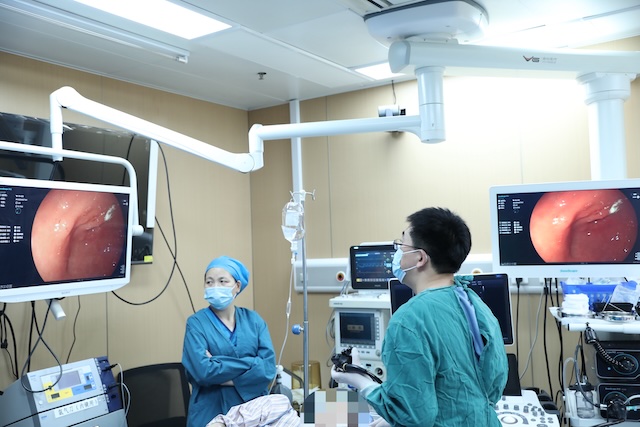
Core Viewpoint - The article discusses the advancements in endoscopic technology, specifically the introduction of spectral imaging technology, which aims to improve the detection rates of colorectal adenomas, thereby enhancing early diagnosis and treatment of colorectal cancer, which is a significant health concern in China [1][3]. Group 1: Colorectal Cancer Statistics and Challenges - Colorectal cancer is the second most common cancer in terms of incidence and the fourth in terms of mortality in China [1]. - The standard method for screening colorectal cancer is colonoscopy, but there are still challenges with missed diagnoses [1][4]. - Approximately 90% of colorectal cancers arise from adenomas, and early removal can increase the five-year survival rate to over 90% [4]. Group 2: Endoscopic Technology and Study Overview - The study led by Shanghai Jiao Tong University School of Medicine involved over 10 medical institutions and focused on comparing the detection rates of adenomas using spectral imaging technology (SFI) versus traditional white light endoscopy [3]. - The study included 698 patients and was designed as a randomized controlled trial, marking the first large-scale multi-center research on this technology in China [3]. Group 3: Results of the Study - The adenoma detection rate (ADR) for spectral imaging technology was 38.29%, significantly higher than the 30.46% ADR for white light endoscopy, with statistical significance [6]. - Secondary outcomes showed that the polyp detection rate, flat serrated lesions detection rate, and advanced adenoma detection rate for spectral imaging were 56.29%, 3.14%, and 6.57% respectively, all higher than the corresponding rates for white light endoscopy [6]. Group 4: Implications and Future Prospects - Spectral imaging technology enhances the distinction between lesions and normal mucosa, improving the detection of flat lesions and serrated lesions that are often missed with white light endoscopy [7]. - This technology is user-friendly, requiring only a button press to switch imaging modes, which could facilitate its adoption in rural hospitals and improve diagnostic capabilities across varying levels of clinical experience [7].

肠镜是结直肠癌筛查“金标准”但仍会漏诊,国产技术寻找突破口
Di Yi Cai Jing· 2025-06-27 04:55
Core Viewpoint - The study led by Shanghai Jiao Tong University Affiliated Renji Hospital demonstrates that the novel spectral imaging technology significantly improves the detection rate of colorectal adenomas compared to traditional white light endoscopy, addressing the challenge of missed diagnoses in flat lesions [1][4]. Group 1: Colorectal Cancer Context - Colorectal cancer is the second most prevalent and the fourth leading cause of cancer-related deaths in China [1]. - Approximately 90% of colorectal cancers arise from adenomas, and early removal can increase the five-year survival rate to over 90% [3]. Group 2: Study Overview - The multi-center randomized controlled trial involved over 698 patients across various regions in China, comparing the adenoma detection rates (ADR) of spectral imaging technology (SFI) and traditional white light endoscopy [1][4]. - The study is the first large-scale investigation of domestic spectral imaging technology in China, lasting nearly one year [1]. Group 3: Results of the Study - The adenoma detection rate for spectral imaging technology was 38.29%, significantly higher than the 30.46% rate for white light endoscopy, with statistical significance [4]. - Secondary outcomes showed that the polyp detection rate, flat serrated lesions detection rate, and advanced adenoma detection rate for spectral imaging were 56.29%, 3.14%, and 6.57%, respectively, all higher than the corresponding rates for white light endoscopy [4]. Group 4: Technological Advantages - Spectral imaging technology enhances the contrast between lesions and normal mucosa, making it easier to identify flat lesions and flat serrated lesions that are often missed with white light endoscopy [4]. - The technology is designed to be user-friendly, allowing for easy switching between imaging modes without the need for dye application, thus reducing the reliance on clinical experience [5].