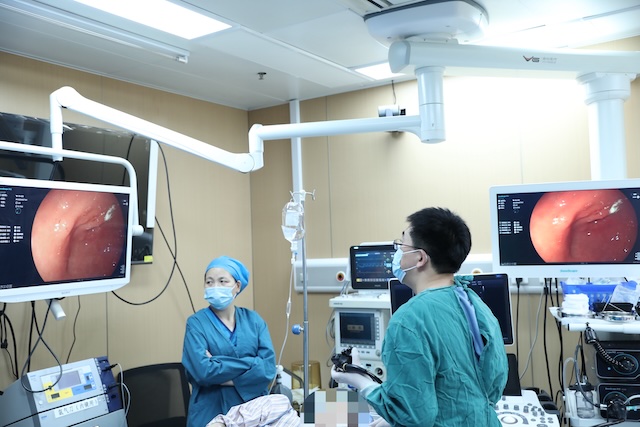
白光内镜

Search documents
肠镜是结直肠癌筛查“金标准”但仍会漏诊,国产技术寻找突破口
第一财经· 2025-06-27 09:24
Core Viewpoint - The article discusses the advancements in endoscopic technology, specifically the introduction of spectral imaging technology, which aims to improve the detection rates of colorectal adenomas, thereby enhancing early diagnosis and treatment of colorectal cancer, which is a significant health concern in China [1][3]. Group 1: Colorectal Cancer Statistics and Challenges - Colorectal cancer is the second most common cancer in terms of incidence and the fourth in terms of mortality in China [1]. - The standard method for screening colorectal cancer is colonoscopy, but there are still challenges with missed diagnoses [1][4]. - Approximately 90% of colorectal cancers arise from adenomas, and early removal can increase the five-year survival rate to over 90% [4]. Group 2: Endoscopic Technology and Study Overview - The study led by Shanghai Jiao Tong University School of Medicine involved over 10 medical institutions and focused on comparing the detection rates of adenomas using spectral imaging technology (SFI) versus traditional white light endoscopy [3]. - The study included 698 patients and was designed as a randomized controlled trial, marking the first large-scale multi-center research on this technology in China [3]. Group 3: Results of the Study - The adenoma detection rate (ADR) for spectral imaging technology was 38.29%, significantly higher than the 30.46% ADR for white light endoscopy, with statistical significance [6]. - Secondary outcomes showed that the polyp detection rate, flat serrated lesions detection rate, and advanced adenoma detection rate for spectral imaging were 56.29%, 3.14%, and 6.57% respectively, all higher than the corresponding rates for white light endoscopy [6]. Group 4: Implications and Future Prospects - Spectral imaging technology enhances the distinction between lesions and normal mucosa, improving the detection of flat lesions and serrated lesions that are often missed with white light endoscopy [7]. - This technology is user-friendly, requiring only a button press to switch imaging modes, which could facilitate its adoption in rural hospitals and improve diagnostic capabilities across varying levels of clinical experience [7].


肠镜是结直肠癌筛查“金标准”但仍会漏诊,国产技术寻找突破口
Di Yi Cai Jing· 2025-06-27 04:55
Core Viewpoint - The study led by Shanghai Jiao Tong University Affiliated Renji Hospital demonstrates that the novel spectral imaging technology significantly improves the detection rate of colorectal adenomas compared to traditional white light endoscopy, addressing the challenge of missed diagnoses in flat lesions [1][4]. Group 1: Colorectal Cancer Context - Colorectal cancer is the second most prevalent and the fourth leading cause of cancer-related deaths in China [1]. - Approximately 90% of colorectal cancers arise from adenomas, and early removal can increase the five-year survival rate to over 90% [3]. Group 2: Study Overview - The multi-center randomized controlled trial involved over 698 patients across various regions in China, comparing the adenoma detection rates (ADR) of spectral imaging technology (SFI) and traditional white light endoscopy [1][4]. - The study is the first large-scale investigation of domestic spectral imaging technology in China, lasting nearly one year [1]. Group 3: Results of the Study - The adenoma detection rate for spectral imaging technology was 38.29%, significantly higher than the 30.46% rate for white light endoscopy, with statistical significance [4]. - Secondary outcomes showed that the polyp detection rate, flat serrated lesions detection rate, and advanced adenoma detection rate for spectral imaging were 56.29%, 3.14%, and 6.57%, respectively, all higher than the corresponding rates for white light endoscopy [4]. Group 4: Technological Advantages - Spectral imaging technology enhances the contrast between lesions and normal mucosa, making it easier to identify flat lesions and flat serrated lesions that are often missed with white light endoscopy [4]. - The technology is designed to be user-friendly, allowing for easy switching between imaging modes without the need for dye application, thus reducing the reliance on clinical experience [5].