绩效薪酬追索扣回机制

Search documents
广州农商行员工被要求退回三年过节费,回应来了
Di Yi Cai Jing· 2025-10-19 13:17
Core Points - A local bank has requested employees to return holiday bonuses received over the past three years, which has sparked industry attention [1] - Employees reported being asked to return a total of approximately 14,000 yuan, with an initial payment of 2,500 yuan required upfront, followed by deductions from their salaries [1] - The bank stated that this action is part of efforts to standardize the distribution of allowances and benefits in compliance with relevant regulations [1] Group 1 - The bank involved is Guangzhou Rural Commercial Bank, which has faced scrutiny due to the holiday bonus refund requests [1] - Previous instances of banks requesting the return of holiday bonuses have been noted, including a case in 2022 where an employee was asked to return 600 yuan for a holiday bonus due to compliance issues [1] - The Guangdong Provincial Federation of Trade Unions issued guidelines earlier this year regarding the management of grassroots union funds, which may relate to the compliance issues surrounding holiday bonuses [2] Group 2 - The guidelines specify that holiday gifts can be given to union members during national holidays, with a total annual amount not exceeding 3,000 yuan per person [2] - The distinction between refunding holiday bonuses and "reverse salary claims" is highlighted, with the latter being a common practice among banks, especially listed ones, to recover performance-related pay due to violations or risks [2] - Since the implementation of the performance pay recovery mechanism in early 2021, 13 listed banks have disclosed specific amounts recovered, totaling nearly 300 million yuan over three years [2]
员工被要求退还三年过节费?广州农商行回应
第一财经· 2025-10-19 07:28
Core Viewpoint - A local rural commercial bank has requested employees to return holiday bonuses from the past three years, raising concerns within the industry [2][3]. Group 1: Employee Reactions and Bank's Response - Employees reported being asked to return a total of approximately 14,000 yuan in holiday bonuses, with an initial payment of 2,500 yuan required [2]. - The bank stated that this action is part of efforts to standardize the distribution of allowances and benefits to ensure compliance with relevant regulations [3]. Group 2: Compliance Issues - The request for returning holiday bonuses may be linked to compliance issues, as indicated by employee comments [3]. - Previous instances of banks requesting the return of holiday bonuses have occurred, such as a case in 2022 where an employee was asked to return 600 yuan for a "Winter Solstice" bonus due to regulatory inspection requirements [3]. Group 3: Regulatory Framework - The Guangdong Provincial Federation of Trade Unions issued guidelines earlier this year, allowing grassroots unions to distribute holiday gifts, with a cap of 3,000 yuan per person annually, and prohibiting cash or vouchers [4]. - The distinction between returning holiday bonuses and "reverse salary claims" is emphasized, with the latter being a common practice among banks, especially listed ones, to recover performance-related pay due to violations or risks [4]. Group 4: Performance Pay Recovery Mechanism - Since the introduction of the performance pay recovery mechanism by the former CBIRC in early 2021, 13 listed banks have disclosed specific amounts recovered, totaling nearly 300 million yuan over three years [5].


员工被要求退还三年过节费?广州农商行回应
Di Yi Cai Jing· 2025-10-19 07:17
Core Points - A certain rural commercial bank has requested employees to return holiday bonuses received from three years ago to the present, which has attracted industry attention [1] - Employees reported that they were asked to return a total of approximately 14,000 yuan in holiday bonuses, with an initial payment of 2,500 yuan required [1] - The bank stated that this action is part of efforts to standardize the distribution of allowances and benefits to ensure compliance with relevant regulations [1] Summary by Sections Employee Reactions - Employees expressed concerns over the lack of formal written notifications regarding the return of holiday bonuses, as the requests were communicated verbally by branch managers [1] - The situation has raised questions about the compliance of the holiday bonuses, leading to the request for their return [1] Bank's Response - The bank acknowledged the situation, emphasizing that the move is aimed at further regulating the distribution of allowances and ensuring adherence to relevant policies [1] - The majority of employees reportedly understand and support the bank's decision [1] Historical Context - There have been precedents in the banking industry where employees were asked to return holiday bonuses due to compliance issues, such as a case in 2022 involving a 600 yuan winter solstice bonus [1] - The Guangdong Provincial Federation of Trade Unions issued guidelines earlier this year regarding the management of grassroots union funds, which may relate to the current situation [2] Regulatory Framework - The guidelines specify that holiday gifts should not exceed 3,000 yuan per person annually and should not include cash or vouchers [2] - The distinction between returning holiday bonuses and "reverse salary claims" is noted, with the latter being a common practice in the banking sector for addressing disciplinary actions [2] - Since the implementation of the performance salary clawback mechanism in early 2021, 13 listed banks have disclosed specific amounts related to clawbacks, totaling nearly 300 million yuan [2]
银行上半年“人均月薪”有多少?招商、兴业超4.5万元
Xin Lang Cai Jing· 2025-09-12 00:55
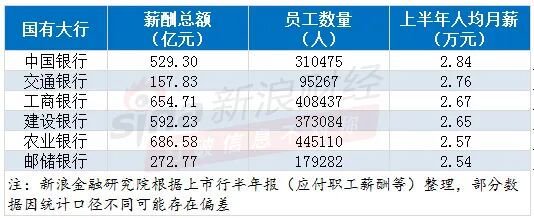
Summary of Key Points Core Viewpoint - The recent strong performance of the banking sector has drawn attention to the salary situation of listed banks, with significant differences in average salaries between state-owned banks and joint-stock banks [1][2]. Salary Data of State-Owned Banks - In the first half of 2025, the average monthly salary for employees in state-owned banks ranged from 25,400 to 28,400 yuan, with Agricultural Bank having the lowest average salary at 25,100 yuan [4][11]. - The total salary expenditure for Agricultural Bank reached 68.658 billion yuan, ranking first among state-owned banks, followed by Industrial and Commercial Bank with 65.471 billion yuan [3][4]. Salary Data of Joint-Stock Banks - Joint-stock banks generally offered higher average monthly salaries, with China Merchants Bank and Industrial Bank exceeding 45,000 yuan, specifically 50,100 yuan and 45,700 yuan respectively [6][7]. - The total salary expenditure for China Merchants Bank was 35.484 billion yuan, leading among joint-stock banks, while several others exceeded 10 billion yuan [5][6]. Employee Count Changes - Many banks reported a reduction in employee numbers, with Agricultural Bank reducing its workforce by 9,606 employees, and Industrial and Commercial Bank by over 6,700 employees [8][12]. - In contrast, China Merchants Bank was the only bank to increase its employee count, adding 867 employees [10][12]. Performance-Based Salary Mechanisms - Several banks have implemented performance-based salary mechanisms, including deferred payment and clawback provisions for high-risk positions, as seen in the practices of Minsheng Bank and Shanghai Pudong Development Bank [13][14]. - The trend of extending salary resources to county-level operations is noted, with Agricultural Bank allocating over 50% of its recruitment plan to county areas to support rural revitalization efforts [16].




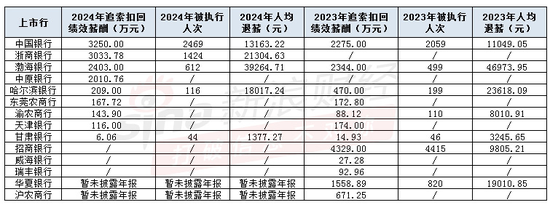
9家上市行“反向追薪”超1.13亿!渤海银行人均退薪3.93万,招商银行未再披露
Xin Lang Cai Jing· 2025-04-03 00:23
Core Viewpoint - The 2024 annual reports of listed banks reveal significant performance salary clawbacks, with a total amount exceeding 113 million yuan across nine banks, indicating a growing trend in enforcing accountability in executive compensation [1][4]. Summary by Category Performance Salary Clawbacks - Nine listed banks have disclosed their performance salary clawback situations in their 2024 annual reports, including major banks like Bank of China, Zhejiang Commercial Bank, and Bohai Bank [1][4]. - The total amount of clawbacks reported by these banks exceeds 113 million yuan, with Bank of China leading at 32.5 million yuan [1][4]. - The average clawback amount per person was highest at Bohai Bank, reaching 39,264.71 yuan, while Bank of China and Harbin Bank also reported significant average clawbacks exceeding 10,000 yuan [2][4]. Year-on-Year Comparison - Compared to 2023, several banks, including China Merchants Bank and Weihai Bank, did not disclose specific clawback amounts for 2024, despite having reported significant figures in the previous year [6]. - In 2023, China Merchants Bank had the highest clawback amount at 43.29 million yuan, affecting 4,415 employees with an average clawback of approximately 9,805 yuan [6]. Disclosure Trends - Zhejiang Commercial Bank and Zhongyuan Bank disclosed specific clawback amounts for the first time in 2024, indicating an improvement in transparency [7]. - Bohai Bank and Dongguan Rural Commercial Bank have consistently disclosed their clawback amounts for three consecutive years, showing a commitment to accountability [5][6]. Regulatory Context - The regulatory framework for performance salary clawbacks has been strengthened over the years, with guidelines established by the former China Banking Regulatory Commission and the China Banking and Insurance Regulatory Commission [10][11]. - As of 2023, over 95% of banking institutions have implemented performance salary clawback mechanisms, reflecting a significant shift towards more robust governance in the banking sector [11].