
综合采购经理人指数(PMI)

Search documents
欧元区需求增长助推经济回暖
Shang Wu Bu Wang Zhan· 2025-11-08 03:15
Core Insights - Eurozone's business activity unexpectedly accelerated in October, driven by new orders, indicating a rebound in economic momentum at the start of the fourth quarter [1] - The Eurozone Composite Purchasing Managers' Index (PMI) rose from 51.2 in September to 52.2 in October, marking the tenth consecutive month of expansion and reaching a 17-month high, significantly surpassing the Reuters survey expectation of 51.0 [1] Economic Performance - Germany's private sector exhibited the strongest growth in nearly two and a half years, primarily supporting robust expansion in the services sector [1] - In contrast, France experienced a decline in demand due to political turmoil, with business activity contracting faster than market expectations [1] Sector Analysis - The services sector continued to lead, with its PMI rising to 52.6, a 14-month high [1] - The manufacturing output index slightly increased to 51.1, and the overall manufacturing PMI returned to 50.0, outperforming expectations [1] Employment Trends - Overall employment showed improvement, with service sector employment growing at the fastest rate since June 2024, while manufacturing layoffs occurred at the fastest pace in four months [1] Pricing and Inflation - Cost growth slightly slowed, but the pace of price increases by businesses picked up marginally [1] - The chief economist at Hamburg Commercial Bank noted that service sector inflation remains moderate, with sales prices rising but close to long-term averages, suggesting the European Central Bank may keep interest rates unchanged [1] Business Confidence - Despite the improvement in business activity, corporate confidence fell to a five-month low, indicating a cautious market outlook [1]
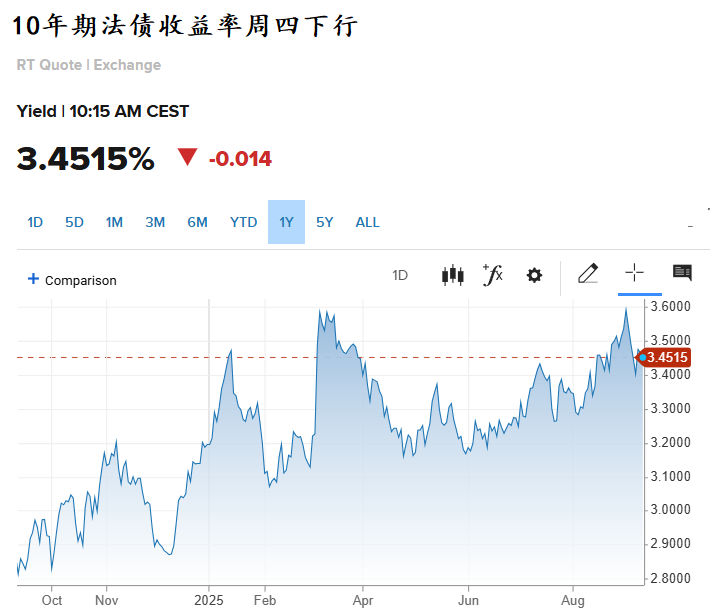
市场料欧洲央行维持利率不变 欧债周四小幅波动
Xin Hua Cai Jing· 2025-09-11 08:56
Group 1 - The European Central Bank (ECB) is expected to maintain the benchmark interest rate at 2.00% during its upcoming meeting, following a pause in its easing cycle after eight consecutive rate cuts since June 2024 [7] - The eurozone inflation rate for August was reported at 2.1%, with core inflation dropping to 2.3%, which is below expectations, indicating a potential for further monetary policy adjustments [7] - The composite Purchasing Managers' Index (PMI) for the eurozone rose to 51.0 in August, marking the highest level in a year and suggesting a return to expansion in the manufacturing sector for the first time in three years [7] Group 2 - The bond market in Europe showed mixed results, with German bond yields mostly rising, while French bond yields declined, reflecting underlying political vulnerabilities in France following the resignation of Prime Minister Borne [4] - The 10-year French bond yield briefly exceeded the Italian bond yield for the first time in 20 years, highlighting a higher risk premium associated with French debt [4] - In the Italian bond market, there was a slight sell-off of bonds with maturities of six years or less, while investors showed interest in bonds with maturities of seven years or more [4]

德国二季度经济萎缩0.3%
Zhong Guo Xin Wen Wang· 2025-08-23 03:50
Group 1 - The German economy experienced a 0.3% quarter-on-quarter decline in GDP for Q2 2025, revised down by 0.2 percentage points from initial estimates [1] - The decline was attributed to underperformance in the manufacturing and construction sectors, despite increases in private and government consumption [1] - Fixed asset investment and exports of goods and services saw a downturn, with a 0.6% decrease in goods exports linked to fluctuating U.S. trade policies [1] Group 2 - The German central bank's monthly report indicated a bleak global trade outlook, weak order conditions, and underutilized existing capacity, which may continue to suppress corporate investment activities [1] - The construction sector is not expected to provide significant support to the economy, and a poor job market along with slowing wage growth are limiting private consumption [1] - Analysts noted a positive signal with the August composite Purchasing Managers' Index (PMI) rising to 50.9 from 50.6 in July, marking the highest level since March and indicating expansion in business activity [1]