绿色吨半粮

Search documents
努力让农田“高产”又“绿色”(迈向“十五五”的创新图景)
Ren Min Ri Bao· 2025-12-28 22:15
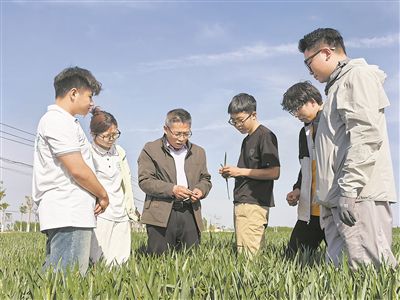
Core Viewpoint - The article emphasizes the importance of food security in China and the need to enhance agricultural production capacity and quality while ensuring efficient resource utilization and environmental protection [1]. Group 1: Agricultural Innovations - The "Green Ton Half Grain" initiative aims to increase the annual yield of grain crops to over 1.5 tons per acre without increasing resource costs [1]. - In Quzhou, the annual grain yield was around 700 kilograms in the early 2000s, with traditional farming methods leading to soil salinization and compaction [1]. - The research team focuses on soil-crop systems, aiming for "uniform, robust, and synchronized" seedlings through comprehensive technological innovations in soil, fertilizer, water, seeds, and management [1]. Group 2: Integrated Production Techniques - The "Winter Wheat - Summer Corn" integrated green production technology significantly reduces irrigation water usage and ensures balanced nutrient supply, laying the foundation for increased yield and soil restoration [2]. - In the Quzhou demonstration area, the annual yield of wheat and corn reached 1,522 kilograms, achieving water savings of 30%, fertilizer savings of 20%, and a 46% reduction in nitrogen loss [2]. - The "Green Ton Half Grain" model has been implemented in 18 demonstration sites across 7 provinces, showing adaptability and replicability, with yields reaching 1.82 tons in Qixian and 1.84 tons in Linzhi [2]. Group 3: Sustainable Agricultural Development - Soil health is crucial for sustainable agricultural development, as improper soil use can lead to decreased yields and a vicious cycle of increasing inputs with declining soil fertility [2]. - The introduction of the "plant-soil feedback" theory aims to maintain soil health and enhance plant growth, complemented by variety breeding and management innovations [2]. Group 4: Future Outlook - The "Green Ton Half Grain" model will continue to be promoted, focusing on creating a food production pattern that integrates different regional cropping systems [3]. - The integration of modern technologies such as artificial intelligence, big data, and the Internet of Things with agricultural practices aims to achieve precise management of farmland [3].
曲周科技小院团队:泥土里“种”出绿色农业
Ke Ji Ri Bao· 2025-06-16 01:22
Core Insights - The article highlights the achievements of the Quzhou Technology Courtyard team from China Agricultural University, which has significantly contributed to agricultural innovation and green development in Quzhou County, Hebei Province [2][3][4] Group 1: Team Achievements - The Quzhou Technology Courtyard team has developed and promoted 37 high-yield and efficient agricultural technologies over the past 16 years, increasing the adoption rate of these technologies from 17.9% to 53.5% between 2009 and 2014 [4] - The team was awarded the 2025 China Youth May Fourth Medal Collective, with 90% of its 122 members being under 35 years old, emphasizing the youth-driven approach to agricultural innovation [2][3] Group 2: Agricultural Practices - The team introduced the "Water-Nitrogen Postponement" technique, which reduced irrigation from four times to two, resulting in wheat yields exceeding 650 kg per mu, thus saving costs and improving productivity [3] - The "Green Ton Half Grain" initiative aims to achieve an annual yield of 1.5 tons per mu while reducing emissions by over 30%, with the 2024 demonstration bases already achieving a yield of 1.52 tons per mu, surpassing the county average by 42% [6] Group 3: Community Engagement - The Quzhou Technology Courtyard team engages closely with local farmers, providing hands-on training and support, which has led to the training of over 80,000 farmers and the cultivation of more than 1,000 "soil experts" and rural leaders [8] - The team has established 16 technology courtyards, allowing farmers to consult freely and receive immediate assistance, thereby bridging the gap between research and practical agricultural needs [3][5]