绿色建筑节能

Search documents
金晶科技20260119
2026-01-20 01:50
Company and Industry Summary Company: Jinjing Technology (金晶科技) Key Points Industry Overview - The float glass price is expected to rebound in 2026 due to low demand and anticipated cold repairs in high-energy-consuming production lines, although the demand for soda ash will face downward pressure from the cold repair requests in the construction and photovoltaic glass sectors [2][4] Financial Performance - The performance in 2025 is complex, with significant losses in architectural and photovoltaic glass impacting overall results. The soda ash business also performed poorly in the second half of the year, contributing to the decline in overall performance [3] Soda Ash Market Outlook - The soda ash market is expected to face challenges in 2026 due to negative pressure from the cold repair requests in the construction and photovoltaic glass sectors. The company is taking active measures to reduce costs to mitigate some of this pressure [6] Production and Sales - The company internally consumes about 30% of its soda ash, with the remaining 70% sold externally. However, due to production line shutdowns in Shandong, the self-consumption ratio may fall below 30% [7] - The company is currently formulating its production and sales budget for 2026, with expectations for optimistic growth compared to 2025, although specific production data is not yet available [13] Deep Processing Business - The deep processing business accounted for approximately 10 million square meters in 2025, with expectations for an increase in 2026. The company is positioning itself towards green building energy efficiency and green energy, aiming to develop deep processing business through adaptation to the downstream solar photovoltaic battery and energy-saving rack sectors [9] TCO Glass Production Capacity - The company has TCO production lines in Tengzhou and Zibo, each with a full capacity of about 15 million square meters. These lines can dynamically adjust product structures based on market conditions, producing raw sheets, architectural coatings, industrial coatings, or automotive coatings [11] PCO Product Development - The company's PCO shipments are primarily concentrated in the perovskite sector, with an estimated shipment volume of about 1 million square meters in 2025. The growth rate for 2026 is expected to be more optimistic than in 2025, although specific production data is not confirmed [5][10] Cost Control Measures - The company is negotiating gas prices to lower fuel costs and has implemented various solutions to address cost issues in the deck business. These measures have been gradually implemented since last year but are not yet fully realized [8] Overseas Operations - The company has an overseas production base in Malaysia, producing photovoltaic glass backsheets and architectural glass to serve the Southeast Asian market. This base collaborates with First Solar in the U.S. [14] Research and Development - Currently, the company does not directly participate in the research and development of perovskite photovoltaic routes for commercial aerospace applications. Some clients may be conducting related tests, but results have not been communicated back to the company [15] Equipment Localization - The localization rate of equipment for the PCO glass production line is high, with most core components being domestically sourced and assembled [19]

2025年中国建筑节能行业产品发展现状 多种产品共同构建建筑节能循环生态【组图】
Qian Zhan Wang· 2025-06-20 08:48
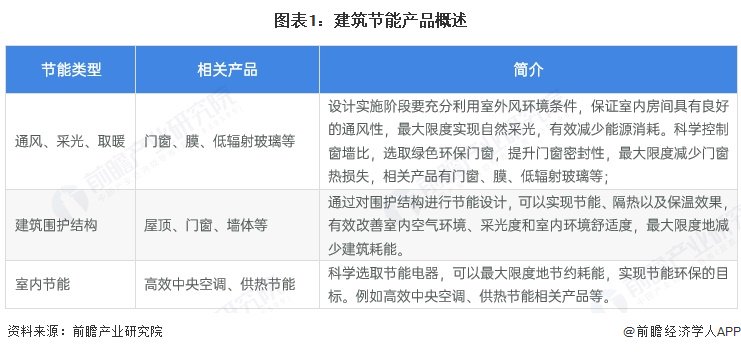
Core Insights - The rapid urban construction in China has led to increased energy consumption in the building industry, necessitating the promotion of green building energy-saving products to mitigate high energy consumption and support the development of energy-efficient construction projects [1][2]. Industry Overview - The building energy-saving industry in China is characterized by a growing market for energy-efficient products, driven by the need to address high energy consumption in construction projects [1]. - Key companies in the industry include China National Materials Group Corporation (中材节能), Beixin Building Materials (北新建材), and others [1]. Energy-Saving Product Types - **Ventilation, Lighting, Heating**: Products such as doors, windows, membranes, and low-emission glass are designed to optimize natural ventilation and lighting, thereby reducing energy consumption [3]. - **Building Envelope Structures**: Energy-saving designs for roofs, doors, and walls improve insulation and reduce energy use, enhancing indoor air quality and comfort [3]. - **Indoor Energy Efficiency**: High-efficiency central air conditioning and heating systems are essential for minimizing energy consumption [3]. Market Size and Growth - The Chinese central air conditioning market has seen continuous growth, with sales reaching 142.9 billion yuan in 2023, an increase of 11.1% year-on-year, and projected to reach 145.8 billion yuan in 2024 [4]. - The production of laminated glass, known for its excellent thermal insulation properties, reached 14.71 million square meters in 2023, with expectations to exceed 15 million square meters in 2024 [5]. Importance of Windows and Doors - Windows and doors are critical components affecting building energy efficiency, accounting for approximately 45%-50% of energy loss in building envelopes [9]. - Poor insulation performance of existing windows leads to significant energy waste, with single-glazed windows causing heat loss of 30%-50% during winter and contributing to 20%-30% of cooling loads in summer [9]. Heating Energy Efficiency Market - Investment in urban heating systems is closely linked to building energy efficiency, with a focus on high-efficiency heating system upgrades and energy-saving optimization of building envelopes [11]. - The fixed asset investment in urban centralized heating has fluctuated between 30-40 billion yuan from 2019 to 2022, with projections for 2024 nearing 40 billion yuan [11].