绿色能源投资

Search documents
四川成渝高速公路(00107) - 海外监管公告
2026-03-30 22:09
香港交易及結算所有限公司及香港聯合交易所有限公司對本公告的內容概不負責,對其準確性 或完整性亦不發表任何聲明,並明確表示,概不對因本公告全部或任何部份內容而產生或因倚 賴該等內容而引致的任何損失承擔任何責任。 四川成渝高速公路股份有限公司 Sichuan Expressway Company Limited* (在中華人民共和國註冊成立之股份有限公司) (股份編號:00107) 海外監管公告 本公告乃根據香港聯合交易所有限公司證券上市規則第13.10B條而作出。 茲載列四川成渝高速公路股份有限公司(「本公司」)在上海證券交易所網站發佈的 《四川成渝高速公路股份有限公司2025年年度報告》《四川成渝高速公路股份有限 公司2025年年度報告摘要》《四川成渝高速公路股份有限公司2025年度環境、社會 和公司治理報告》《四川成渝高速公路股份有限公司2025年度環境、社會和公司治 理報告摘要》《四川成渝高速公路股份有限公司獨立董事2025年度述職報告(余海 宗)》《四川成渝高速公路股份有限公司獨立董事2025年度述職報告(步丹璐)》《四 川成渝高速公路股份有限公司獨立董事2025年度述職報告(周華)》《四川成渝高 速公 ...
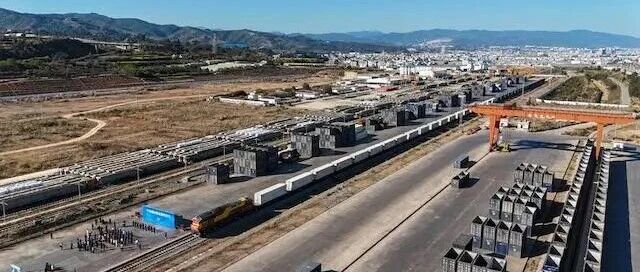
云南房地产投资占比5年下降超一半,工业投资增至3成多
第一财经· 2026-01-28 10:08
Core Viewpoint - The article discusses the significant changes in Yunnan's investment structure over the past five years, highlighting a shift from real estate investment to industrial investment amid a declining real estate market and increasing industrial investment [3][4]. Investment Structure Changes - Yunnan's investment growth has transitioned from being primarily driven by real estate and infrastructure to being led by industrial investment [3]. - The proportion of real estate investment in total investment decreased from 27.2% in 2020 to 12.0% in 2025, while industrial investment's share increased from 26.7% to 52.1% during the same period [3][5]. - Water conservancy investment accounted for 4.8% of total investment in 2025, up 1.5 percentage points from 2020 [3]. Trends in Investment Growth - From 2021 to 2023, both industrial and overall investment maintained double-digit growth rates, with industrial investment growing by 2.2% in 2024 despite a decline in total investment [4]. - The share of industrial private investment in total private investment rose from 42.6% in 2021 to 65.1% in 2025, supporting high-quality economic development in the province [4]. Real Estate Investment Decline - Real estate development investment in Yunnan has seen a rapid decline, with annual growth rates of -4.3%, -26.9%, -34.4%, and -28.5% from 2020 to 2024 [5]. - In 2025, fixed asset investment in the province decreased by 7.0%, with real estate development investment still declining by 2.9% [5]. Emerging Investment Areas - Green energy investments have become a crucial support for stable investment, with wind power investment increasing by 54.3%, electricity supply investment by 45.0%, and hydropower investment by 18.5% [5]. - The non-ferrous metal mining and selection industry saw a 20.8% increase in investment, with aluminum smelting and processing investments growing by 16.1% and 7.9%, respectively [5].

云南房地产投资占比5年下降超一半,工业投资增至3成多
Di Yi Cai Jing· 2026-01-28 07:12
Core Viewpoint - Yunnan's investment structure has significantly changed over the past five years, with a sharp decline in real estate investment and a nearly doubling of industrial investment, reflecting a shift towards more effective and sustainable investment strategies [1][2]. Investment Trends - The investment growth in Yunnan has transitioned from being primarily driven by real estate and infrastructure to being led by industrial investments, with a notable increase in private sector participation [1]. - By 2025, the proportion of industrial investment in total investment is expected to rise from 26.7% in 2020 to 52.1%, while real estate investment's share will drop from 27.2% to 12.0% [1]. Performance Metrics - From 2021 to 2023, both industrial and overall investment maintained double-digit growth rates, with industrial investment growing by 2.2% in 2024 despite a negative growth in total investment [2]. - The share of industrial private investment in total private investment is projected to increase from 42.6% in 2021 to 65.1% by 2025, supporting high-quality economic development in the province [2]. Real Estate Sector Decline - Real estate development investment, which was once a key driver of Yunnan's economic growth, has seen a rapid decline, with significant drops in investment from 2020 to 2024, including a staggering -34.4% in 2023 [2]. - The cumulative decline in real estate investment over the past three years has been the largest in the country, indicating a major shift in the economic landscape [2]. Fixed Asset Investment Outlook - In 2025, total fixed asset investment in Yunnan is expected to decrease by 7.0%, with real estate development investment continuing to decline by 2.9% [3]. - Green energy investments are emerging as a crucial support for stabilizing investments, with wind power investment increasing by 54.3% and electricity supply investment growing by 45.0% [3].
前11月,全省固定资产投资结构优化
Xin Lang Cai Jing· 2025-12-24 16:47
Core Viewpoint - The province experienced a 7.5% year-on-year decline in fixed asset investment from January to November, with project investment decreasing by 3.7% when excluding real estate development, while private investment in projects saw a slight increase of 0.2% [1] Investment Trends - Investment in basic living-related sectors such as food, clothing, housing, transportation, and entertainment showed strong growth, with agricultural and food processing industries seeing investments rise by 17.9% and 44.5% respectively [1] - The textile and apparel industry experienced a significant investment increase of 39.6%, while furniture and automotive manufacturing investments grew by 5.4% and 30.1% respectively [1] - The accommodation, catering, and entertainment sectors also reported substantial investment growth, with increases of 19.9%, 43.9%, and 41.5% respectively [1] High-Tech and Green Energy Investments - Investment in high-tech service industries grew by 18.1%, surpassing the overall investment growth rate by 25.6 percentage points, and its share of total investment increased by 0.9 percentage points year-on-year [1] - In the green energy sector, investments in electricity, heat, gas, and water production and supply industries rose by 30.6%, indicating sustained high growth in green energy investments [1]
美企因害怕特朗普而减少绿色投资?克里批美国政治寒蝉效应
Di Yi Cai Jing· 2025-11-26 08:12
Group 1 - John Kerry expressed shock at the level of fear among U.S. CEOs regarding President Trump, stating that despite the lucrative returns from green energy investments, many companies are still hesitant to invest due to potential political and legal repercussions [1][2] - Kerry highlighted that the recent COP30 climate conference was the first held without the participation of the U.S. federal government since the inception of the UN climate change conferences in 1995, yet several major companies like Microsoft, Google, and General Motors still attended, indicating a commitment to business development and supply chain security [4] - A recent analysis from the University of Maryland's Center for Global Sustainability indicated that existing policies could lead to a 35% reduction in U.S. emissions by 2035, largely driven by corporate initiatives [4] Group 2 - The renewable energy sector saw $2.2 trillion in spending over the past year, driven by market demand and consumer needs, despite some investors retracting their support due to fears related to climate change and political backlash [2] - Companies are recognizing the economic benefits of climate action, which also positively impacts health, food, and water security, as emphasized by Kerry [3]
青岛智联绿色能源股权投资基金登记成立,出资额10亿元
Zheng Quan Shi Bao Wang· 2025-09-05 08:33
Core Insights - A new private equity fund named Qingdao Zhilian Green Energy Equity Investment Fund Partnership has been established with a capital contribution of 1 billion RMB [1] - The fund's managing partner is Qingdao Urban Investment Private Fund Management Co., Ltd., and its business scope includes private equity investment, investment management, and asset management activities [1] - The fund is jointly funded by Qingdao Urban Investment Venture Capital Co., Ltd., Qingdao Financial Cooperation Project Guidance Fund Partnership, and Qingdao Science and Technology Innovation Fund Partnership [1]
固定资产投资规模继续扩大
Guo Jia Tong Ji Ju· 2025-08-19 01:11
Core Insights - National fixed asset investment (excluding rural households) reached 288,229 billion yuan from January to July, showing a year-on-year growth of 1.6% [1] Group 1: Equipment Investment - The "Two New" policies have led to a significant increase in equipment purchase investment, which grew by 15.2% year-on-year, outpacing overall investment growth by 13.6 percentage points, contributing 2.2 percentage points to total investment growth [2] Group 2: Manufacturing Investment - Manufacturing investment has seen a robust increase, growing by 6.2% year-on-year, which is 4.6 percentage points higher than the overall investment growth, contributing 1.5 percentage points to total investment growth. Notably, consumer goods manufacturing investment rose by 10.8%, while equipment manufacturing investment increased by 4.8%. High-tech manufacturing sectors such as aerospace and equipment manufacturing saw investment growth of 33.9% and 16.0%, respectively [3] Group 3: Infrastructure Investment - Infrastructure investment has shown a steady growth of 3.2% year-on-year, exceeding overall investment growth by 1.6 percentage points, with a contribution rate of 43.0% to total investment growth, an increase of 6.0 percentage points from the first half of the year. Key sectors include water transportation (18.9% growth), water management (12.6% growth), and railway transportation (5.9% growth) [4] Group 4: Green Energy Investment - Green energy investment has surged, with the electricity, heat, gas, and water production and supply sector growing by 21.5% year-on-year, contributing 1.4 percentage points to total investment growth. Investments in solar, wind, nuclear, and hydropower collectively increased by 21.9% [5] Group 5: High-Tech Service Investment - High-tech service investment has expanded, growing by 6.2% year-on-year, which is 4.6 percentage points higher than overall investment growth. This sector now accounts for 5.1% of total service industry investment, up by 0.4 percentage points from the same period last year, with information service investment increasing by 32.8% [6] Group 6: Project Investment - National project investment (excluding real estate development) grew by 5.3% year-on-year, surpassing overall investment growth by 3.7 percentage points. Projects with total planned investments of 100 million yuan and above saw a 4.1% increase, contributing 2.3 percentage points to total investment growth. Private sector project investment (excluding real estate) rose by 3.9%, with notable growth in accommodation and catering (19.6%), infrastructure (8.8%), and cultural, sports, and entertainment sectors (8.1%) [7]
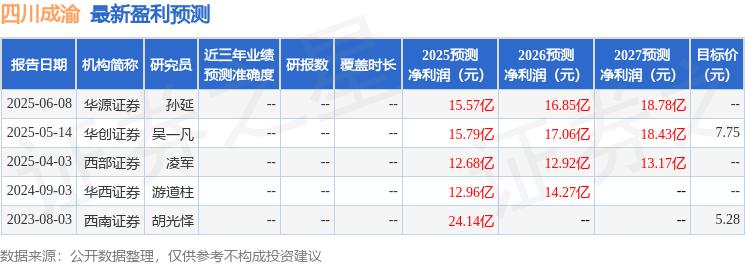
太平洋:首次覆盖四川成渝给予增持评级
Zheng Quan Zhi Xing· 2025-08-03 05:19
Core Viewpoint - Pacific Securities recently initiated coverage on Sichuan Chengyu (601107) with a "Buy" rating, highlighting effective cost control and successful bidding for the Chengya expansion project [1] Financial Performance - In the 2024 annual report, Sichuan Chengyu achieved total revenue of 10.362 billion, a year-on-year decrease of 11.07%; net profit attributable to shareholders was 1.459 billion, an increase of 22.91%; and non-recurring net profit was 1.39 billion, up 27.22% [2] - For Q1 2025, the company reported revenue of 1.85 billion, a year-on-year decrease of 8.08%, while non-recurring net profit increased to 443 million, a rise of 16.51% [3] Business Overview - Sichuan Chengyu is the only A+H share listed company in Sichuan focusing on highway infrastructure, involved in investment, construction, operation, and management of highways, as well as green energy investments and resource development [4] - As of the end of 2024, the company operates approximately 900 kilometers of highways, with 858 kilometers being toll roads, and has ongoing construction for the Chengle expansion project covering about 136.1 kilometers [4] Investment Outlook - The company has completed the Tianqiong Expressway and is currently working on the Chengle expansion project, having won the bid for the Chengya expansion project in July [5] - The company is expected to maintain its dividend policy, proposing a cash dividend of approximately 890 million for 2024, which represents 60.8% of the annual net profit, with a dividend yield of about 5.77% based on the closing price on the report date [2][5]