网络舆情

Search documents
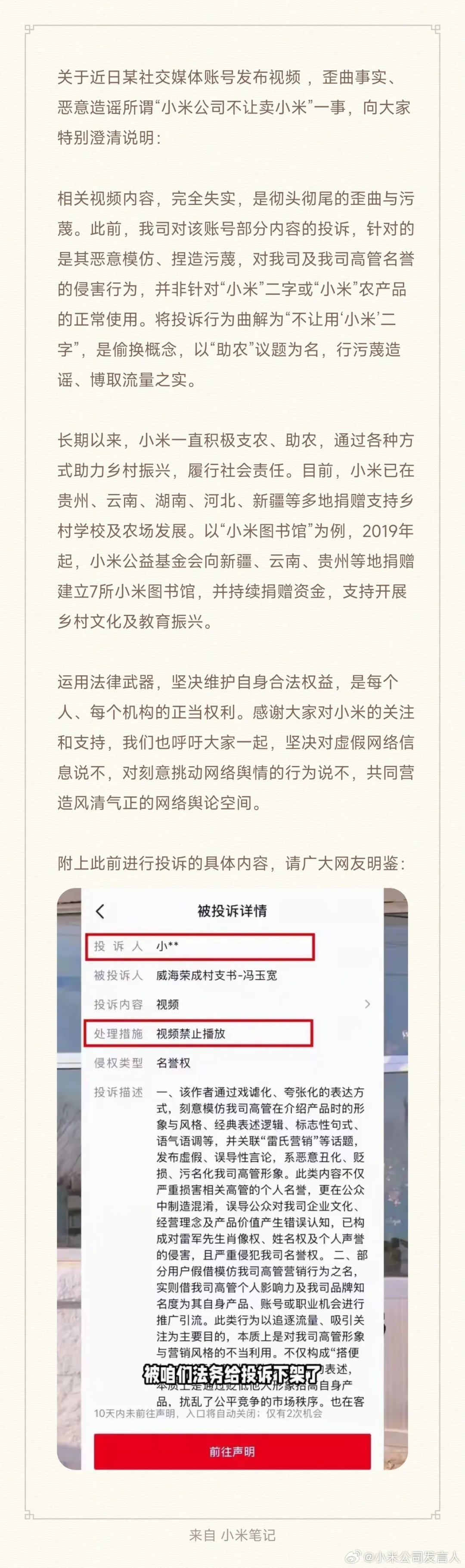
小米回应“村支书卖小米被投诉下架”:彻头彻尾的歪曲与污蔑!当事人道歉,律师解读:或涉侵权
Mei Ri Jing Ji Xin Wen· 2025-12-12 13:09
Core Viewpoint - The controversy surrounding a village official selling millet online and the subsequent complaint from Xiaomi has sparked significant public interest, with Xiaomi clarifying that their complaint was not about the use of the term "millet" but rather about defamation and misrepresentation of their brand [1][2][4]. Group 1: Xiaomi's Response - Xiaomi's spokesperson stated that the claims made in a viral video were completely false and distorted, emphasizing that the complaint was aimed at protecting the company's reputation and not at restricting the use of the word "millet" [1][2]. - The company has a history of supporting rural development and has made donations to schools and farms in various provinces, including Guizhou, Yunnan, and Xinjiang, as part of their social responsibility initiatives [1][3]. Group 2: Incident Details - The village official, known as Feng Yuquan, created a video that allegedly mocked Xiaomi's CEO Lei Jun and used misleading information, which led to the complaint regarding defamation [4][9]. - Following the backlash, Feng issued an apology, acknowledging that his video had caused a negative impact on Xiaomi and wasted social resources, and he committed to regulating his online behavior in the future [6][13]. Group 3: Legal Implications - Legal experts indicated that if the video used Lei Jun's name or likeness in a derogatory manner, it could potentially infringe on his name and reputation rights [19].


网络舆情的形成与管理
Sou Hu Cai Jing· 2025-09-04 08:37
Core Viewpoint - The article emphasizes that online public opinion is a complex phenomenon that reflects public attitudes and emotions towards social issues, and it should not be simplistically categorized as crisis management or a branch of communication studies [2][3]. Group 1: Nature and Characteristics of Online Public Opinion - Online public opinion is a manifestation of social discourse that is influenced by various factors, including political, social, economic, psychological, and legal aspects [3][4]. - The complexity of online public opinion requires a multidisciplinary approach for comprehensive understanding, integrating insights from political science, sociology, economics, psychology, communication studies, and law [3][4][18]. Group 2: Formation Mechanisms - The formation of online public opinion is rooted in social structures and psychological mechanisms, with feelings of social inequality and relative deprivation being significant underlying causes [5][7]. - Internet technology accelerates the formation and dissemination of public opinion, providing platforms for expression and reducing psychological barriers to sharing opinions [6][19]. Group 3: Stages of Development - Online public opinion typically progresses through three stages: occurrence, diffusion, and decline, each characterized by specific psychological mechanisms and public engagement [9][10]. - During the occurrence stage, an event triggers initial public interest; in the diffusion stage, information spreads rapidly, leading to diverse opinions; and in the decline stage, public attention shifts away from the issue [9][10]. Group 4: Governance Strategies - Effective management of online public opinion requires collaboration among multiple stakeholders, including government, enterprises, and various institutions [11][12]. - Governments play a crucial role in regulating and guiding public opinion, emphasizing the need for legal frameworks and timely communication to prevent misinformation [12][13]. - Enterprises must monitor public sentiment and respond to crises effectively to protect brand reputation, while also ensuring responsible content management on their platforms [14][15]. Group 5: Future Directions - The evolution of information technology presents both challenges and opportunities for online public opinion management, necessitating a focus on ethical considerations and cross-border collaboration [19]. - Future research should continue to explore innovative approaches to managing online public opinion, aiming to balance freedom of expression with the need for social order [19].