社会心理机制

Search documents
七天涨粉两百万 鸡排哥们带来“文旅增量”|消费快评
2 1 Shi Ji Jing Ji Bao Dao· 2025-09-30 14:16
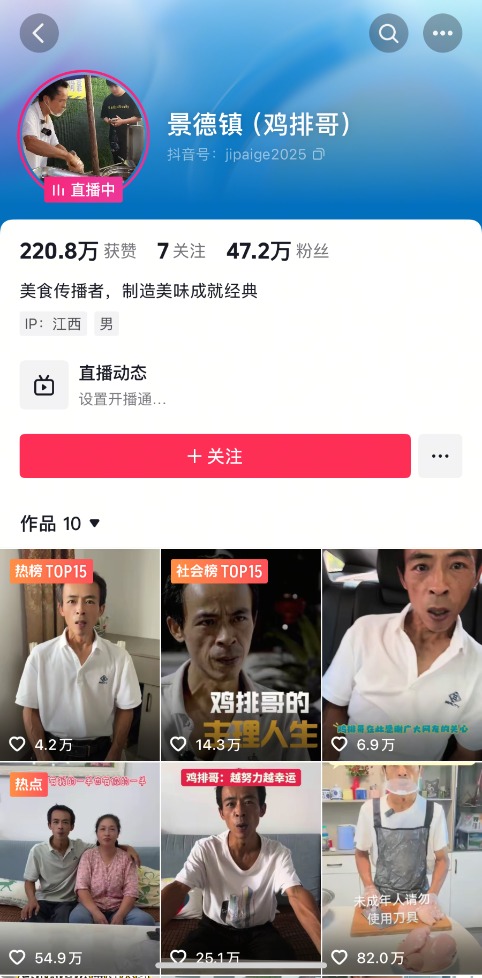
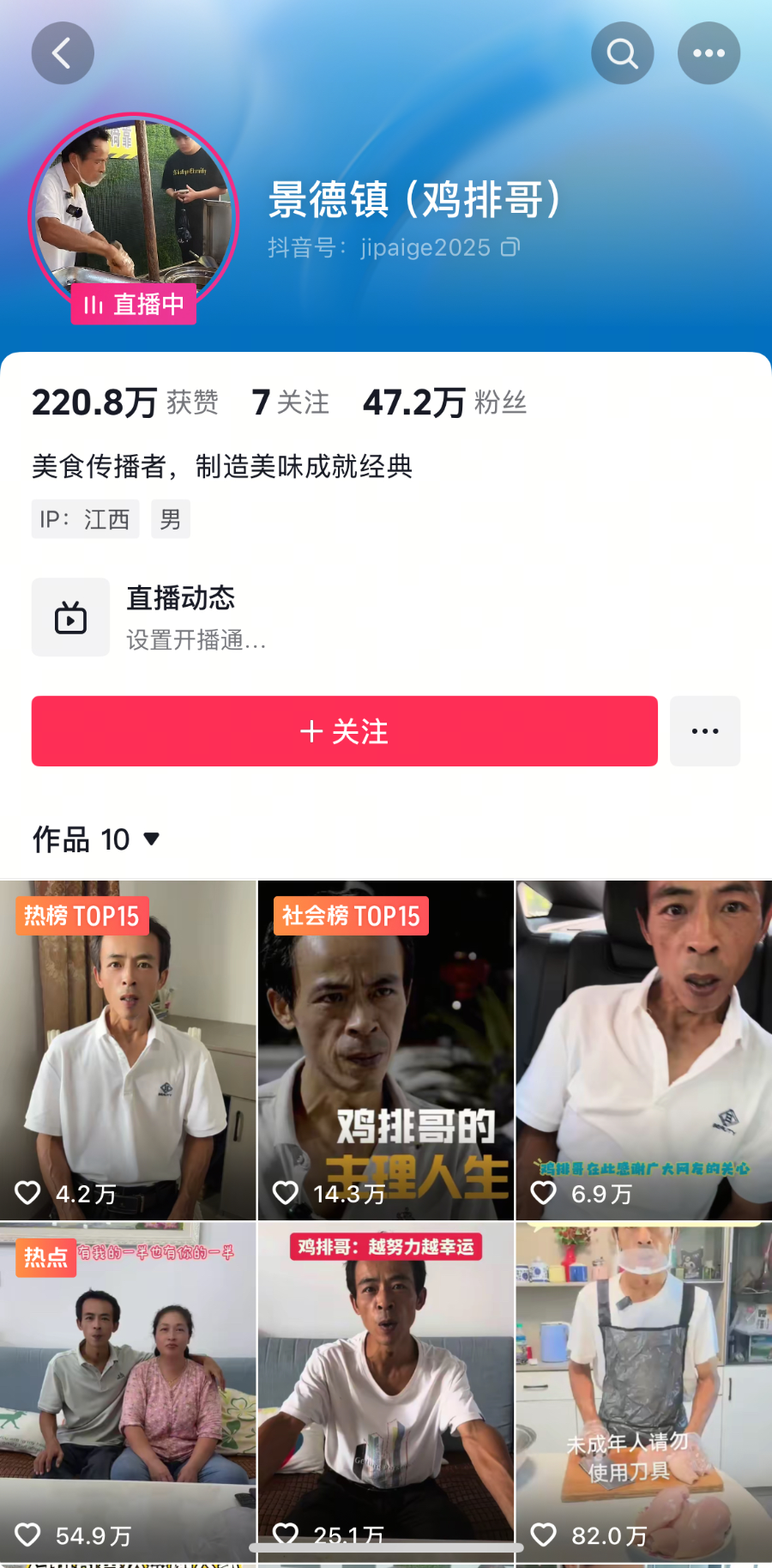
Core Viewpoint - The rise of "Chicken Chop Brother" in Jingdezhen has significantly boosted local tourism and hospitality during the National Day holiday, showcasing the impact of viral social media phenomena on local economies [1][5][9] Group 1: Impact on Local Economy - The popularity of "Chicken Chop Brother" has led to a surge in visitors to Jingdezhen, with hotels and accommodations within a 2-kilometer radius experiencing price increases of 2-3 times during the holiday period [5] - The character's online presence has resulted in a rapid increase in followers, reaching 2.208 million on Douyin within just seven days, with individual posts garnering up to 820,000 likes [1] Group 2: Government Response - The local government has established a dedicated team to manage the influx of visitors and maintain order, indicating a proactive approach to capitalize on the viral trend [6] - Plans are in place for further discussions on how to support and guide tourists during the holiday, reflecting the government's commitment to harnessing this unexpected tourism boost [6][9] Group 3: Broader Implications for Tourism - The phenomenon illustrates that local figures, rather than just celebrities, can effectively promote regional tourism, suggesting a new avenue for local tourism marketing strategies [9] - The case of "Chicken Chop Brother" parallels other viral events, such as the "Goose Brother" in Chongqing, highlighting a trend where ordinary individuals can drive significant economic activity through social media engagement [8][9]

七天涨粉两百万,鸡排哥们带来“文旅增量”|消费快评
2 1 Shi Ji Jing Ji Bao Dao· 2025-09-30 11:58
Core Insights - The rise of "Chicken Chop Brother" in Jingdezhen has significantly boosted local tourism and economy during the National Day holiday, attracting a large number of visitors and increasing hotel prices in the vicinity [1][2][3] Group 1: Impact on Local Economy - The popularity of "Chicken Chop Brother" has led to hotel prices near his stall increasing by 2-3 times during the National Day holiday [2] - The local government has formed a dedicated team to manage the influx of visitors and ensure order at the stall, indicating a proactive approach to capitalize on this unexpected tourism boost [3] Group 2: Social Media Influence - "Chicken Chop Brother" gained 2.208 million followers on Douyin within a week, showcasing the power of social media in driving local business success [1] - The phenomenon reflects a broader trend where ordinary individuals can become local tourism ambassadors, leveraging their authenticity and passion to engage younger audiences [5] Group 3: Government Response and Strategy - Local authorities are planning to hold meetings to discuss strategies for managing the increased tourist flow and ensuring a positive experience for visitors [3] - The case of "Chicken Chop Brother" parallels other viral phenomena, such as the "Goose Brother" in Chongqing, highlighting the potential for local governments to harness social media trends for economic gain [4][5]
七天涨粉两百万,鸡排哥们带来“文旅增量”
2 1 Shi Ji Jing Ji Bao Dao· 2025-09-30 11:56
Core Viewpoint - The rise of "Chicken Chop Brother" in Jingdezhen has significantly boosted local tourism and hospitality during the National Day holiday, showcasing the impact of viral social media phenomena on local economies [1][6]. Group 1: Impact on Local Economy - The popularity of "Chicken Chop Brother" has led to a surge in visitors to Jingdezhen, with local hotels experiencing price increases of 2-3 times during the National Day period [5]. - The rapid growth of "Chicken Chop Brother's" social media presence, with 2.208 million followers on Douyin within a week, indicates a strong online engagement that translates into physical foot traffic [1][5]. Group 2: Government Response - The local government has established a dedicated team to manage the influx of visitors and ensure order at the sales site, reflecting proactive measures to capitalize on the viral trend [7]. - Plans are in place for further discussions on how to support "Chicken Chop Brother" and manage the expected tourist flow during the holiday [7]. Group 3: Broader Implications for Local Tourism - The phenomenon highlights a new avenue for local tourism promotion, suggesting that ordinary individuals can effectively serve as ambassadors for their regions, rather than relying solely on celebrities [9]. - The case of "Chicken Chop Brother" parallels other viral events, such as the "Goose Brother" in Chongqing, demonstrating a pattern of local food items gaining popularity through social media [8].
网络舆情的形成与管理
Sou Hu Cai Jing· 2025-09-04 08:37
Core Viewpoint - The article emphasizes that online public opinion is a complex phenomenon that reflects public attitudes and emotions towards social issues, and it should not be simplistically categorized as crisis management or a branch of communication studies [2][3]. Group 1: Nature and Characteristics of Online Public Opinion - Online public opinion is a manifestation of social discourse that is influenced by various factors, including political, social, economic, psychological, and legal aspects [3][4]. - The complexity of online public opinion requires a multidisciplinary approach for comprehensive understanding, integrating insights from political science, sociology, economics, psychology, communication studies, and law [3][4][18]. Group 2: Formation Mechanisms - The formation of online public opinion is rooted in social structures and psychological mechanisms, with feelings of social inequality and relative deprivation being significant underlying causes [5][7]. - Internet technology accelerates the formation and dissemination of public opinion, providing platforms for expression and reducing psychological barriers to sharing opinions [6][19]. Group 3: Stages of Development - Online public opinion typically progresses through three stages: occurrence, diffusion, and decline, each characterized by specific psychological mechanisms and public engagement [9][10]. - During the occurrence stage, an event triggers initial public interest; in the diffusion stage, information spreads rapidly, leading to diverse opinions; and in the decline stage, public attention shifts away from the issue [9][10]. Group 4: Governance Strategies - Effective management of online public opinion requires collaboration among multiple stakeholders, including government, enterprises, and various institutions [11][12]. - Governments play a crucial role in regulating and guiding public opinion, emphasizing the need for legal frameworks and timely communication to prevent misinformation [12][13]. - Enterprises must monitor public sentiment and respond to crises effectively to protect brand reputation, while also ensuring responsible content management on their platforms [14][15]. Group 5: Future Directions - The evolution of information technology presents both challenges and opportunities for online public opinion management, necessitating a focus on ethical considerations and cross-border collaboration [19]. - Future research should continue to explore innovative approaches to managing online public opinion, aiming to balance freedom of expression with the need for social order [19].