美妆企业上市

Search documents
全链”上市!美妆企业争做“第一股
Shen Zhen Shang Bao· 2026-01-16 00:33
Core Viewpoint - The beauty industry is experiencing a surge in IPO activities, with over 41 companies aiming for public listings in 2025, while simultaneously facing challenges with 10 companies exiting the capital market [1][4]. Group 1: IPO Activities - In December, Lin Qingxuan successfully listed on the Hong Kong Stock Exchange, marking it as the first high-end domestic skincare stock in Hong Kong [1]. - Major domestic beauty brands like Naturals, Proya, and Marubi are also pursuing listings, with Proya and Marubi aiming for dual listings in both A-shares and H-shares [1]. - The IPO wave includes a diverse range of companies across the beauty supply chain, including raw material suppliers and packaging companies, with 8 companies like Vicky Technology and Jiakai Biotechnology also in the IPO race [2]. Group 2: Market Challenges - Despite the IPO enthusiasm, 10 beauty-related companies have exited the A-share or New Third Board markets, indicating a stringent selection process by capital markets [4]. - Many companies, including Naturals and Vicky Technology, have faced delays in their IPO processes, often remaining in the application or advisory stages [4]. - The third-quarter report for 2025 shows that only a few beauty companies have maintained revenue growth, with many facing significant operational pressures [5]. Group 3: Industry Dynamics - The beauty industry is characterized by a dual trend of IPO excitement and market exits, highlighting the need for companies to address issues such as heavy reliance on marketing over research and development [6]. - Companies like Naturals have reported high marketing costs, with sales and marketing expenses reaching 57% of revenue, while R&D investment has decreased significantly [6]. - The reliance on flagship products, such as Lin Qingxuan's dependence on its essence oil, poses additional challenges for sustainable growth [7].

“全链”上市!美妆企业争做“第一股”
Shen Zhen Shang Bao· 2026-01-15 17:51
Core Viewpoint - The beauty industry is experiencing a surge in IPO activities, with over 41 beauty-related companies aiming for IPOs in 2025, indicating a robust interest in capital markets within this sector [2][3]. Group 1: IPO Activities - In December 2024, Lin Qingxuan successfully listed on the Hong Kong Stock Exchange, marking it as the first high-end domestic skincare stock in Hong Kong [2]. - Major domestic beauty brands such as Naturals, Proya, and Marubi have initiated their IPO processes, with Proya and Marubi already listed on A-shares, aiming for a dual listing in Hong Kong [2][3]. - The IPO wave includes a diverse range of companies from the beauty supply chain, including raw material suppliers, packaging companies, and brand operators [2][3]. Group 2: Market Dynamics - Since the end of 2024, there has been a notable trend of companies exiting the capital market, with 10 beauty-related companies having withdrawn from A-shares or the New Third Board [5]. - Many companies are facing delays in their IPO processes, with some, like Naturals and Weiqi Technology, still in the application or advisory stages despite having significant revenue [5][6]. - The A-share beauty companies reported a total revenue of 27.707 billion yuan and a net profit of 3.753 billion yuan in the first three quarters of 2025, with Proya leading at 7.098 billion yuan, showing only a slight growth of 1.89% year-on-year [6]. Group 3: Challenges in the Industry - The beauty industry is grappling with challenges such as an overemphasis on marketing at the expense of research and development, as evidenced by Naturals' marketing costs significantly outweighing its R&D investments [7][8]. - Companies like Lin Qingxuan are heavily reliant on a single product category for revenue, which poses risks to their long-term growth and stability [8]. - The current market environment is increasingly selective, favoring companies with solid market foundations, clear brand positioning, and strong technological barriers [5][7].

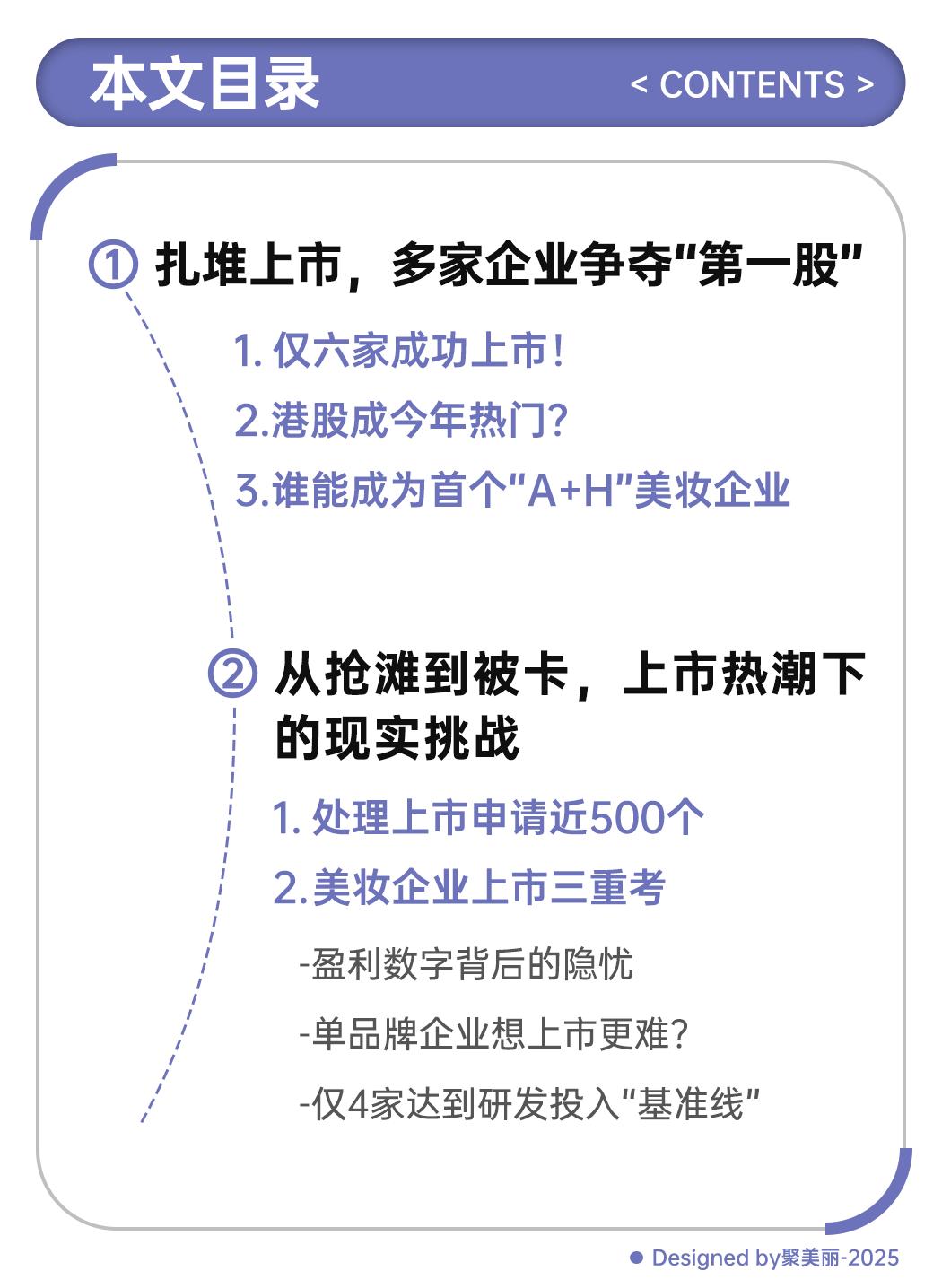
2025年,30+美妆企业冲击上市,仅6家成功
3 6 Ke· 2025-12-22 00:06
Core Insights - The beauty industry is experiencing a significant IPO wave, with over 30 companies attempting to enter capital markets, but only about 20% have successfully listed [3][4][7] - The focus of beauty companies has shifted from A-shares to Hong Kong stocks, driven by stricter regulations in the A-share market and more favorable conditions in Hong Kong [11][14][16] Group 1: IPO Landscape - Only six beauty companies have successfully gone public this year, including brands like Ying Tong Holdings and Pitanium Limited, with three listed on the Hong Kong Stock Exchange, two on NASDAQ, and one on the A-share market [4][6] - The majority of companies are still in the IPO process, with many facing delays due to regulatory scrutiny and the need for robust financial performance [7][21] - The current IPO environment is characterized by a high level of competition, with the capital market becoming increasingly selective about which companies to approve for listing [3][22] Group 2: Market Trends - The shift towards Hong Kong listings is evident, as the A-share market has seen a significant decline in successful IPOs since 2022, with a 69.69% drop in the number of listings [14] - Hong Kong has become a preferred destination for beauty companies due to its favorable market conditions and supportive regulatory environment, which includes recent reforms to the IPO process [16][20] - The trend of dual listings (A+H) is emerging, with several companies that are already listed in A-shares now seeking to enter the Hong Kong market [17][20] Group 3: Challenges and Opportunities - Companies face three main challenges in the IPO process: sustainable profitability, brand diversification, and research and development capabilities [24][25] - The ability to demonstrate consistent profitability is crucial, as evidenced by leading companies like Proya, which reported over 5 billion RMB in revenue, while others struggle to reach the 1 billion RMB mark [25][28] - R&D investment is critical for long-term success, with only a few companies meeting the industry benchmark for R&D spending, highlighting a gap in innovation among many players [39][42]