美股杠杆

Search documents
杠杆警报!美股这个“狂热指标”已经超过了1999年和2007年
美股IPO· 2025-10-21 00:41
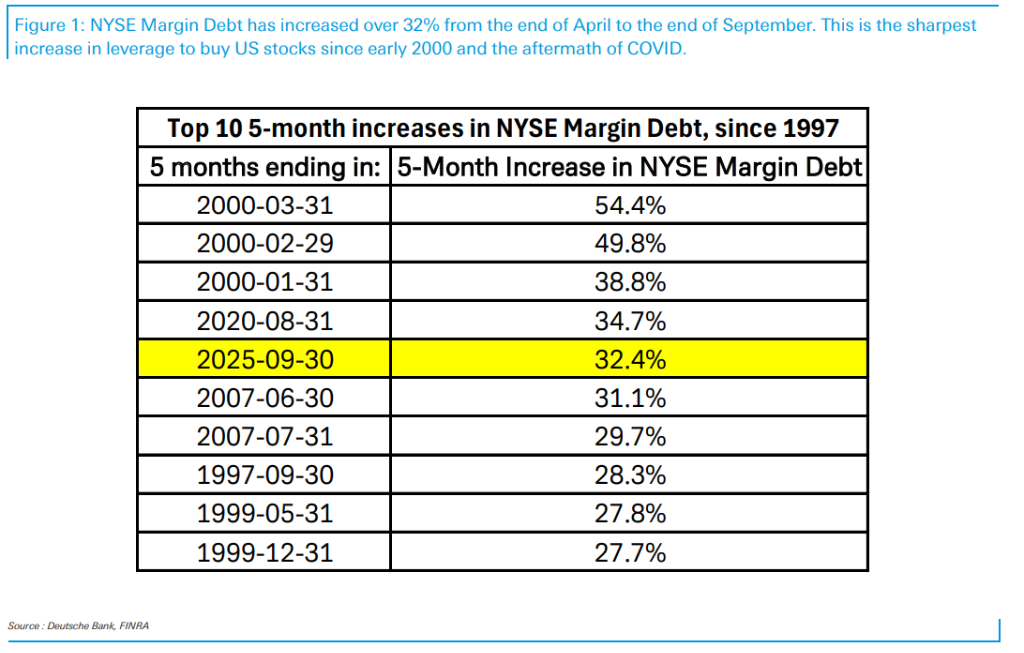
Core Viewpoint - Deutsche Bank highlights a significant increase in investor leverage, with margin debt rising 32.4% from April to September, marking a concerning trend reminiscent of past market bubbles [2][3][4]. Group 1: Leverage Increase - The speed of leverage increase is unprecedented, surpassing levels seen during the 1999 internet bubble and the 2007 financial crisis [4][6]. - The current margin debt is approaching historical highs, with its ratio to U.S. nominal GDP nearing the peak recorded in Q3 2021 [6][9]. Group 2: Market Sentiment - Market sentiment has shifted from healthy bullishness to irrational exuberance, as evidenced by the rapid borrowing for stock purchases [4][6]. - Historical data indicates that periods of high margin debt growth often precede poor entry points for risk assets [6][9]. Group 3: Economic Context - Unlike the 2020-2021 period, current fiscal and monetary conditions are less supportive, raising concerns about market resilience [8][9]. - The absence of substantial liquidity support suggests that the risks associated with extreme leverage levels may be more severe than generally perceived [9].


杠杆警报!美股这个“狂热指标”已经超过了1999年和2007年
Hua Er Jie Jian Wen· 2025-10-21 00:19
Core Insights - A key leverage indicator measuring the euphoria in the US stock market has surged to levels exceeding those seen during the 1999 internet bubble and the 2007 financial crisis, signaling significant warnings for risk assets [1] - Deutsche Bank's tracking of NYSE margin debt shows a 32.4% increase in investor leverage from the end of April to the end of September, marking one of the fastest rates of re-leveraging in history [2][3] Group 1: Leverage Surge - The market sentiment has shifted from healthy bullishness to irrational exuberance, evidenced by the rapid borrowing by investors to purchase stocks [2] - The current five-month increase in NYSE margin debt is only surpassed by the periods of early 2000 and the post-COVID stimulus rebound in 2020 [2][3] Group 2: Historical Context - Historical data indicates that when margin debt growth exceeds 40% year-over-year, there is a significant risk of widening spreads in high-yield bonds over the next 6 to 12 months [5] - The current margin debt levels are approaching historical peaks relative to US nominal GDP, raising concerns about the sustainability of this leverage [3][5] Group 3: Market Conditions - Unlike the stability observed in 2020-2021, which was supported by unprecedented fiscal and monetary policies, the current financial environment is characterized by negative fiscal impulses and declining bank reserves [5] - The extreme levels of leverage today, without substantial liquidity support, suggest that the risks may be more severe than generally perceived by the market [5]