职场健康

Search documents
“养老投资+健康生活” 嘉实养老续航站深圳正式起航
Sou Hu Cai Jing· 2025-12-02 10:10
Core Viewpoint - The event organized by Jiashi Fund aims to raise awareness about personal pension planning among urban office workers, coinciding with the third anniversary of the personal pension system in China [5][15]. Group 1: Event Overview - Jiashi Fund, in collaboration with Health News Agency, hosted a health and pension-themed pop-up event in Shenzhen, focusing on the integration of workplace health and personal pension savings [5]. - The event featured two main components: a live expert interview on health and wealth topics and an interactive offline experience, utilizing various online platforms for real-time engagement [5][11]. Group 2: Wealth Planning Insights - Li Jianjin, a director at Jiashi Fund, discussed the aging trend in China, predicting that by 2040, 24% of the population will be aged 65 and above, highlighting the importance of personal pension savings to mitigate future income gaps [7]. - He emphasized the need to shift from merely saving for retirement to strategic future planning, advocating for long-term investment strategies to achieve asset growth [7]. Group 3: Health and Wellness Focus - Dr. Cui Peng from South China Hospital stressed the importance of bone health for office workers, recommending daily calcium intake of 800-1000 mg and the role of Vitamin D in calcium absorption [9]. - The event included practical stretching exercises aimed at alleviating workplace-related health issues, promoting the idea that integrating movement into daily routines is essential for health [9]. Group 4: Interactive Engagement - The pop-up event featured three interactive zones: a health testing station, a wealth investment declaration area, and a knowledge quiz station, encouraging participants to engage with pension investment concepts [14]. - Jiashi Fund has been a pioneer in pension investment in China, launching pension-focused mutual funds and integrating various resources to support pension business development [14].


研判2025!中国按摩器行业发展背景、行业产业链、发展现状、竞争格局及发展趋势分析:银发经济与职场健康需求共振,中国按摩器行业迎来黄金发展期[图]
Chan Ye Xin Xi Wang· 2025-07-24 01:10
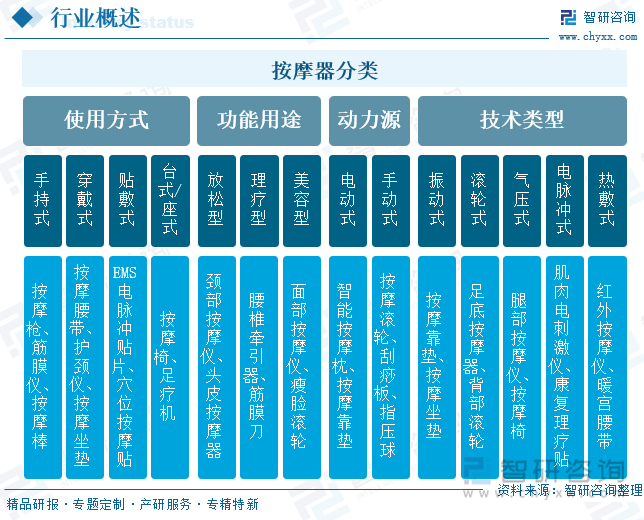
Core Insights - The massage device industry in China is experiencing significant growth, driven by increasing health awareness and the rising prevalence of spinal diseases among the population, particularly among young adults aged 25-39 [1][6][12] - The market size of the massage device industry is projected to reach 460 billion yuan in 2024, with a year-on-year growth of 9.5%, and is expected to exceed 500 billion yuan by 2025 [1][12] - The small massage device segment, including neck and lumbar massagers, eye massagers, and fascia guns, is particularly strong, with a compound annual growth rate (CAGR) of 9.7% from 2018 to 2024 [1][14] Industry Overview - Massage devices are designed to simulate manual massage techniques through mechanical vibrations, rolling, tapping, or heat application, aiding in muscle relaxation and blood circulation [2] - The industry is characterized by a shift from passive treatment to proactive health management, with modern devices integrating AI and biofeedback technologies [12][22] Development Background - The aging population and the increase in sub-health individuals are long-term drivers for the massage device industry, with over 310 million people aged 60 and above in China by 2024 [4] - The prevalence of lumbar diseases has become a significant public health issue, with over 200 million patients nationwide, particularly affecting the working population [6][8] Market Characteristics - Consumer preferences vary by age group, with younger individuals favoring portable and stylish devices, while older adults prefer simple and safe options [8][9] - The middle-aged demographic is focused on professional therapeutic products for chronic pain management, indicating a diverse market segmentation [8][9] Industry Chain - The massage device industry chain consists of upstream raw material suppliers, midstream manufacturers, and downstream application scenarios and sales channels [10] - The manufacturing sector is highly competitive, with a focus on technological innovation and cost control [10] Competitive Landscape - The industry is dominated by local brands such as Aojiahua, Rongtai Health, and Beiqingsong, which hold over 25% of the market share [18][20] - Competition is shifting from price wars to technological advancements and ecosystem integration, with a focus on enhancing consumer experience [18][20] Future Trends - The industry is moving towards intelligent technology integration, with AI and IoT driving personalized health management solutions [22][23] - There is a growing trend towards multi-scenario applications, with products being used in homes, vehicles, and medical settings [24] - Chinese brands are expanding globally, with exports expected to exceed 12 billion USD in 2024, targeting emerging markets with localized products [25]