按摩器

Search documents
马学军和他的倍轻松:30年爬上聊城首富,5年蒸发80亿市值 | 大A避雷针
Sou Hu Cai Jing· 2026-02-11 08:23
Core Viewpoint - The rapid rise and subsequent fall of Beilingsong and its founder Ma Xuejun illustrate the volatile nature of the capital market, where initial success can quickly turn into significant challenges and regulatory scrutiny [1][17]. Company Overview - Beilingsong, founded by Ma Xuejun, transitioned from a small health product company to a publicly listed entity on the STAR Market, achieving a market capitalization of over 100 billion yuan shortly after its IPO [7][10]. - The company initially focused on marketing, heavily investing in celebrity endorsements, which contributed to its rapid growth but also set the stage for future vulnerabilities [11][12]. Regulatory Issues - On December 25, 2025, Beilingsong announced that it and its actual controller Ma Xuejun were under investigation by the China Securities Regulatory Commission (CSRC) for information disclosure violations, leading to a 14.68% drop in stock price the following day [2][6]. - This was not the first time the company faced regulatory scrutiny; a self-inspection report revealed that Ma Xuejun had misappropriated 12.08 million yuan of company funds between 2021 and 2022 [4][5]. Financial Performance - Following its IPO, Beilingsong's financial performance deteriorated sharply, with a 24.7% decline in revenue in 2022, resulting in a net loss of 124 million yuan [13][14]. - Despite a revenue rebound to 1.275 billion yuan in 2023, the company continued to incur losses, with a projected net loss of 84 million to 105 million yuan for the entire year of 2025 [14][16]. Marketing Strategy - The company's aggressive marketing strategy, including high-profile endorsements from celebrities like Xiao Zhan and Yi Yang Qianxi, initially drove sales but later raised questions about sustainability and return on investment [11][12]. - Sales expenses remained disproportionately high, reaching 6.88 billion yuan in 2023, which accounted for 54% of revenue, indicating a troubling trend of high costs without corresponding revenue growth [14][16]. Challenges Ahead - As of early 2026, Beilingsong faced multiple challenges, including a significant drop in stock price (over 87% from its peak) and ongoing regulatory pressures [16]. - The company is attempting to pivot towards a new business model focused on "technology products + effective massage," but early results have shown a 34.07% decline in revenue for the first three quarters of 2025 [16].

倍轻松1月29日获融资买入271.87万元,融资余额6909.14万元
Xin Lang Cai Jing· 2026-01-30 01:37
Group 1 - The core viewpoint of the news is that Beilingsong (倍轻松) is experiencing a decline in both revenue and net profit, indicating potential challenges in its business performance [2] - As of January 29, Beilingsong's financing balance is 69.09 million yuan, accounting for 3.64% of its market capitalization, which is below the 40th percentile level over the past year, suggesting a low financing position [1] - The company reported a total revenue of 552 million yuan for the period from January to September 2025, a year-on-year decrease of 34.07%, and a net profit attributable to shareholders of -65.63 million yuan, a decrease of 600.98% year-on-year [2] Group 2 - Beilingsong has not distributed any dividends in the past three years, with a total payout of 66.94 million yuan since its A-share listing [3] - As of September 30, 2025, the number of shareholders increased by 4.92% to 5,073, while the average circulating shares per person decreased by 4.69% to 16,941 shares [2] - The company specializes in the research and development of health products, primarily focusing on the design, production, and sales of portable massage devices, with its main revenue sources being shoulder (22.03%), head and scalp (18.10%), and eye (13.08%) products [1]
SKG三闯IPO,募资前缘何先举债给实控人分红1.7亿
Nan Fang Du Shi Bao· 2026-01-28 13:49
Core Viewpoint - SKG's third attempt to go public reveals significant discrepancies between its founding principles and current operational challenges, including declining revenue, profit, and heavy reliance on a single product, raising questions about its future viability in the capital market [1][2][6]. Group 1: Financial Performance - SKG's revenue decreased from 1.06 billion yuan in 2021 to 900 million yuan in 2022, a year-on-year decline of 14.68% [2] - The net cash flow plummeted from 260 million yuan in 2021 to a negative 1 million yuan [2] - The net profit for SKG dropped from 210 million yuan in 2020 to 100 million yuan in 2022, marking a continuous decline over three years [2][3] Group 2: Product Dependency - SKG heavily relies on its cervical massager, which contributed 586 million yuan, 855 million yuan, and 743 million yuan to revenue from 2019 to 2021, accounting for 74.19%, 86.67%, and 70.33% of total revenue respectively [2] - Revenue from the cervical massager fell from 860 million yuan in 2020 to 450 million yuan in 2022, with its share of total revenue dropping from 86.67% to 50.42% [3] Group 3: Marketing vs. R&D Investment - SKG's marketing expenses from 2020 to 2022 were 210 million yuan, 215 million yuan, and 165 million yuan, consistently over 18% of revenue, totaling approximately 430 million yuan [4] - In contrast, R&D expenses decreased from 9.1% in 2022 to 6.6% in 2025, with a 17.7% year-on-year reduction in 2024 [4][5] - The number of R&D personnel dropped from 172 in 2022 to 161 in 2025, a reduction of over 6% [5] Group 4: Controversial Dividend Practices - SKG controversially borrowed funds to distribute dividends totaling 170 million yuan to shareholders, despite declining revenue and profits [6][7] - The total dividends paid reached 280 million yuan, accounting for 74% of net profit during the reporting period [7] - The company's interest-bearing loans surged from 173,000 yuan at the end of 2022 to 1.8 billion yuan by the third quarter of 2025 [8] Group 5: Market Competition and Future Outlook - The massage device market in China experienced a compound annual growth rate of 11.05% from 2015 to 2021, with increasing competition from brands like Xiaomi and Beiliang, intensifying price wars [8] - Analysts suggest that SKG's brand longevity will depend on its ability to build core competitiveness beyond marketing [9]
倍轻松:多维度发力,开启高质量发展新征程
Quan Jing Wang· 2025-11-21 09:21
Core Insights - The event "Value Transmission, Trust Promotion, and Opportunity Sharing" was successfully held, showcasing the development achievements and strategic layout of the company Beiqing Song (倍轻松) [1][2] - The company has opened 15 "Relax Moment" stores across China, focusing on cities like Shenzhen, Guangzhou, Xi'an, Chongqing, and Chengdu, with plans for further expansion [1] - Technological innovation is the core driving force for the company's development, with a strong emphasis on integrating traditional Chinese medicine with modern technology [1][2] Company Development - As of October 30, 2025, Beiqing Song has achieved initial operational success with its store network, particularly in airport and community locations [1] - The company has established a robust online operation system covering major e-commerce platforms such as Amazon, Walmart, TikTok, and others, while also employing a dual-track model of direct sales and national agents for offline operations [2] - The company focuses on the design, research, development, production, sales, and service of smart portable massagers, aiming to provide users with convenient personal health care experiences [2] Future Outlook - Beiqing Song plans to enhance brand influence and market competitiveness through continuous expansion of domestic stores, deepening technological innovation, and steady overseas market development [2] - The company aims to lead the industry in technological advancements, particularly in portable massage devices and health data connectivity [1][2]
倍轻松上半年净利亏损3611.47万元,同比由盈转亏
Bei Jing Shang Bao· 2025-08-21 13:15
Core Viewpoint - The company reported a significant decline in revenue and a shift to net loss in the first half of 2025, indicating potential ongoing financial challenges [1] Financial Performance - The company achieved operating revenue of 385 million yuan in the first half of 2025, a year-on-year decrease of 36.22% [1] - The net profit attributable to shareholders was -36.11 million yuan, marking a transition from profit to loss compared to the previous year [1] Company Overview - The company, known as Beiliang Song, is a national high-tech enterprise focused on the innovation, research, and development of health products, primarily engaged in the design, production, sales, and service of smart portable massagers [1] Risk Factors - As of June 30, 2025, the company reported that its undistributed losses reached one-third of the total paid-in capital [1] - The company faces risks of continued losses due to potential ongoing economic downturns, challenges in operating its direct stores, ineffective product launches, lower-than-expected revenue growth from new channels, increasing sales expense ratios, and difficulties in maintaining high gross margins and controlling costs [1]
倍轻松亮相樟宜机场COMPASS峰会 创新模式引领高端出行健康服务
Zheng Quan Shi Bao Wang· 2025-08-08 02:51
Core Insights - Changi Airport in Singapore was awarded the title of "World's Best Airport" in 2025, highlighting its exceptional service and experience [1] - Breo, a leading brand in high-end smart health technology from China, gained significant attention at the COMPASS summit for its innovative "product + service" model in the high-end travel health service sector [1] Group 1: Breo's Service Model - Breo's stores at Changi Airport serve as a "comfort oasis" for travelers, offering services like smart eye massages and neck massages to meet the core demands for relaxation and energy recovery during fragmented waiting times [1] - The company emphasizes a comprehensive solution built around "instant, professional, and holistic relaxation," showcasing that "product is service, and service deepens product" as a key strategy to address diverse and personalized needs [2] Group 2: Strategic Developments - Breo's model is supported by three pillars: smart hardware technology, professional service in high-value locations like airports, and comprehensive coverage of diverse consumer needs from single-item care to full-body relaxation solutions [2] - The collaboration between Breo and Changi Airport is set to deepen, with a new store opening in the Jewel complex on September 5, 2025, aimed at enhancing the partnership with a top global aviation hub and exploring more potential service models [2] - The new store will introduce an upgraded "instant relaxation full-body solution," designed to efficiently recharge travelers during their short stays [2]
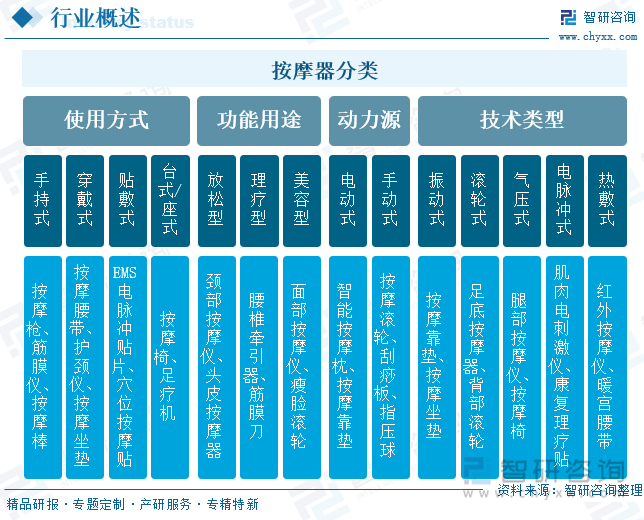
研判2025!中国按摩器行业发展背景、行业产业链、发展现状、竞争格局及发展趋势分析:银发经济与职场健康需求共振,中国按摩器行业迎来黄金发展期[图]
Chan Ye Xin Xi Wang· 2025-07-24 01:10
Core Insights - The massage device industry in China is experiencing significant growth, driven by increasing health awareness and the rising prevalence of spinal diseases among the population, particularly among young adults aged 25-39 [1][6][12] - The market size of the massage device industry is projected to reach 460 billion yuan in 2024, with a year-on-year growth of 9.5%, and is expected to exceed 500 billion yuan by 2025 [1][12] - The small massage device segment, including neck and lumbar massagers, eye massagers, and fascia guns, is particularly strong, with a compound annual growth rate (CAGR) of 9.7% from 2018 to 2024 [1][14] Industry Overview - Massage devices are designed to simulate manual massage techniques through mechanical vibrations, rolling, tapping, or heat application, aiding in muscle relaxation and blood circulation [2] - The industry is characterized by a shift from passive treatment to proactive health management, with modern devices integrating AI and biofeedback technologies [12][22] Development Background - The aging population and the increase in sub-health individuals are long-term drivers for the massage device industry, with over 310 million people aged 60 and above in China by 2024 [4] - The prevalence of lumbar diseases has become a significant public health issue, with over 200 million patients nationwide, particularly affecting the working population [6][8] Market Characteristics - Consumer preferences vary by age group, with younger individuals favoring portable and stylish devices, while older adults prefer simple and safe options [8][9] - The middle-aged demographic is focused on professional therapeutic products for chronic pain management, indicating a diverse market segmentation [8][9] Industry Chain - The massage device industry chain consists of upstream raw material suppliers, midstream manufacturers, and downstream application scenarios and sales channels [10] - The manufacturing sector is highly competitive, with a focus on technological innovation and cost control [10] Competitive Landscape - The industry is dominated by local brands such as Aojiahua, Rongtai Health, and Beiqingsong, which hold over 25% of the market share [18][20] - Competition is shifting from price wars to technological advancements and ecosystem integration, with a focus on enhancing consumer experience [18][20] Future Trends - The industry is moving towards intelligent technology integration, with AI and IoT driving personalized health management solutions [22][23] - There is a growing trend towards multi-scenario applications, with products being used in homes, vehicles, and medical settings [24] - Chinese brands are expanding globally, with exports expected to exceed 12 billion USD in 2024, targeting emerging markets with localized products [25]