联合用药

Search documents
医保执行价腰斩超半,KRAS G12C抑制剂市场开启“贴身肉搏战”
3 6 Ke· 2026-01-22 07:37
Core Insights - The introduction of new pricing for lung cancer drugs, particularly the KRAS G12C inhibitors, has significantly reduced costs for patients, with prices dropping by nearly 70% for some medications [2][4][7] - The 2025 medical insurance directory includes 50 innovative drugs, with nearly half being cancer treatments, highlighting a focus on unmet clinical needs [2] - The competitive landscape for KRAS G12C inhibitors is intensifying, with companies now competing on clinical efficacy and commercial execution rather than just pricing [5][7][8] Pricing and Market Impact - The price of Fluorouracil has decreased from approximately 24,900 yuan to 5,790.4 yuan per box, resulting in a 68.87% reduction [7] - Patients previously faced annual treatment costs of 223,200 yuan, which can now be reduced to approximately 20,845.44 yuan after insurance reimbursement, saving over 200,000 yuan annually [4] - The entry of these drugs into the insurance system is expected to reshape market dynamics and increase competition among pharmaceutical companies [4][8] Competitive Landscape - The KRAS G12C inhibitors market is characterized by three main products: Fluorouracil, Goresir, and Gexoriser, all approved for similar indications, creating a "three-legged" competitive structure [6] - The market for KRAS G12C inhibitors is not overly saturated, with the mutation occurring in about 14% of non-small cell lung cancer cases, and approximately 4.3% in the Chinese population [6] - Companies are focusing on differentiating their products through clinical evidence and effective management of side effects to establish a preferred choice among doctors and patients [7][8] Future Directions - Companies are exploring combination therapies and expanding indications beyond non-small cell lung cancer to other cancers like colorectal and pancreatic cancer, which may significantly increase market potential [13] - The focus on overcoming drug resistance and enhancing efficacy through partnerships and global market strategies is seen as essential for long-term success [13] - The competitive focus is shifting towards who can provide better clinical outcomes and safety profiles, indicating a new phase in the market dynamics for KRAS G12C inhibitors [7][8]


与化疗路上的恶心呕吐说再见
Xin Lang Cai Jing· 2026-01-11 17:16
Core Viewpoint - The article emphasizes the importance of modern antiemetic strategies in managing chemotherapy-induced nausea and vomiting, highlighting the effectiveness of a preventive approach and combination therapy [1][2][3] Group 1: Mechanism of Nausea and Vomiting - Chemotherapy-induced vomiting is primarily triggered by the activation of the brain's vomiting control system, which can occur through damage to the gastrointestinal mucosa or direct stimulation of the brain's chemoreceptor trigger zone by drugs and their metabolites [1] - The severity of nausea and vomiting is categorized into high, medium, and low risk based on the chemotherapy drugs used, which informs the development of prevention strategies [1] Group 2: Antiemetic Strategies - Modern antiemetic strategies utilize a "prevention first, combination therapy" approach, employing agents like ondansetron, dexamethasone, and NK-1 receptor antagonists to manage both acute and delayed vomiting [1][2] - NK-1 antagonists, such as aprepitant, can effectively block the binding of substance P to the NK-1 receptor, significantly improving the complete control rate of delayed vomiting to over 70% for highly emetogenic chemotherapy [2] Group 3: Clinical Recommendations - The "golden triangle" regimen is commonly used for medium to high emetic risk chemotherapy, involving the pre-chemotherapy use of NK-1 antagonists, 5-HT receptor antagonists, and dexamethasone, followed by continued use post-chemotherapy to cover the high-risk period for delayed vomiting [2] - Additional supportive measures, such as a light diet, small frequent meals, and hydration, are recommended to alleviate gastrointestinal burden, alongside the importance of patient communication and adherence to medical advice [2][3]
趋势研判!2025年中国抗痛风药物行业产业链、产业环境、市场规模及未来前景分析:高尿酸血症及痛风发病率持续上升,产业规模总体呈现增长态势[图]
Chan Ye Xin Xi Wang· 2025-06-13 01:19
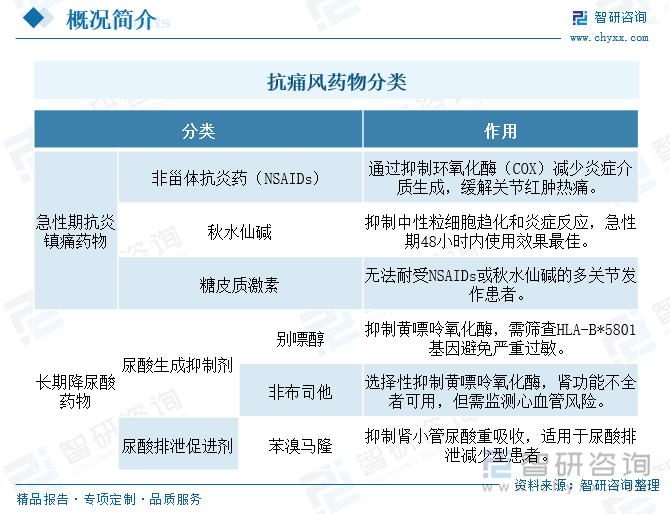
Industry Overview - Gout is a chronic disease caused by purine metabolism disorders, characterized by hyperuricemia and the deposition of urate crystals in joints and tissues, leading to various clinical symptoms [1][2] - The gout medication market in China has grown significantly, with the market size increasing from 700 million yuan in 2015 to 2.2 billion yuan in 2024 [1][10] - The prevalence of hyperuricemia in China is approximately 14%, with a patient population of around 197 million, while gout prevalence ranges from 1% to 3%, affecting approximately 15.5 to 42.29 million people [6][8] Market Dynamics - The gout medication market is primarily driven by the increasing incidence of gout and hyperuricemia due to lifestyle changes and dietary habits [10] - The market is currently experiencing a contraction due to the entry of mainstream gout medications like febuxostat into centralized procurement, but future growth is expected as patient numbers rise [10] - By 2030, the gout medication market in China is projected to exceed 10 billion yuan [10] Product Classification - Gout medications are categorized into acute anti-inflammatory analgesics and long-term urate-lowering drugs, with urate-lowering drugs accounting for about 40% of the global market [2][4] - In the domestic market, traditional drugs like febuxostat and benzbromarone hold a market share of approximately 60% [2] Competitive Landscape - The industry is characterized by intense competition, with generic drugs dominating the market while innovative drugs are rapidly being developed [14] - Major players include Kangyuan Pharmaceutical, Huahai Pharmaceutical, Yipinhong, and Hengrui Medicine, which are focusing on developing new urate-lowering agents to address the limitations of existing medications [14][15] - The introduction of centralized procurement policies has pressured generic drug prices, prompting companies to shift towards high-value innovative drugs [14] Key Companies - Hengrui Medicine is developing a new urate-lowering drug, SHR4640, which has shown significant efficacy and low toxicity, with a market application expected in 2025 [15][18] - Yipinhong is working on AR882, a new urate excretion promoter, which has received FDA support for global clinical trials [15] - Tonghua Dongbao has expanded its product pipeline in the gout treatment area, with two new drugs in clinical trials [16] Development Trends - The industry is shifting from generic to innovative drug development, with URAT1 inhibitors becoming a research focus [20] - Biologics and long-acting therapies are emerging as new growth points, with products like SEL-212 expected to enhance patient compliance and market potential [21] - Personalized treatment and combination therapies are becoming key research directions, aiming to meet unmet clinical needs [22]