脉冲神经网络

Search documents
传统大模型有何局限性?欧洲科学院院士金耀初:能耗比较大且没有自主学习能力
Xin Lang Cai Jing· 2026-01-15 07:13
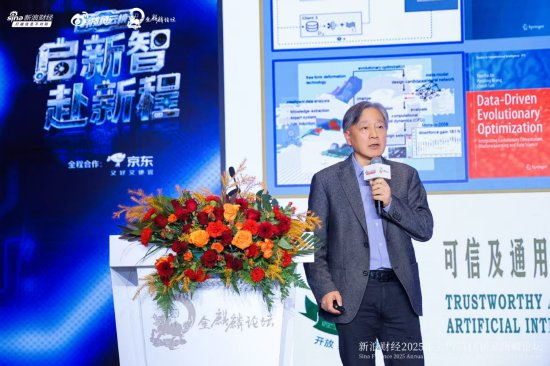
Core Insights - The "2025 Technology Wind List" annual event was held on January 15, 2026, in Beijing, focusing on the theme "Inspiring New Intelligence, Embarking on a New Journey" [1][4] - Jin Yaochu, an academician of the European Academy of Sciences and founder of the Academy of Trustworthy and General Artificial Intelligence at Westlake University, emphasized the importance of safety in embodied intelligence, noting that large models have inherent hallucinations and safety risks [1][4][5] Group 1 - Jin Yaochu discussed the need to integrate pulse-based information processing methods into embodied intelligent systems, which is currently being explored [3][7] - He highlighted the limitations of traditional large models, including high energy consumption and lack of autonomous learning capabilities, contrasting them with pulse neural networks that are event-driven and energy-efficient [3][7] - The integration of brain mechanisms such as plasticity and neural regulation into data-driven and large model-driven approaches is essential for achieving autonomous perception and decision-making [3][7] Group 2 - Jin Yaochu raised concerns about aligning the values of embodied intelligent systems with human values to ensure harmonious coexistence [3][7] - He pointed out that safety becomes increasingly critical when integrating large models into embodied systems, particularly regarding perception, reasoning, and interaction with robots and humans [1][5]

甲骨文:与OpenAI的合作安排“没有延迟”;宇树科技推出人形机器人App Store,用户可下载动作预设丨AIGC日报
创业邦· 2025-12-14 01:08
Group 1 - Oracle denies reports of a delay in the completion of the data center for OpenAI, stating that all contractual milestones are on schedule and agreed upon by both parties [2] - Google introduces Gemini's translation feature into its text translation service and launches a beta version for real-time voice-to-voice translation through headphones [2] - Yuzhu Technology launches a humanoid robot App Store, allowing users to download action presets for complex operations, currently featuring presets like funny actions and dance moves [2] - Tianqiao Brain Science Research Institute establishes the Spiking Intelligence Lab, focusing on brain-like models and spiking neural network research, led by Professor Li Guoqi from the Chinese Academy of Sciences [2]

突破类脑模型性能瓶颈:校正频率偏置实现性能与能效双突破|NeurIPS 2025
量子位· 2025-11-26 06:37
Core Insights - The article discusses the limitations of Spiking Neural Networks (SNNs) and introduces a new architecture called Max-Former that addresses these limitations by enhancing high-frequency information processing [5][24]. Group 1: Performance Limitations of SNNs - SNNs have been traditionally viewed as inferior to Artificial Neural Networks (ANNs) due to their binary pulse transmission, which was believed to cause significant information loss [5][6]. - The research indicates that the real issue lies in the frequency bias of SNNs, where spiking neurons act as low-pass filters, suppressing high-frequency components and favoring low-frequency information [4][8][19]. - This frequency imbalance leads to a degradation in the feature representation capabilities of SNNs, limiting their performance [10][23]. Group 2: Introduction of Max-Former - The Max-Former architecture is designed to counteract the inherent low-frequency preference of SNNs by incorporating two lightweight "frequency-enhancing lenses" [24][28]. - The architecture includes an additional Max-Pool operation in the Patch Embedding stage to actively inject high-frequency signals at the input source [28]. - It also replaces early-stage self-attention with deep convolution (DWC), which retains local high-frequency details while being computationally efficient [28]. Group 3: Performance Metrics and Results - Max-Former achieved a Top-1 accuracy of 82.39% on ImageNet with fewer parameters compared to Spikformer, demonstrating a significant performance improvement [27]. - The architecture also reduced energy consumption by over 30% while achieving performance breakthroughs [30]. - The findings suggest that optimizing SNNs with high-pass operators can lead to improvements in both performance and energy efficiency [31]. Group 4: Broader Implications - The insights gained from the Max-Former architecture are applicable beyond Transformer models, as demonstrated by the Max-ResNet architecture, which also benefited from the addition of high-frequency operations [33]. - The research provides a new perspective on the performance bottlenecks of SNNs, suggesting that their optimization should not merely mimic successful designs from ANNs [35].

专家访谈汇总:黄金再度强势飙涨,加仓还是观望?
阿尔法工场研究院· 2025-05-21 14:48
Group 1: Gold Market Insights - Spot gold prices surpassed $3,300 per ounce for the first time since May 9, driven by rising geopolitical tensions and negative GDP growth in the U.S., which increased safe-haven demand [1] - Domestic gold consumption remains strong, with retail sales of gold and silver jewelry in April up 25.3% year-on-year and 14.7% month-on-month, indicating that domestic demand is independent of international gold price fluctuations [1] - There is a divergence in institutional views on gold; bullish arguments include inflation risks and a potential Fed rate cut, while cautious signals highlight the current high price levels and the possibility of profit-taking due to eased trade tensions [1] Group 2: Solar Industry Impact from Tariffs - The U.S. plans to impose extreme tariffs on Southeast Asian solar equipment, with Cambodia facing a 3,521% tariff due to non-cooperation in investigations, while Malaysia faces only 34% [2] - The U.S. heavily relies on Southeast Asia for solar imports, with 80% of imports coming from four countries, leading to a potential shift in procurement to domestic or third-party manufacturers [2] - U.S. solar project developers are facing increased costs due to these tariffs, which may delay installation progress and create cash flow pressures for EPC companies [2] Group 3: Humanoid Robots Development - The commercialization of humanoid robots depends on their ability to create actual value by addressing real-life challenges, with a long-term development cycle similar to that of autonomous driving, estimated at 10-20 years [3] - The industry is entering an accelerated phase due to supportive policies and the presence of a significant talent pool in the field of embodied intelligence, with a focus on practical applications [3] - Early application scenarios have been validated in sectors like power and chemical inspections, indicating a potential for successful technology-commercialization loops [3] Group 4: AI Agent Development - The AI agent market is rapidly evolving, with diverse technical paths and a focus on expanding application scenarios, although a unified standard has yet to be established [4] - There are significant differences between the North American and Chinese markets, with both targeting enterprise-level markets as a core breakthrough point [4] - Current challenges include high token consumption during interactions and the need for robust computational infrastructure, which remains a key limiting factor for commercial scalability [4] Group 5: Public Fund Regulation Changes - New regulations for public funds are driving a shift in strategy, with a focus on core asset pricing and a potential systemic adjustment in strategy paradigms [5] - The easing of U.S.-China tariffs has improved market risk appetite, with a focus on opportunities in the export chain [5] - Social financing growth is supported by low base effects and monetary policy, although potential impacts from tariff shocks should be monitored [5]