
美联储降息周期

Search documents
——1-2月经济数据点评:经济的开门红成色几何
Changjiang Securities· 2026-03-16 14:41
Economic Performance - In January-February, industrial added value increased by 6.3% year-on-year, exceeding market expectations[6] - Social retail sales grew by 2.8% year-on-year, also surpassing market consensus[6] - Fixed asset investment rose by 1.8% year-on-year, indicating a significant recovery[6] Investment Insights - Private investment saw a year-on-year decline of 2.6%, while public investment increased by 6.8%[9] - Manufacturing investment rebounded to a year-on-year growth of 3.1%, the highest since July of the previous year[9] - Infrastructure investment (including electricity) surged by 11.4%, marking the highest growth since April of the previous year[9] Consumption Trends - The consumption of essential goods showed a notable increase, with a year-on-year growth rate of 7.6%[9] - Restaurant income rose by 4.8% year-on-year, the highest since May of the previous year[9] - Despite overall retail improvement, durable goods consumption showed mixed results, with declines in automotive and communication equipment sales[9] External Factors - Strong external demand remains a key driver of economic performance, particularly in the context of the Federal Reserve's interest rate cuts[3] - Geopolitical tensions may disrupt external demand, necessitating a focus on domestic policy adjustments[3] - The late timing of the Spring Festival contributed to the significant improvement in economic data, warranting cautious optimism about sustainability[3]
供需与宏观基本面共振,把握资源品大时代:资源ETF博时(510410)
Changjiang Securities· 2026-03-05 00:33
1. Report Industry Investment Rating No information about the industry investment rating is provided in the report. 2. Core Viewpoints of the Report - Macro - level factors, including the stabilization and recovery of PPI and abundant global liquidity, form dual core benefits driving the rise of the natural resources index. The resource ETF Bosera (510410), which tracks the Shanghai Securities Natural Resources Index, can effectively capture investment opportunities through balanced allocation in various resource sectors [3][6]. - Different resource sectors have their own favorable factors. For example, gold benefits from central bank strategic gold purchases, rigid supply, and the interest - rate cut cycle; silver is supported by industrial demand and low inventory; lithium and cobalt face supply contraction and demand growth; rare earths are supported by quota control and strategic attributes; coal supply is tightening while demand shows resilience; and crude oil prices are supported by demand recovery and supply control [3][7][8][9]. 3. Summary by Relevant Catalogs 3.1 Natural Resources Industry Fundamental Analysis - **PPI and Global Liquidity**: PPI and global macro - liquidity are important external factors affecting the natural resources index. During the PPI upward phase, resource product prices rise, improving corporate performance and driving the index up. Global liquidity affects commodity prices through multiple channels, and in a period of abundant liquidity, it can push the index higher [16][18]. - **Gold**: In 2026, gold is in a dual resonance period of "long - term credit reshaping" and "medium - term liquidity easing", showing an upward trend. The recent price adjustment is not a signal of a trend reversal. Central bank gold purchases, investment demand, and supply constraints all support the price of gold [23]. - **Silver**: The sharp fluctuations in the silver market are a necessary process from "speculation - driven" to "value re - evaluation". Industrial demand from "photovoltaic + AI" and low inventory levels form a solid price bottom. It is recommended to pay attention to the key support around $75 per ounce [34][35][38]. - **Copper**: Supply - side rigidities, such as mine production limitations and smelter profit compression, make copper prices prone to rise and difficult to fall. The supply in the first half of 2026 is expected to be tighter [44][45]. - **Aluminum**: Domestic and overseas electrolytic aluminum production capacity is restricted, while demand is expected to improve. The industry is in a tight - balance state, and domestic electrolytic aluminum enterprises' profits are expected to expand [52][55][59]. - **Lithium**: The supply - demand fundamentals of the lithium industry have reversed. Supply growth is slowing down, while demand from energy storage and power is increasing. The lithium market is expected to shift from surplus to shortage, and lithium prices are likely to rise [66][73][75]. - **Cobalt**: Congo - Kinshasa's implementation of export quotas will lead to a shortage of cobalt in the next two years. Enterprises with their own cobalt mines will benefit relatively, and the supply uncertainty is increasing [89][95]. - **Nickel**: The nickel industry is currently at the bottom. Although the supply has been increasing, the downward space of nickel prices is limited. With the improvement of macro - demand and the implementation of Indonesian policies, nickel prices may rise [107][108][124]. - **Rare Earths**: Rare earths have significant strategic attributes. Domestic supply control is strengthening, and global trade frictions have increased their strategic value. Prices and valuations are expected to rise [127][135][136]. - **Tungsten**: Tungsten has strong supply rigidities due to resource and policy constraints. The supply is tight, and the price has increased significantly. In the future, new supply may slow down, and tool price increases will support the tungsten price [146][147][156]. - **Coal**: The supply of coal is tightening in the short and long term, while demand shows resilience. The coal price is expected to rise, but the decline in electricity prices may suppress the long - term price center [158][163][173]. - **Oil**: The supply of U.S. shale oil is limited, and OPEC has a strong willingness to cut production to support prices. Global oil demand is expected to continue to recover, and the oil price center is expected to be between $60 - $65 per barrel in 2026 [178][184][195]. 3.2 Shanghai Securities Natural Resources Index - The Shanghai Securities Natural Resources Index selects resource - related securities in Shanghai Stock Exchange. It has a balanced distribution in various resource sub - sectors, which can capture investment opportunities in different resource sectors and reduce risks [201][206]. - Historically, the index's revenue and net profit growth have fluctuated, but it shows strong resilience. Currently, it shows a bottom - reversal trend, and its revenue and net profit growth are expected to recover in 2026 - 2027 [206][207]. - Compared with other broad - based indexes, the Shanghai Securities Natural Resources Index has advantages in different time intervals [213]. 3.3 Bosera Natural Resources ETF (510410) - Bosera Natural Resources ETF closely tracks the Shanghai Securities Natural Resources Index. It uses a full - replication method for passive investment with strict risk - control targets [214]. - As of February 13, 2026, the ETF has achieved good returns and has a scale of 1.057 billion yuan, with good market liquidity. Its fund manager has rich financial experience, and the fund management company has a large asset - management scale [216].




构建商品牛市轮动框架-下一个或是化工
2026-03-01 17:23
Summary of Conference Call Records Industry Overview - The focus is on the commodity market, particularly the chemical sector, within the context of a potential commodity bull market rotation framework [1][2][3]. Key Points and Arguments - **Commodity Bull Market Rotation Framework**: Historical patterns show a rotation sequence of "precious metals → industrial metals → energy and chemicals → agricultural products" during commodity bull markets, typically triggered by liquidity easing and economic recovery [1][2]. - **Current Economic Context**: The U.S. economy is in a phase of monetary easing, weak recovery, and moderate inflation, which usually favors both stocks and commodities. Precious metals are expected to transition to industrial metals, with CPI steepening and significant potential for natural gas, energy, and chemicals to rise [1][6]. - **Chemical Sector Dynamics**: Chemical stocks often lead futures and spot prices, but concerns about "chemical stocks running ahead of fundamentals" need to be contextualized. Some chemical products have not shown universal fundamental support for their price increases [1][7]. - **PPI Analysis**: The Producer Price Index (PPI) is influenced by base effects, and understanding price direction requires a breakdown of PPI's internal structure to identify products with price increase potential. A negative growth convergence of -2% to 0% is anticipated for PPI in 2026 [1][8]. - **Investment Opportunities**: The chemical sector is positioned for potential profit expansion due to a combination of demand-side recovery and supply-side natural clearing, with capital expenditure growth at historically low levels [3][9][11]. Additional Important Insights - **Historical Comparisons**: Past commodity cycles, such as those in 2005 and 2009, exhibited similar patterns of price increases and rotation structures, emphasizing the role of precious and industrial metals in the early stages of recovery [5]. - **Supply-Side Dynamics**: The chemical sector is among those experiencing supply contraction, which is crucial for future price stability and potential profit growth. This is part of a broader trend affecting various industries, including energy metals and general machinery [9][10][11]. - **Policy Impact**: The current policy environment is more moderate compared to previous years, with a focus on natural clearing mechanisms rather than aggressive interventions. This includes capital expenditure reductions and industry consolidation [3][9]. Conclusion - The chemical sector is expected to gain increased attention from capital markets as it aligns with both demand recovery and supply-side constraints. The current economic phase suggests a favorable outlook for commodities, particularly chemicals, as they transition into a more prominent role in the commodity bull market cycle [11].
A股马年开门红,逢低关注“科技+资源品”双主线
British Securities· 2026-02-25 01:27
Market Overview - The A-share market experienced a "red opening" on the first trading day of the Year of the Horse, with the Shanghai Composite Index surpassing the 4100-point mark and the Shenzhen Component Index rising over 1%, setting a positive tone for post-holiday market trends [2][9][10] - Despite the positive opening, there was a notable structural differentiation in market performance, with cyclical sectors like petrochemicals and non-ferrous metals leading gains, influenced by external factors such as the escalating US-Iran situation and internal price increase logic [2][10] Capital Flow and Market Sentiment - The return of capital post-holiday was in line with expectations, significantly boosting market liquidity, as evidenced by a notable increase in trading volume, with total turnover reaching 22,021 billion [6][10] - However, the weak performance of the Hong Kong market has somewhat dampened risk appetite in the A-share market, indicating a cautious overall market sentiment on the first trading day [10][11] Future Market Outlook - The upcoming important meetings are expected to clarify policy directions for the "14th Five-Year Plan," with anticipated policy benefits likely to gradually materialize, suggesting a probable continuation of a fluctuating upward trend in the market [3][9] - Key areas to monitor include the sustainability of price increase logic in cyclical sectors and signs of stabilization in the technology sector following recent corrections [3][9] Investment Strategy - Investors are advised to focus on the dual main lines of "technology + resource products," specifically targeting cyclical sectors benefiting from price increases and geopolitical catalysts, such as petrochemicals and non-ferrous metals [3][9] - Additionally, long-term trends in technology sectors, including AI computing power, semiconductors, and humanoid robots, should be considered for opportunistic investments during any temporary pullbacks [3][9]
避险情绪提振,金价震荡上涨
Mei Ri Jing Ji Xin Wen· 2026-02-24 08:12
Core Viewpoint - The recent fluctuations in gold prices, driven by economic data and geopolitical events, indicate a potential long-term bullish trend for gold as a safe-haven asset amid rising inflation and geopolitical uncertainties [1][4]. Group 1: Economic Data - The U.S. Q4 GDP annualized quarter-on-quarter initial value is 1.4%, below expectations of 2.8% and the previous value of 4.4%, impacted by a 43-day government shutdown [2][3]. - Core PCE for December 2025 rose to 3% year-on-year, higher than expectations and previous values, indicating persistent inflationary pressures [2]. - The U.S. manufacturing PMI fell from 52.4 to 51.2, and the services PMI decreased from 52.7 to 52.3, both below expectations, suggesting a marginal slowdown in economic activity [2]. Group 2: Market Dynamics - The U.S. Supreme Court overturned the IEEPA tariffs, reducing the effective tax rate from 16% to 9%, but former President Trump announced retaliatory measures, raising tariffs back to 15% [3]. - The FOMC meeting minutes revealed a divergence among members regarding interest rate guidance, with some suggesting the possibility of rate hikes if inflation remains above 2% [3]. - The Russian central bank sold 300,000 ounces of gold in January to cover budget deficits, marking the first reduction since October, although the total value of gold reserves increased by 23% to $402.7 billion due to rising gold prices [3]. Group 3: Gold Market Outlook - Gold prices have rebounded to the $5200 level after a period of decline, with expectations of increased volatility due to upcoming options expirations and external factors like a strengthening dollar [4]. - The long-term outlook for gold remains strong, supported by monetary expansion, fiscal deficit monetization, and increasing demand for gold as a safe asset amid global geopolitical tensions [4]. - The combination of a potential Fed rate cut cycle, heightened global uncertainties, and a trend towards de-dollarization is expected to provide long-term support for gold prices [4].
现货黄金盘中冲上5200美元,黄金股票ETF(517400)涨超4%
Sou Hu Cai Jing· 2026-02-24 06:01
Group 1 - The core viewpoint of the article highlights the significant rise in spot gold prices, which reached $5200 per ounce, driven by geopolitical tensions between the U.S. and Iran, and the subsequent impact on precious metals and oil prices [1] - The article notes that the ongoing negotiations between the U.S. and Iran have not reached a resolution, leading to a deterioration in the situation and a continuous increase in the price of London gold [1] - The long-term trend for gold remains strong, supported by factors such as monetary expansion, fiscal deficit monetization, and increasing demand for gold as a safe asset amid global geopolitical instability [1] Group 2 - The article emphasizes the potential for continued upward momentum in precious metals, industrial metals, and crude oil, driven by the pricing logic in the commodity market [1] - It suggests that the trend of "de-dollarization" globally may position gold as a new pricing anchor, enhancing its appeal as a reserve asset [1] - The combination of a Federal Reserve interest rate cut cycle, increased overseas uncertainties, and the global trend of de-dollarization continues to support gold prices [1]
春节期间金价震荡走高,黄金ETF国泰(518800)、黄金股票ETF(517400)大涨
Sou Hu Cai Jing· 2026-02-24 02:13
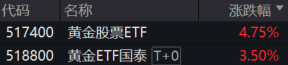
Group 1 - Gold prices have strongly broken through the $5200 per ounce mark, driven by two main catalysts: Trump's increase of global import tariffs to 15% and escalating tensions between the U.S. and Iran [1][3] - The increase in tariffs has raised inflation expectations and heightened concerns over U.S. fiscal discipline and the credibility of the dollar, leading to a weaker dollar index and a surge in gold prices [3][6] - The geopolitical situation in the Middle East is at a critical point, with the U.S. considering limited military strikes against Iran, which adds to market risk premiums [3][8] Group 2 - The recent performance of gold is a typical case of macro narratives resonating with short-term events, particularly the impact of tariff policies and geopolitical tensions [3] - The market has seen a significant increase in gold-related ETFs, with the Gold Stock ETF (517400) rising by 4.75% and the Gold ETF (518800) increasing by 3.50% [2] - Historical patterns suggest that after confirming a mid-term bottom, gold often experiences a new upward trend during periods of declining volatility [5][11] Group 3 - The long-term investment logic for gold remains strong, supported by three core pillars: the Federal Reserve's interest rate cut cycle, global de-dollarization, and ongoing geopolitical risks [7][12] - Central banks, including the People's Bank of China, have been increasing their gold reserves, indicating a strategic shift in asset allocation [7][12] - The demand for gold as a safe-haven asset is expected to rise due to ongoing geopolitical uncertainties and the challenges facing the dollar credit system [12] Group 4 - Investors are encouraged to consider both gold ETFs and gold stock ETFs, with the latter offering higher earnings elasticity during rising gold price phases [9][10] - The current valuation of gold stocks remains within a historically reasonable range, suggesting potential for performance and valuation recovery as gold prices rise [10][11] - The market is witnessing a shift from "precious metals" to "precious metal equity assets," highlighting the growing appeal of gold stocks in a recovering risk appetite environment [10]

黄金上行趋势未完待续,资金抢筹布局,黄金ETF国泰(518800)近20日资金净流入超80亿元
Mei Ri Jing Ji Xin Wen· 2026-02-12 02:10
Group 1 - The end of the precious metals bull market typically requires a significant narrative logic reversal, but the long-term trends supporting gold, such as the Federal Reserve's interest rate cuts, de-globalization, global de-dollarization, and central bank gold purchases, remain intact [1] - Historical data indicates that after reaching a peak, gold prices often experience a rapid decline, followed by substantial gains, suggesting that current gold prices may have established a mid-term low [1] - The long-term trend for gold remains strong, driven by challenges to the dollar credit system due to excessive money supply and fiscal deficit monetization, alongside increasing demand for gold as a safe asset amid global geopolitical instability [1] Group 2 - The ongoing trend of global de-dollarization positions gold as a potential new pricing anchor, providing upward momentum for precious metals [1] - The combination of the Federal Reserve's interest rate cut cycle, increasing overseas uncertainties, and the global de-dollarization trend continues to support gold prices [1] - Investors are encouraged to consider investment opportunities in gold ETFs, such as the Cathay Gold ETF (518800) and gold stock ETFs (517400) [1]
黄金大消息!又一国有大行宣布,上调起购金额
Zhong Guo Ji Jin Bao· 2026-02-11 22:38
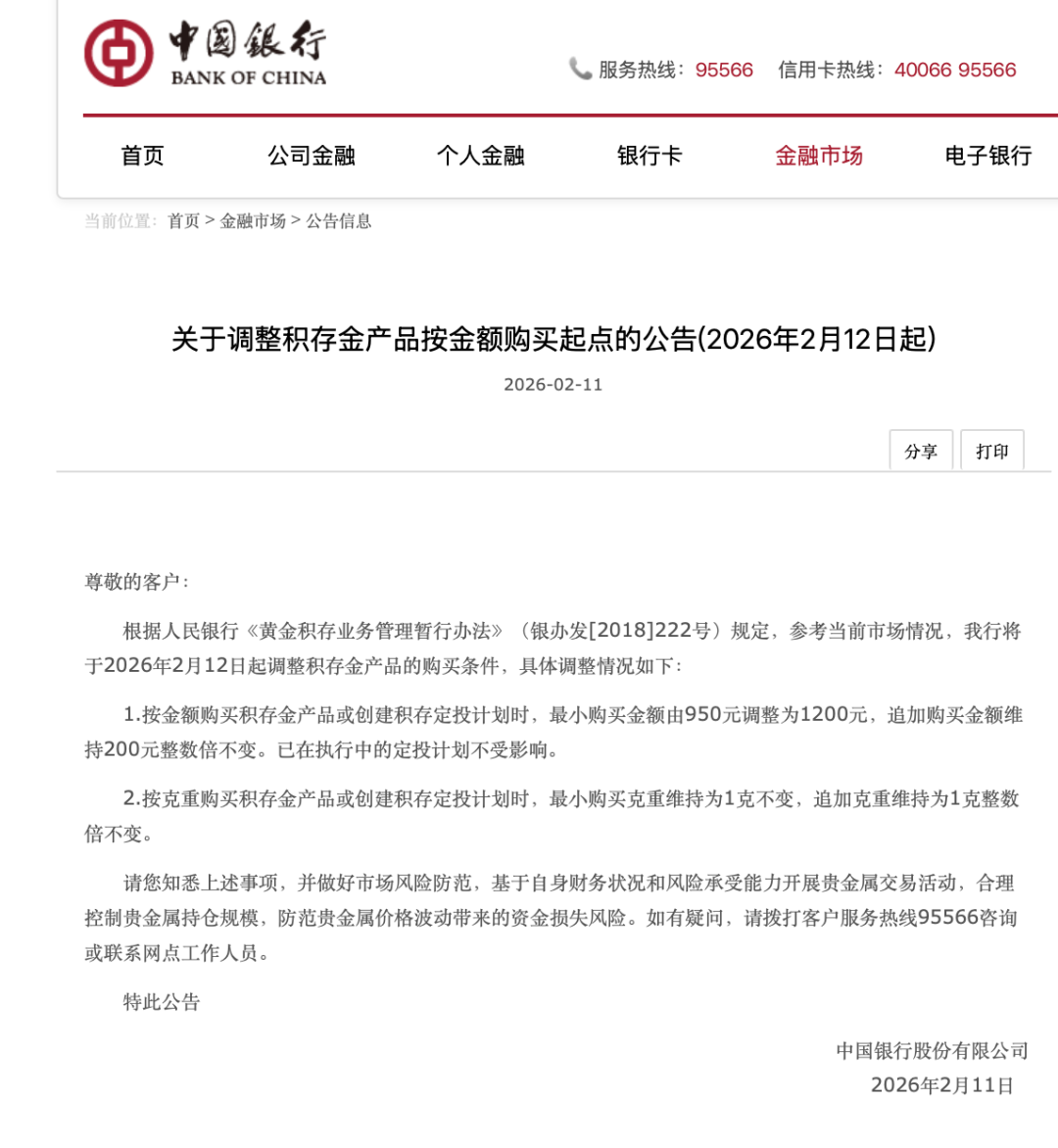
Group 1 - The core point of the article is that China Bank has adjusted the minimum purchase amount for its accumulation gold products from 950 yuan to 1200 yuan, effective February 12, 2026 [1][2] - The adjustment in purchase conditions includes maintaining the additional purchase amount at 200 yuan and keeping the minimum weight for purchasing gold at 1 gram unchanged [2] - This change follows a trend among several banks, including Industrial and Commercial Bank of China and Agricultural Bank of China, which have also raised their minimum purchase amounts for accumulation gold products in early 2026 [5] Group 2 - In 2025, China Bank raised the minimum purchase amount for accumulation gold products four times, starting from 650 yuan in February and reaching 950 yuan by October [4] - The overall trend in the banking industry shows a tightening of access to accumulation gold business, with banks responding to regulatory requirements and market conditions to protect investors from irrational short-term trading [5] - The gold prices have shown significant volatility, with recent trends indicating a rebound above 5000 USD per ounce, which may influence banks' strategies regarding gold accumulation products [6][9]
金价震荡反弹,长期仍存支撑,黄金股票ETF(517400)收涨超2.6%
Sou Hu Cai Jing· 2026-02-11 10:39
Core Viewpoint - Gold prices are experiencing a rebound, with long-term support expected, as historical patterns suggest a significant new upward trend may follow after current fluctuations [1] Group 1: Market Trends - Gold stocks ETF (517400) rose over 2.6% on February 11 [1] - Historical analysis indicates that major shifts in gold bull markets often require significant narrative reversals, such as the end of the oil embargo in the 1970s and the transition from inflation to deflation post-2008 [1] Group 2: Long-term Support Factors - Current factors supporting gold prices include the Federal Reserve's interest rate cuts, rising global uncertainties, and the trend of de-dollarization [1] - The demand for gold as a safe asset is increasing due to frequent global geopolitical tensions and challenges to the dollar credit system amid excessive money supply and fiscal deficit monetization [1] Group 3: Investment Opportunities - Investors are encouraged to monitor investment opportunities in gold ETFs, specifically Cathay Gold ETF (518800) and gold stocks ETF (517400) [1]