
自主审核单位

Search documents
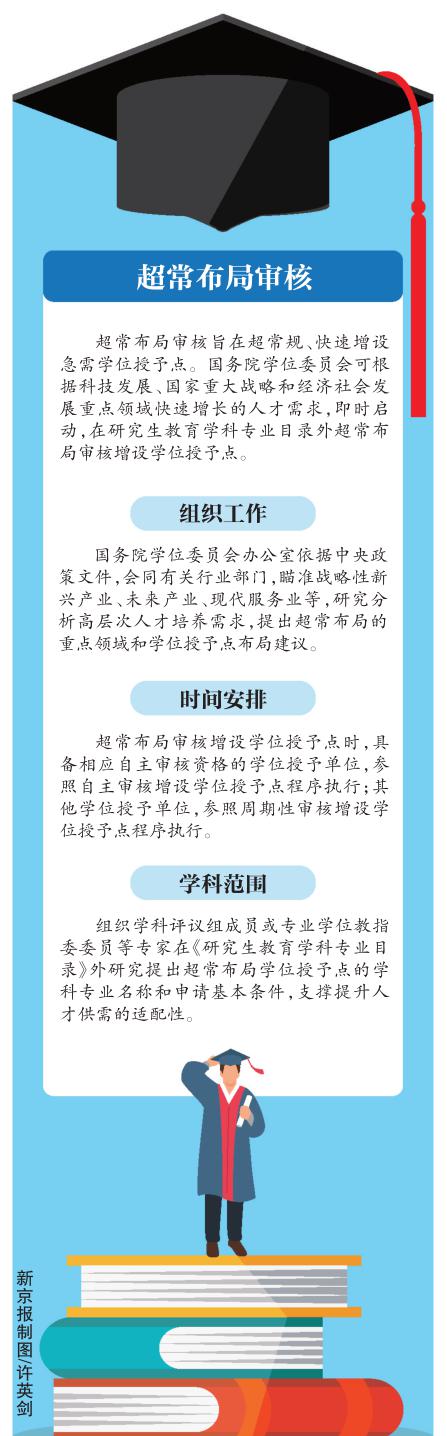
学位授予资格超常布局审核机制建立
Xin Lang Cai Jing· 2025-12-28 17:20
Core Points - The State Council Academic Degree Committee issued the "Measures for the Review of Doctoral and Master's Degree Granting Qualifications," establishing a new mechanism for extraordinary layout review to address the time limitations of previous review processes [1][12] Group 1: Strategic Demand Orientation - The revised measures emphasize three guiding aspects: strategic demand, reform and decentralization, and quality standards [5] - The focus on strategic demand aims to enhance the degree granting qualification review system to better align with national strategic needs and technological development [5][7] - The measures allow for dynamic adjustments in degree programs by local governments and universities, promoting a more responsive educational structure [5][9] Group 2: Extraordinary Layout Review Mechanism - The new review measures include four types of qualification reviews: periodic review, dynamic adjustment, self-review, and extraordinary layout review [6] - The extraordinary layout review will be initiated based on immediate needs, allowing for rapid establishment of degree granting points in response to urgent talent demands [7][10] Group 3: Self-Review Units - Self-review units are categorized into master's and doctoral self-review units, allowing universities to autonomously establish new degree granting points based on demand [8][9] - Since 2017, 38 universities have been approved as self-review units, resulting in the establishment of 441 doctoral and 454 master's degree points [8][9] Group 4: Quality Assurance Mechanisms - The measures include a mechanism for re-evaluating newly established degree granting units to ensure compliance with quality standards [10][11] - The State Council Academic Degree Committee will conduct evaluations every three years to monitor the quality of self-review units and their degree granting points [11][12]

《博士硕士学位授予资格审核办法》印发,相关解读来了
Xin Hua Wang· 2025-12-25 23:32
Core Viewpoint - The State Council Academic Degree Committee has issued the "Measures for the Review of Doctoral and Master's Degree Granting Qualifications," aimed at enhancing the quality of degree granting and graduate education through a more flexible and responsive review process [2][5]. Group 1: Background and Purpose - The revision of the "Measures" is driven by the need to align with national strategic demands and optimize the structure of academic disciplines and professional settings in higher education [4][5]. - The document serves as a crucial basis for the review of degree granting qualifications, which has been a key focus since the implementation of the "Degree Regulations of the People's Republic of China" in 1980 [4][5]. Group 2: Key Directives of the Revised Measures - The revised "Measures" emphasize three main directives: 1. Strategic demand orientation, focusing on serving technological development and national strategic needs [6]. 2. Reform and decentralization, expanding the autonomy of local governments and universities in setting academic disciplines [6]. 3. Quality standards, ensuring strict adherence to quality control in the review process and the establishment of degree granting points [6][12]. Group 3: Implementation of Extraordinary Layout Review - The extraordinary layout review mechanism is designed to respond quickly to the growing demand for high-level talent in key sectors, allowing for the rapid establishment of new degree granting points [7][8]. - Pilot programs have already been initiated, such as the establishment of degree granting points in low-altitude technology and engineering, reflecting the urgent needs of emerging industries [7][8]. Group 4: Expansion of Autonomous Review Units - The State Council Academic Degree Committee has approved 38 universities as autonomous review units since 2017, allowing them to independently review and establish new degree granting points [9][10]. - A total of 441 doctoral and 454 master's degree points have been added through this autonomous review process, focusing on critical fields such as integrated circuits, artificial intelligence, and biomedicine [9][10]. Group 5: Role of Provincial Degree Committees - Provincial degree committees are tasked with optimizing the academic discipline layout based on regional economic and social development needs, ensuring that degree granting points align with local demands [11]. - They are also responsible for the dynamic adjustment of degree granting points, guiding institutions to withdraw underperforming programs and enhance those that meet urgent local needs [11]. Group 6: Quality Assurance Measures - Quality assurance is highlighted as a critical aspect of the degree granting qualification review process, with strict standards and procedures to be followed [12]. - The State Council Academic Degree Committee will conduct evaluations every three years to monitor the quality of autonomous review units and their degree granting points, with the authority to suspend or revoke qualifications if necessary [12].

教育部就《博士硕士学位授予资格审核办法》答记者问
Yang Shi Wang· 2025-12-25 06:33
Core Viewpoint - The newly revised "Measures for the Review of Doctoral and Master's Degree Granting Qualifications" aims to optimize graduate education and discipline settings in response to national strategic needs and technological development [2][3]. Group 1: Background and Purpose of the Revision - The revision of the "Measures" is driven by the central government's emphasis on graduate education and discipline optimization, serving as a key mechanism for high-level talent cultivation [2]. - Since the implementation of the "Degree Regulations" in 1980, the State Council Degree Committee has conducted 14 rounds of degree granting qualification reviews, leading to an increase in doctoral and master's degree granting institutions [2]. - The revision aligns with the requirements of the "Degree Law," which will be implemented in January 2025, necessitating updates to the management and quality assurance of degree granting qualifications [3]. Group 2: Key Directives of the Revision - The revision emphasizes three main directives: 1. Strategic demand, focusing on serving technological development and national strategic needs [4]. 2. Reform and decentralization, expanding the autonomy of local governments and universities in discipline settings [4]. 3. Quality standards, ensuring strict adherence to quality control and regulatory processes in degree granting qualifications [4]. Group 3: Implementation of Extraordinary Layout Review - The extraordinary layout review mechanism is designed to quickly establish degree granting points in response to urgent national needs, particularly in emerging fields [5][6]. - A pilot program has been initiated for low-altitude technology and engineering, with 24 universities authorized to establish related degree granting points [5]. Group 4: Expansion of Autonomous Review Units - Since 2017, 38 universities have been approved as autonomous review units, allowing them to independently review and establish new degree granting points [7][8]. - A total of 441 doctoral and 454 master's degree points have been added through this autonomous review process, focusing on key areas such as integrated circuits and artificial intelligence [8]. Group 5: Role of Provincial Degree Committees - Provincial degree committees are tasked with optimizing local discipline settings and ensuring alignment with regional economic needs [9]. - They are responsible for dynamically adjusting degree granting points and ensuring quality control in the review process [9]. Group 6: Quality Assurance Measures - Quality assurance is critical, with strict standards and procedures established for the review process [10]. - Regular evaluations of autonomous review units will be conducted to ensure compliance with quality standards, with potential penalties for non-compliance [10].
教育部学位管理与研究生教育司负责人就《博士硕士学位授予资格审核办法》答记者问
Xin Lang Cai Jing· 2025-12-25 06:05
Core Viewpoint - The newly revised "Measures for the Review of Doctoral and Master's Degree Granting Qualifications" aims to optimize graduate education and discipline settings in response to national strategic needs and technological development [2][3]. Group 1: Background of the Revision - The revision is driven by the central government's emphasis on graduate education and discipline optimization, with the State Council's Degree Committee having conducted 14 rounds of degree granting qualification reviews since 1980 [2]. - As of now, there are 504 doctoral degree granting institutions and 863 master's degree granting institutions in China, reflecting an ongoing optimization of discipline structures and enhancement of high-level talent cultivation capabilities [2]. Group 2: Key Directives of the Revision - The revision emphasizes three main directives: 1. Strategic Demand: Aligning degree granting qualifications with national strategic needs and enhancing talent supply-demand adaptability [4]. 2. Reform and Decentralization: Expanding the autonomy of local governments and universities in discipline settings, allowing for dynamic adjustments [4]. 3. Quality Standards: Establishing strict quality standards and regulatory mechanisms to ensure orderly and standardized review processes [4]. Group 3: Implementation of Extraordinary Layout Review - The extraordinary layout review mechanism is designed to quickly establish degree granting points in response to urgent national needs, such as the recent pilot for low-altitude technology and engineering [5][6]. - The State Council's Degree Committee will refine this mechanism based on pilot experiences, focusing on strategic emerging industries and enhancing adaptability in discipline settings [6]. Group 4: Expansion of Autonomous Review Units - Since 2017, 38 universities have been approved as autonomous review units, which can independently conduct reviews for new degree granting points [7][8]. - A total of 441 doctoral points and 454 master's points have been added through this autonomous review process, with a focus on key areas like integrated circuits and artificial intelligence [8]. Group 5: Role of Provincial Degree Committees - Provincial degree committees are tasked with optimizing local discipline settings and ensuring that degree granting points align with regional economic needs [9]. - They are responsible for dynamically adjusting degree granting points and maintaining quality standards in the review process [9]. Group 6: Quality Assurance Measures - Quality assurance is critical, with strict adherence to review procedures and conditions to ensure high standards in degree granting qualifications [10]. - The State Council's Degree Committee will conduct evaluations every three years and monitor the quality of newly established degree granting points [10].