自愿性信息披露

Search documents
视界 | 基于中国公司治理分类评价的几点思考
Sou Hu Cai Jing· 2026-02-19 06:47
Core Viewpoint - The core of improving the modern enterprise system with Chinese characteristics is corporate governance, which is also essential for building world-class enterprises. The latest report indicates an overall improvement in corporate governance, with specific indices related to minority investor protection, board governance, entrepreneurial capability, and financial governance showing upward trends. However, there are declines in voluntary information disclosure and executive compensation indices, reflecting economic pressures on corporate performance [1]. Group 1: Corporate Governance Indices - The report highlights an upward trend in indices related to minority investor rights protection, board governance, entrepreneurial capability, and financial governance, indicating positive changes in corporate governance [1]. - The voluntary information disclosure index has decreased, suggesting a need for improvement in transparency [1]. - The executive compensation index has also declined, indicating a mismatch between executive pay and their contributions, likely due to economic pressures affecting corporate performance [1]. Group 2: Strengthening Shareholder Rights - To effectively strengthen constraints on major shareholders and protect minority shareholder rights, three key issues need to be addressed: the excessive control of major shareholders, the need for legislative reforms to increase the cost of infringement, and the adoption of principles from the G20/OECD to ensure effective remedies for all shareholders [2]. Group 3: Mixed Ownership and Governance Structure - The development of mixed ownership and enhancing investor confidence could involve allowing the general manager to also serve as the party secretary, with independent or external directors as chairpersons. This structure aims to improve board independence and decision-making effectiveness [3]. - The independence of the board is crucial for representing all shareholders and enhancing confidence from social and foreign capital [3]. - Company charters should clarify the checks and balances among governance bodies to avoid administrative dominance and ensure effective corporate governance [3].
从“强制披露”到“主动沟通”,上市公司投关管理嬗变
2 1 Shi Ji Jing Ji Bao Dao· 2025-05-15 14:08
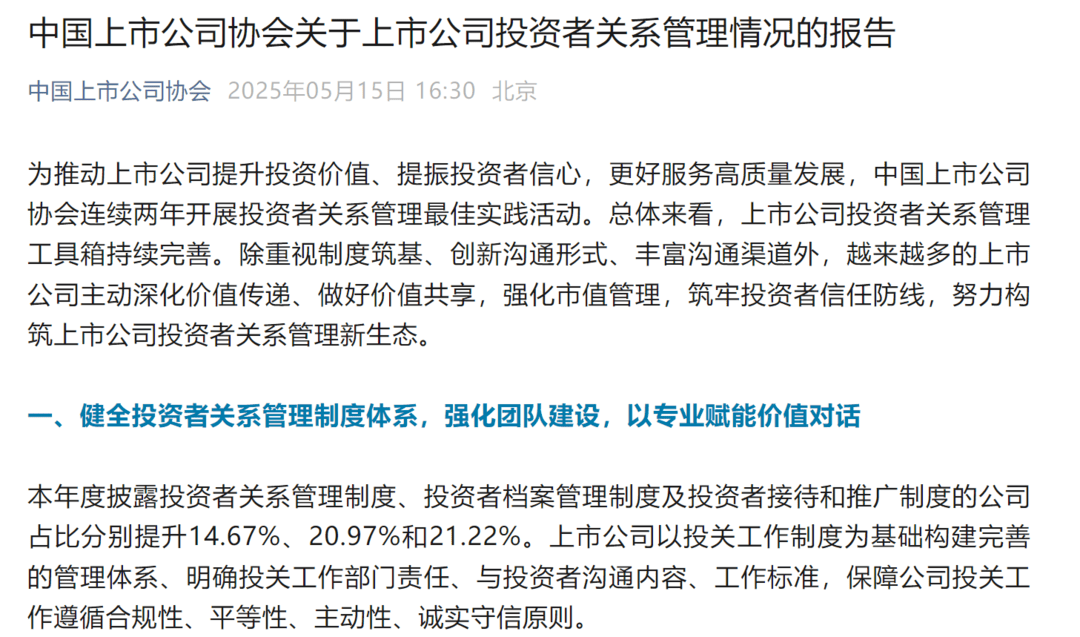
Core Viewpoint - The management of investor relations (IRM) in listed companies is transitioning from compliance-oriented to value co-creation, driven by the need to enhance investment value and investor confidence in the context of capital market reforms [1][11]. Group 1: Investor Relations Management Practices - The China Listed Companies Association (CLCA) has been promoting best practices in investor relations management for two consecutive years, leading to double-digit growth in key indicators such as institutional construction, digital communication, and voluntary disclosure in 2024 [1]. - The proportion of companies disclosing investor relations management systems, investor file management systems, and investor reception and promotion systems has increased by 14.67%, 20.97%, and 21.22% respectively, indicating a growing recognition of the importance of institutional construction [2]. - The percentage of companies providing equal treatment and convenience for retail investors has risen significantly to 26.58%, reflecting an increased emphasis on investor protection [2]. Group 2: Professional Talent Development - Companies are focusing on building a professional investor relations team with a strong knowledge base in corporate governance, financial accounting, and relevant laws and regulations [2]. - A diversified training system is being established to enhance the team's understanding of macroeconomic conditions, regulatory policies, and best practices, ensuring comprehensive support for investors [2]. Group 3: Enhancements in Earnings Presentation - The "value transmission" aspect of earnings presentations is gaining importance, with attendance rates for company executives at these meetings reaching 98.5% in 2024, indicating a shift towards more open communication with investors [3]. - Companies are actively breaking down communication barriers, using earnings presentations as a key platform for direct engagement with retail investors [3]. Group 4: Data-Driven Investor Services - Companies are utilizing multi-dimensional data integration and intelligent analysis to create a comprehensive investor service system, enhancing the precision and effectiveness of investor communications [4]. - The use of new media channels has exceeded 70%, highlighting the growing role of platforms like WeChat, Weibo, and short video platforms in investor relations management [4]. Group 5: Voluntary Disclosure Trends - There is a notable shift from mandatory to voluntary disclosure among listed companies, with nearly one-third of companies increasing their willingness to disclose information voluntarily [6]. - This trend is seen as a key indicator of high-quality market development, aimed at reducing information asymmetry and enhancing market transparency [6]. Group 6: Systematic Value Management - Companies are systematically constructing value management frameworks, including regular meetings to track market dynamics and incorporating value management into performance assessments [10]. - Tools such as cash dividends, special dividends, equity incentives, and employee stock ownership plans are becoming important for value management [10]. Group 7: Importance of Investor Relations - Investor relations management is recognized as a cornerstone for high-quality development, essential for companies to adapt to external economic uncertainties [11]. - The CLCA aims to facilitate deep communication and positive interaction between listed companies and investors, contributing to the stability and vitality of the capital market [11].
中上协这份年度报告显示:筑牢投资者信任,越来越多上市公司在行动
Sou Hu Cai Jing· 2025-05-15 11:36
Core Viewpoint - The report from the China Listed Companies Association indicates that listed companies are increasingly enhancing their investor relations management, focusing on value transmission and trust-building with investors [1] Group 1: Improvement of Investor Relations Management - The proportion of companies disclosing investor relations management systems, investor file management systems, and investor reception and promotion systems has increased by 14.67%, 20.97%, and 21.22% respectively [4] - The percentage of companies providing convenience and equal treatment for small investors has significantly risen to 26.58% [4] - Companies are emphasizing the development of professional investor relations teams, requiring personnel to have a solid knowledge structure in corporate governance, financial accounting, and relevant laws and regulations [4] Group 2: Utilization of New Media Channels - Over 70% of listed companies are actively adapting to digital communication trends by building a new media communication matrix centered around WeChat, Weibo, and short video platforms [5] - Companies are inviting shareholders to engage through cloud exhibitions and product tasting days, enhancing face-to-face communication with investors [5] - The attendance rate of chairpersons and general managers at annual report performance briefings has reached 98.5%, with independent directors' attendance exceeding 80% [5] Group 3: Voluntary Information Disclosure - Listed companies are strengthening voluntary information disclosure, with nearly one-third of companies expanding the breadth and depth of their disclosures [6] - Companies are improving their public opinion management systems by optimizing organizational structures and standardizing monitoring processes [6] - Many companies have elevated public opinion management to a top-level initiative, establishing comprehensive management systems [6] Group 4: Building Investor Trust - Companies are systematically constructing value management systems by forming efficient value management teams and establishing regular working mechanisms [7] - Management regularly holds value management meetings to track market dynamics and accurately grasp value trends [7] - Cash dividends, special dividends, equity incentives, employee stock ownership plans, and mergers and acquisitions are becoming important tools for value management, enhancing market confidence and solidifying investor trust [7]