航天技术突破

Search documents
星际航行学院,是科幻照进现实吗
21世纪经济报道· 2026-01-29 13:48
Core Viewpoint - The establishment of China's first interstellar navigation academy on January 27 marks a significant step in national strategy and indicates a burgeoning future industry in space exploration [1] Group 1: Academy Overview - The academy is directly supported by the Chinese Academy of Sciences and its five major aerospace research institutes, providing students access to national-level experimental platforms [1] - The faculty includes six academicians and over 30 national-level leading talents, with the first president being a top expert in aerospace engines [2] - The academy has substantial research funding, with individual projects potentially receiving up to 100 million yuan, and matching funds from the National University of Science and Technology [2] Group 2: Strategic Importance - The next 10 to 20 years are viewed as a "golden window period" for China's deep space exploration, indicating a critical point for technological accumulation and talent preparation [2] - The academy aims to establish three "high grounds": a foundation for basic research, a hub for innovative talent, and an international academic influence [2] Group 3: Broader Implications - Major breakthroughs in space technology will eventually impact everyday life, similar to how the Apollo program led to advancements in integrated circuits and materials [3] - China's investment in interstellar navigation is expected to stimulate high-end manufacturing, new materials, artificial intelligence, and precision instruments in the short term, while also preparing for core technological capabilities for the next 50 to 100 years [4]


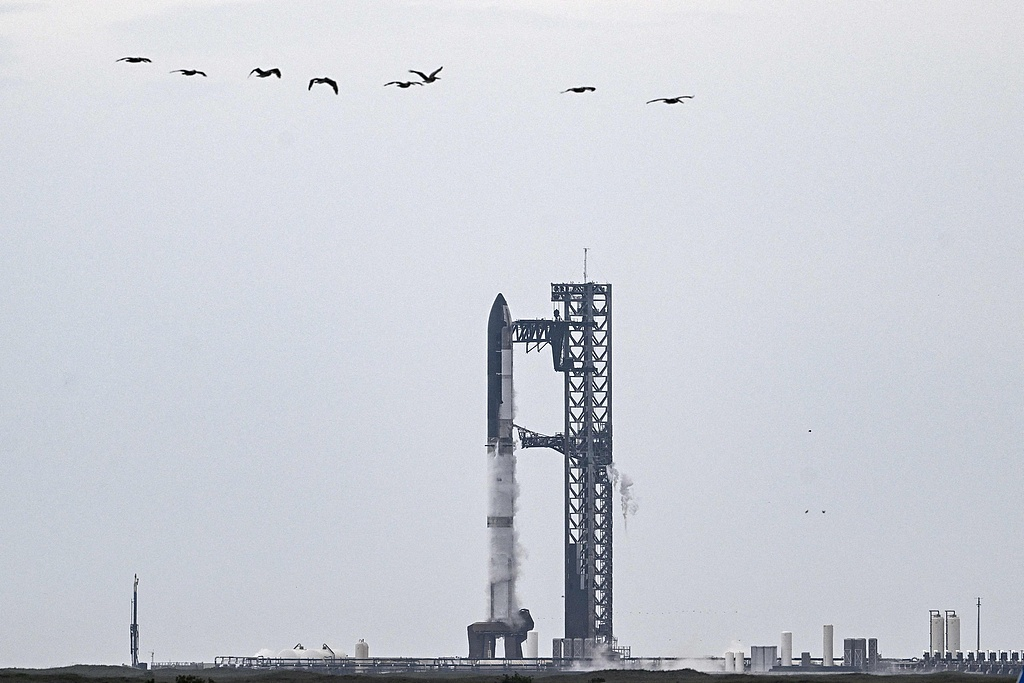
一波三折,“星舰”完成第十飞,马斯克发帖回应
Huan Qiu Shi Bao· 2025-08-27 22:53
Core Viewpoint - SpaceX's Starship successfully completed its tenth test flight, marking a significant breakthrough after a series of previous failures, and demonstrating key technological advancements in space exploration [1][3][4] Group 1: Test Flight Achievements - The Starship's first successful orbital test flight was completed, achieving all testing objectives, including a successful soft landing in the Indian Ocean [1][3] - The Super Heavy booster successfully splashed down in the Gulf of Mexico, validating recovery technology and redundancy design through a simulated engine failure [3][4] - The Starship deployed eight simulated satellites during the flight, showcasing its capability for batch satellite launches [3][4] Group 2: Implications for Future Missions - The successful test flight enhances confidence in NASA's plans for crewed lunar missions, indicating a potential boost in launch efficiency for Starlink satellite deployments [4] - The success of the Starship is seen as a signal of the United States maintaining its leadership in space exploration and technology, which is crucial for future competitive positioning in the aerospace industry [4]