航线扩张

Search documents
国联民生证券:国内客座率涨幅扩大 看好国际航线2026年继续扩张
Zhi Tong Cai Jing· 2026-01-23 06:20
Core Viewpoint - The report from Guolian Minsheng Securities indicates a sustained tight supply-demand relationship in domestic routes, with expectations for moderate price increases in 2026 due to regulatory measures aimed at addressing low ticket prices. The international routes are anticipated to benefit from inbound tourism, leading to a gradual recovery in both volume and pricing by 2026 [1] Group 1: Supply and Demand Dynamics - In December, the demand growth rate for the entire industry continued to exceed supply, with domestic passenger load factors increasing and international load factors showing a slight decline [1] - The combined ASK/RPK for six listed airlines in December showed a year-on-year increase of +6.6% and +9.1%, respectively, indicating a robust demand environment [1] - Domestic routes maintained low supply growth in December, with ASK/RPK increasing by +4.2% and +7.2%, achieving a passenger load factor of 85.7%, which is the highest level recorded for December [1] Group 2: Pricing Trends - December saw a slight year-on-year increase in domestic ticket prices, while international ticket prices experienced a decline [2] - The industry aircraft utilization rate remained high at 7.6 hours in December, with a slight decrease of -0.1% year-on-year, while wide-body aircraft utilization increased by +3.2% [2] - Domestic economy class ticket prices, including fuel surcharges, showed a year-on-year increase of +0.1%, while international ticket prices fell by -11.6% [2] Group 3: Fleet Expansion - The fleet of the six airlines grew by 0.4% month-on-month in December, with a total of 3,386 aircraft managed, reflecting a cumulative growth of +4.0% compared to the end of 2024 [3] - The majority of new aircraft deliveries were narrow-body models, particularly the A320 series, with 24 new narrow-body aircraft introduced in December [3]

三大航减亏折返跑:南航亏损面继续扩大
Bei Jing Shang Bao· 2025-07-15 03:53
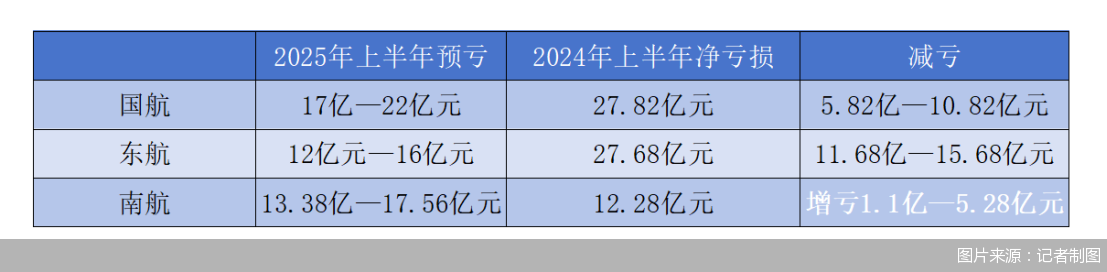
Core Viewpoint - The three major airlines in China reported significant losses for the first half of 2025, with noticeable performance differentiation among them. While Air China and China Eastern Airlines managed to reduce their losses, China Southern Airlines faced an increase in losses due to various challenges, including slow recovery of international routes and competitive disadvantages [1][3]. Group 1: Financial Performance - Air China is expected to report a net loss of 17 billion to 22 billion yuan, a reduction of 5.82 billion to 10.82 billion yuan compared to the previous year [2][3]. - China Eastern Airlines anticipates a net loss of 12 billion to 16 billion yuan, reducing losses by 11.68 billion to 15.68 billion yuan year-on-year [2][3]. - China Southern Airlines, however, is projected to incur a net loss of 11.68 billion to 15.68 billion yuan, an increase in losses by 1.1 billion to 5.28 billion yuan compared to the previous year [2][3]. Group 2: Market Conditions - The domestic passenger market is showing signs of steady recovery, but factors such as declining ticket prices and competition from high-speed rail continue to pressure airline revenues [1][6]. - The average ticket price for domestic economy class in the first half of 2025 was 740 yuan, a decrease of 6.9% year-on-year [6][7]. - The competitive landscape is shifting, with high-speed rail increasingly attracting high-end travelers away from airlines, while discounted airfares are drawing ordinary travelers to aviation [7][9]. Group 3: Operational Strategies - The three major airlines are focusing on expanding their routes in 2025, with Air China emphasizing the importance of both domestic and international route growth for profitability [5][10]. - Air China and China Eastern Airlines reported increases in passenger capacity and turnover, with Air China's capacity up by 3.5% and passenger turnover up by 5.5% in the first five months of the year [5][10]. - China Southern Airlines is also working to enhance its business travel market and international routes to mitigate its geographical disadvantages [10][13]. Group 4: Challenges and Outlook - China Southern Airlines faces significant operational challenges due to its geographical position, which has hindered the recovery of its international routes and increased competition in the domestic market [10][12]. - The airline's performance is further impacted by structural changes in passenger demographics and external factors such as international uncertainties and supply chain disruptions [10][12]. - As the critical summer travel season begins, all three airlines must navigate the dual challenges of revenue management and capacity allocation to improve their financial standings [1][13].