芯片替代

Search documents
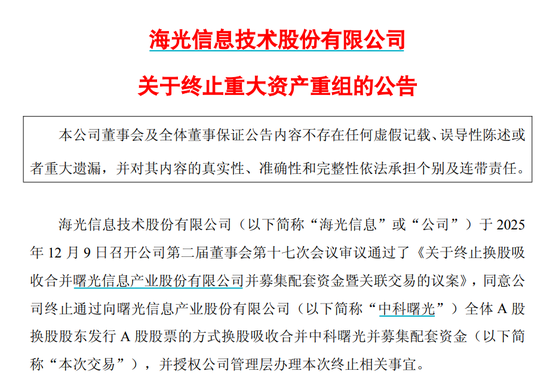
合并落空,45万股民无眠!中科、海光股民齐呼利好!机构:对海光没影响
Xin Lang Cai Jing· 2025-12-09 23:21
Core Viewpoint - The merger between Haiguang Information and Zhongke Shuguang has been terminated due to changes in market conditions and the complexity of the transaction, which has led to concerns among shareholders of both companies [1][3][7]. Group 1: Merger Details - The merger was initiated in May and announced in June, with Haiguang Information planning to absorb Zhongke Shuguang through a share exchange ratio of 0.5525:1 [3][10]. - Haiguang Information specializes in high-end processor design, focusing on general computing and AI computing markets, with products including CPUs and DCUs [3][10]. - Zhongke Shuguang is involved in high-end computer, storage, and data center product development, and has been expanding its digital infrastructure and intelligent computing businesses [3][10]. Group 2: Market Reactions - Prior to the merger announcement, Haiguang Information had a market capitalization of 315.8 billion, while Zhongke Shuguang was approximately 90.3 billion; post-announcement, their market caps rose to 509.7 billion and 146.5 billion respectively, with both stocks increasing over 60% [4][11]. - Following the merger announcement, Zhongke Shuguang's stock hit the daily limit up, while Haiguang Information rose by 4.3%, but Haiguang's stock later fell by 4.5%, returning to pre-announcement levels [4][11]. - Shareholders expressed mixed feelings, with some viewing the termination as a relief for Zhongke Shuguang, allowing it to focus on its strengths in liquid cooling technology and server market share [5][11]. Group 3: Investor Sentiment - There are concerns among shareholders, particularly for Zhongke Shuguang, with some fearing significant losses and calling for rights protection [5][12]. - Despite fears of a potential drop, many investors remain calm, believing that the stock will not experience drastic declines [6][13]. - Analysts suggest that the termination aligns with market expectations, as there were doubts about the feasibility of the merger due to a historical discount in the theoretical prices of both companies [6][14].


暴涨10-100倍?火了两三周的安世,现在啥情况
芯世相· 2025-10-31 10:23
Core Viewpoint - The article discusses the significant impact of the recent asset freeze of Nexperia, a subsidiary of Wingtech Technology, by the Dutch government, leading to a shortage of chips and potential production halts in the automotive industry [3][6]. Group 1: Impact on Automotive Industry - Nexperia's chips are crucial for the automotive sector, with 90% of its products meeting automotive standards, and the automotive business projected to account for 62.03% of its revenue in 2024 [6]. - The European Automobile Manufacturers Association warned that the chip shortage from Nexperia could disrupt production plans, as the industry is rapidly depleting inventory [6][7]. - Several automakers, including Mercedes-Benz, General Motors, and Honda, have reported varying degrees of impact, with some already reducing production or facing potential shutdowns due to the chip shortage [7][8]. Group 2: Market Dynamics and Chip Prices - The current market for Nexperia chips has seen prices surge dramatically, with reports of price increases ranging from tenfold to over a hundredfold for certain chips [9][10]. - Demand for specific automotive chips, such as the 74HC series and various MOSFETs, has intensified, leading to a chaotic pricing environment where some chips have seen price hikes from $0.8 to $30 within ten days [9][10]. - Chip distributors are experiencing increased demand but are also facing challenges with price volatility, leading some to stop accepting spot orders and focus on scheduled orders instead [10][11]. Group 3: Replacement and Alternatives - The automotive industry is exploring alternative suppliers, with companies like Infineon, ON Semiconductor, and ROHM potentially providing substitutes for Nexperia's standard components [8]. - Valeo has reportedly found alternatives for over 95% of its components, while other manufacturers are forming task forces to monitor the situation and ensure supply chain stability [8][9]. - The complexity of replacing Nexperia's chips lies in the need for re-certification and safety validation, which could prolong the transition to alternative suppliers [8].

几十K需求满天飞,安世芯片到底火成啥样了?
芯世相· 2025-10-17 09:42
Core Viewpoint - The semiconductor market, particularly related to Anshi Semiconductor, is experiencing a surge in demand and price increases due to recent export restrictions and asset freezes imposed by the Dutch government and the Chinese Ministry of Commerce [3][10][30]. Group 1: Market Dynamics - Following the announcement of export bans on certain Anshi chips, there has been a significant increase in demand, with reports of orders in the tens of thousands to hundreds of thousands of units [7][8]. - The market for Anshi chips has become "hot," with instances of stockpiling, price hikes, and a surge in inquiries from both trade and end-user customers [11][12][30]. - Prices for Anshi chips have reportedly doubled or tripled, with specific examples indicating a rise from 0.25 yuan (tax included) to 1 yuan (tax excluded) for certain components [11][12]. Group 2: Production and Capacity - Anshi Semiconductor, originally part of NXP's standard components division, has significant manufacturing capabilities in Germany and the UK, producing over 700 billion semiconductors annually [14][16]. - The company has a strong presence in China, with approximately 80% of its packaging capacity located there, contributing to about 48% of its revenue [16][30]. Group 3: Product Portfolio and Alternatives - Anshi Semiconductor offers a wide range of products, including bipolar transistors, diodes, ESD protection devices, MOSFETs, and IGBTs, with a focus on automotive applications [18][20]. - The company is a leader in discrete components, holding the top position in global shipments for small-signal diodes and transistors [20][21]. - As demand for Anshi products rises, there is an increasing interest in alternative suppliers, with several domestic brands being considered for replacement, particularly in the diode and MOSFET categories [27][28]. Group 4: Future Outlook - The semiconductor industry is closely monitoring the situation, with expectations that the demand for Anshi products will continue to rise while alternative suppliers may gain traction [30]. - The ongoing discussions about potential replacements indicate a shift in the market dynamics, as companies seek to mitigate risks associated with reliance on Anshi [29][30].