海光CPU

Search documents
X86漏洞,海光免疫,自主芯片价值凸显
半导体行业观察· 2026-01-23 01:37
Core Viewpoint - The article highlights the emergence of the StackWarp vulnerability affecting multiple AMD ZEN architecture processors, emphasizing the ongoing security risks within the X86 ecosystem. It contrasts this with the immunity demonstrated by domestic CPU manufacturer Haiguang, which has been confirmed to be unaffected by this vulnerability [1][3]. Group 1: Vulnerability Overview - The StackWarp vulnerability, discovered by Germany's CISPA Helmholtz Center for Information Security, allows malicious VM hosts to manipulate the stack pointer of customer virtual machines, enabling remote code execution and privilege escalation within confidential virtual machines [3]. - AMD's SEV-SNP is identified as a critical entry point for this vulnerability, where attackers can alter the RSP register to control execution flow and data within the virtual machine [3][4]. - AMD has acknowledged the vulnerability and stated that low-risk patches have been available for EPYC products since July of the previous year [3]. Group 2: Haiguang's Immunity - Haiguang's CPU, which holds complete X86 licensing, has been noted for its natural immunity to the StackWarp vulnerability due to its proprietary CSV virtualization technology, which fundamentally differs from AMD's SEV-SNP [3][4]. - The article emphasizes that Haiguang's CSV3 technology has effectively closed the attack vectors that StackWarp exploits, showcasing the importance of domestic innovation in CPU security [4]. Group 3: Domestic Innovation and Security - The article discusses the significance of genuine innovation versus mere imitation in the context of domestic chip development, particularly for Haiguang's X86 localization efforts [6]. - Haiguang has independently completed multiple product iterations and established a sustainable C86 technology roadmap, which has led to enhanced performance and security features [6][7]. - The C86 architecture has been designed to inherently support security algorithms and has shown resilience against various vulnerabilities that affect other X86 chips, thereby validating the value of domestic technological self-reliance [7].


StackWarp 漏洞惊魂,国产 CPU 原生免疫
是说芯语· 2026-01-21 09:15
1月20日消息,德国CISPA亥姆霍兹中心研究人员公布了一项名为"StackWarp"的安全漏洞,消息初期被 传为波及AMD Zen架构全系列处理器,引发行业关注。不过,AMD迅速响应,不仅公布了漏洞完整详 情、受影响产品型号及修复措施,还发布声明澄清事实,平息市场恐慌。 图源: cyberkendra AMD在声明中明确表示,该漏洞通过内部测试、外部研究社区合作及漏洞赏金计划被发现,编号为 AMD-SB-3027与CVE-2025-29943,属于"客户栈指针损坏漏洞",官方将其划定为低危(Low Severity)。"SB-3027公告所涉及的低危漏洞正是这些努力的成果,相关补丁自去年7月起便已可用于 AMD EPYC产品。"AMD强调,其持续通过多重举措保障终端用户及客户安全。 据AMD官网安全报告解释,StackWarp漏洞源于访问控制措施存在缺陷,未能阻止虚拟机管理程序对一 项内部配置位进行设置,本质是由翻转未公开的MSR寄存器位引发的CPU栈损坏问题。公开资料显 示,该漏洞主要利用CPU栈引擎对栈指针实施确定性篡改,从而打破AMD SEV-SNP完整性。根据AMD 给出的补丁方案,为了彻底阻断攻击 ...

AI-医疗-DeepSeek新一代大模型电话会
2026-01-15 01:06
Summary of Conference Call on AI in Healthcare - DeepSeek Industry Overview - The application of AI in the healthcare sector is increasingly widespread, particularly in areas such as image recognition, Clinical Decision Support Systems (CDSS), and intelligent triage [1][2] - Collaboration between Ruijin Hospital and Huawei has led to the development of an open-source large model that significantly enhances pathological recognition capabilities, which has been adopted by multiple hospitals to alleviate the shortage of pathologists [1][2] Key Insights and Arguments - AI technology has shown remarkable progress in medical imaging, especially in chest X-rays, CT scans, MRIs, and angiography, with significant efficiency in identifying lung nodules during the pandemic [2] - The integration of AI in rehabilitation robotics is a promising area, particularly in community hospitals, with companies like Fourier Intelligence making substantial advancements [2][3] - The current AI systems in hospitals are primarily provided by external vendors, while hospitals supply the necessary hardware, such as Haiguang CPUs and Huawei 910B integrated machines [5] - AI accounts for approximately 1% of total healthcare IT spending, with one-third of that allocated to AI solutions [6] Emerging Trends - Personal health applications, both domestically (e.g., Ant Financial's Aifuku) and internationally (e.g., OpenAI Health), are rapidly developing, focusing on managing patient data through apps in collaboration with healthcare professionals [7][8] - Future data integration efforts may focus on chronic diseases like diabetes, with third-party platforms facilitating data sharing and utilization [9] Data Management and Integration - Current efforts in hospital data management are being spearheaded by local health authorities, with projects in the planning stages to organize and potentially trade data assets [10][11] - Although no hospital has fully established a comprehensive data management system yet, pilot projects are underway to explore data asset trading [11] Competitive Dynamics - The relationship between public hospitals, third-party companies, and large enterprises is evolving, with commercial entities potentially addressing service limitations imposed by insurance reimbursement standards [12] - The demand for rehabilitation services is high in aging cities like Shanghai, where the shortage of rehabilitation physicians and expensive equipment presents challenges [3][14] Future Prospects - The acceptance of large models in hospitals has increased significantly, with AI technology becoming a standard component in various healthcare IT projects [4] - The integration of AI in hospital management is expected to enhance operational efficiency and improve service quality [4] - The market for rehabilitation robots is expected to diversify in terms of payment models, with potential for private institutions to adopt service fees or insurance payments [17] Conclusion - The healthcare industry is on the brink of a significant transformation driven by AI technologies, with ongoing developments in data management, rehabilitation robotics, and personalized health applications paving the way for improved patient care and operational efficiency [1][2][3][4][5][6][7][8][9][10][11][12][14][17]

瞄准英伟达,国产算力产业走向“闭环”
3 6 Ke· 2026-01-09 12:39
Core Insights - The Chinese computing power industry is experiencing rapid growth in capital operations, highlighted by significant IPOs and market enthusiasm for domestic semiconductor companies [1][2] - The focus of competition in the domestic computing power sector is shifting from hardware specifications to system stability, software ecosystem usability, and cost-effectiveness [3][4] Capital Market Activity - TianShuZhiXin Semiconductor Co., Ltd. went public on January 8, 2026, with over 400 times subscription, indicating strong market interest [1] - Other domestic GPU companies, such as MoEr Thread and MuXi Co., saw their stock prices surge on their debut, with MoEr Thread's market cap exceeding 305.5 billion yuan and MuXi's reaching 330 billion yuan [1] - ChangXin Technology submitted its IPO application on December 30, 2025, reporting revenue of 32.084 billion yuan for the first three quarters of 2025, showcasing the scale of domestic DRAM production [1] Technological Developments - The "Ten Thousand Card Cluster" concept is becoming a benchmark for evaluating domestic computing power, but it also presents challenges in reliability as system scale increases [3][4] - The introduction of the scaleX Ten Thousand Card Super Cluster by ZhongKe Shuguang, featuring 10,240 AI accelerator cards, represents a significant advancement in system architecture [3][4] - The need for high-quality, low-latency data transmission networks is critical for supercomputing, with domestic products now matching international standards [5][6] Storage Solutions - ChangXin Technology and ChangChun Group are positioned in the core areas of DRAM and NAND Flash, respectively, with ChangXin reporting a compound annual growth rate of over 70% in revenue from 2022 to 2024 [6][7] - The introduction of advanced technologies like Xtacking in NAND Flash production by ChangChun Group marks a significant technological breakthrough [7] Software Ecosystem - The transition to a robust software ecosystem is complex, with developers facing high costs in switching from established platforms like NVIDIA's CUDA [10][11] - MoEr Thread is addressing this by launching the MTT AIBOOK, which includes development tools to facilitate easier adoption of its platform [10] - Cloud service providers are playing a crucial role in integrating various hardware brands to create a unified software environment, addressing compatibility issues [11][12] Market Dynamics - The industry is witnessing a shift towards collaborative ecosystems, with companies recognizing the need for specialization rather than attempting to cover the entire supply chain independently [9][12] - The emergence of customized products from companies like Haiguang is aimed at meeting the specific needs of large enterprises, reflecting a trend towards more open architectures [15] Future Outlook - The domestic computing power industry is expected to face challenges related to global supply chain fluctuations, particularly in DRAM and NAND supply [13] - The successful integration of domestic computing solutions in high-stakes environments, such as the National High Energy Physics Data Center, indicates growing confidence in local technologies [14] - The potential easing of export restrictions on NVIDIA's H200 chip could impact the domestic ecosystem, but the established supply chain and customer preferences for security are likely to mitigate risks [17]


证券市场周刊-第47期 2025
2025-12-29 01:04
Summary of Key Points from the Conference Call Industry and Company Focus - The conference call primarily discusses the **"Artificial Intelligence+"** initiative and its implications for various industries, particularly in the context of the **2026 economic outlook** in China. The focus is on how AI will drive innovation and economic growth across sectors, including technology, manufacturing, and services [12][38][40]. Core Insights and Arguments 1. **Policy Direction**: The **2025 Central Economic Work Conference** emphasized the need to deepen and expand the **"Artificial Intelligence+"** initiative, positioning it as a strategic focus for the next five years. This includes enhancing AI governance and integrating AI into various sectors [12][38][40]. 2. **Economic Growth Projections**: The **2026 capital market** is expected to maintain a bullish trend, transitioning from a structural bull market to a more comprehensive one. The focus will be on sectors like **semiconductors, AI, low-altitude economy, solid-state batteries, and biomedicine**, which are anticipated to drive economic growth [9][10]. 3. **Investment Opportunities**: The report highlights that **A-shares** are likely to see continued inflows, with public funds expected to exceed **1 trillion yuan** in issuance, reflecting a strong willingness among residents to invest [9][10]. 4. **Sector Performance**: The **AI industry** is projected to experience significant growth, with companies in the sector, such as **Nexi Technology**, reporting substantial revenue increases due to AI-related investments. For instance, Nexi's revenue for the first three quarters of 2025 reached **16.5 billion yuan**, a **221.7%** increase year-on-year [47]. 5. **Market Dynamics**: The **A-share market** is expected to benefit from favorable macroeconomic conditions, including a **loose monetary policy** and supportive fiscal measures, which will enhance liquidity and investor confidence [9][10][31]. Other Important but Potentially Overlooked Content 1. **Sector-Specific Insights**: The **liquor industry**, particularly companies like **Kweichow Moutai** and **Wuliangye**, is highlighted for its strong dividend payouts, with a combined distribution exceeding **40 billion yuan**. This sector is seen as a stable investment amid market fluctuations [4][9]. 2. **Technological Advancements**: The report notes that the **AI infrastructure** is transitioning from rapid expansion to efficient utilization, with a focus on improving the quality of AI applications and their integration into everyday business practices [38][40]. 3. **Long-term Strategic Goals**: The **"Artificial Intelligence+"** initiative is not just a technological upgrade but is viewed as a critical driver for achieving high-quality economic development and enhancing China's competitive edge in the global market [40][41][46]. This summary encapsulates the key points discussed in the conference call, focusing on the implications of the **"Artificial Intelligence+"** initiative for various industries and the overall economic outlook for 2026.


东海证券晨会纪要-20251225
Donghai Securities· 2025-12-25 03:45
Group 1: US Economic Insights - The US economy demonstrated unexpected resilience in Q3 2025, with GDP growth rate rising to 4.3%, significantly above the expected 3.3% [5][6] - Personal consumption was the main driver of GDP growth, contributing 2.4% to the GDP, up from 1.7% in the previous quarter [5][6] - The trade deficit narrowed, with exports increasing by 8.8% compared to a previous decline of 1.8%, contributing positively to GDP [5][7] Group 2: Haiguang Information (688041) Overview - Haiguang Information is a leading domestic CPU manufacturer, focusing on high-performance processors and GPGPU products, with a strong market position in the AI chip sector [11][12] - The company has developed multiple CPU series, including the flagship 7000 series for data centers and the 5000 series for industry clients, achieving commercial success with the Haiguang 4 CPU [11][12] - The demand for Haiguang's CPUs is expected to rise due to the acceleration of AI server shipments and domestic innovation needs, with a projected 24.3% growth in global AI server shipments in 2025 [12][13] Group 3: Market Projections for Haiguang - Revenue projections for Haiguang Information are optimistic, with expected revenues of 143.05 billion, 207.76 billion, and 287.59 billion yuan for 2025, 2026, and 2027 respectively, reflecting growth rates of 56.13%, 45.23%, and 38.43% [14] - The net profit forecast for the same period is 30.57 billion, 44.90 billion, and 64.58 billion yuan, with growth rates of 58.32%, 46.87%, and 43.83% [14] - The company is expected to maintain a leading position in the domestic market, benefiting from the ongoing push for domestic alternatives to Intel and AMD [12][14]
scaleX万卡超集群落地 中国AI算力格局从“单点突围”转向“生态博弈”
Huan Qiu Wang· 2025-12-24 08:51
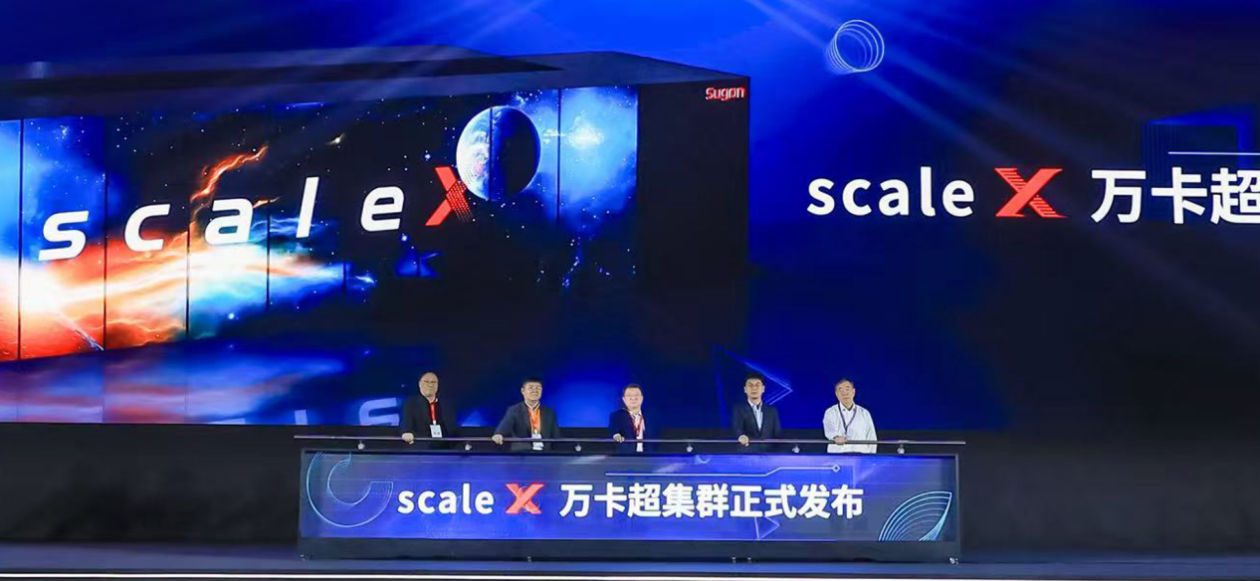
Core Viewpoint - The Chinese computing power industry is at a strategic crossroads, deciding between continuing a closed technology stack approach or pioneering a new competitive model based on open collaboration [1][3]. Industry Challenges - The current domestic AI computing power industry faces a dilemma of "full-chain internal competition" and "dual barriers," leading to significant industry anxiety. Companies have invested heavily in creating isolated "technology islands," resulting in fragmentation and high adaptation costs for users [4][5]. - The performance gap and ecological barriers present deeper challenges, with domestic chips lagging behind international standards and NVIDIA's CUDA ecosystem creating a strong lock-in effect [4]. Strategic Shift - The solution lies in transitioning from a "closed full-stack" to an "open layered" competitive logic, emphasizing collaboration among various manufacturers to create an industry platform that can systematically challenge dominant players [6][8]. - The establishment of the Photonic Organization serves as a platform to balance competition and cooperation, allowing companies to focus on their strengths while sharing results for mutual benefit [6][8]. Implementation of Open Architecture - Leading IT companies in China are moving away from a "large and comprehensive" model to a "focused and strong + ecological empowerment" approach, concentrating resources on their core competencies while opening other areas to ecosystem partners [8]. - The scaleX super cluster exemplifies this open architecture, achieving significant breakthroughs in system architecture and energy efficiency, with a 20-fold increase in computing density and a PUE of 1.04 [9]. Market Engagement - The open architecture aims to lower the barriers for users transitioning from closed ecosystems, enhancing cost efficiency and optimization for clients, particularly benefiting small AI chip design and software companies [9][10]. - The shift from standardized supply to joint customization is crucial for domestic computing power systems to penetrate mainstream commercial markets [10]. Future Outlook - The competition in the AI computing power industry is evolving into a battle between centralized control models and distributed innovation models based on open standards [14]. - The open path chosen by the Chinese industry reflects a deep understanding of its structural and innovative characteristics, aiming to harness the full potential of its comprehensive electronic information manufacturing chain and vibrant small to medium enterprises [14].
东海证券晨会纪要-20251224
Donghai Securities· 2025-12-24 03:33
Group 1: Key Recommendations - Haiguang Information (688041) is a leading domestic CPU enterprise, positioned in the trillion-yuan market for computing power chips, with a dual-drive strategy of CPU and DCU products, leading in hardware performance and software ecosystem [5][6][9] - Micron's performance guidance exceeded expectations, with Q1 FY2026 revenue reaching $13.64 billion, a significant year-on-year increase of 57%, driven by surging storage demand amid the AI wave [11][12] Group 2: Company Analysis - Haiguang Information - Established in 2014, Haiguang has developed its CPU products based on AMD's authorized technology, with the latest iteration being the Haiguang Five, while the Haiguang Four has already been commercialized [5][6] - The company’s CPUs are compatible with x86 architecture, achieving performance levels comparable to international mainstream CPUs, and dominating the market in government and industry sectors [6][9] - The demand for Haiguang's CPUs is driven by the acceleration of AI server shipments and domestic demand for independent innovation, with a projected 24.3% growth in global AI server shipments in 2025 [6][9] Group 3: Market Trends and Projections - The global AI chip market is expected to reach $92 billion in 2025, growing by 29.58%, with China's share ranking second globally [7][9] - Haiguang's DCU products, based on GPGPU architecture, are designed to meet the full range of AI training and inference needs, with significant partnerships established with major internet companies [7][9] - Revenue projections for Haiguang from 2025 to 2027 are estimated at 143.05 billion, 207.76 billion, and 287.59 billion yuan, with corresponding year-on-year growth rates of 56.13%, 45.23%, and 38.43% [9] Group 4: Company Analysis - Micron - Micron's cloud storage business saw a staggering 99.5% year-on-year revenue increase, reaching $5.284 billion, driven by AI-related demand [12][13] - The company anticipates a significant shortage in storage chip supply, which is expected to persist into 2026 and beyond, with a focus on high-bandwidth memory (HBM) demand projected to grow at a compound annual growth rate of approximately 40% [12][13] - Micron plans to increase its capital expenditure budget for FY2026 from $18 billion to approximately $20 billion to enhance HBM supply capabilities and accelerate the mass production of new DRAM nodes [12][13] Group 5: Industry Insights - The electronic industry is experiencing a gradual recovery, with AI investments exceeding expectations and storage chip prices rising [11][16] - The report suggests focusing on companies benefiting from strong domestic and international demand in the AIOT sector, as well as those involved in semiconductor equipment and key components [16]
海光信息(688041):国产CPU领军企业,DCU卡位算力芯片千亿蓝海
Donghai Securities· 2025-12-23 09:18
Investment Rating - The report assigns a "Buy" rating for the company, marking its first coverage [1]. Core Insights - The company is positioned as a leading domestic CPU manufacturer, with its DCU products targeting the rapidly expanding AI chip market, projected to reach $92 billion globally by 2025, growing at a rate of 29.58% [2]. - The company has established deep partnerships with major internet firms and has achieved compatibility with mainstream AI models, enhancing its market presence [2]. - Revenue growth is expected to remain robust, with projections of CAGRs of 56.13%, 45.23%, and 38.43% for the years 2025, 2026, and 2027 respectively [6]. Company Overview - The company, founded in 2014, specializes in high-end processors and accelerators, including CPUs and DCUs, with a comprehensive product layout that meets the demands of various sectors such as telecommunications, finance, and AI [12]. - The company has a strong R&D focus, continuously iterating its product lines, with significant advancements in CPU and DCU technologies [12][28]. - The company operates under a fabless model, with a high customer concentration, where the top five clients account for over 90% of sales [18]. Product Lines - The company offers two main product lines: CPUs, which are compatible with the x86 architecture, and DCUs, which utilize a GPGPU architecture compatible with mainstream AI software [18][17]. - The CPU product series includes high-performance processors for data centers and mid-range processors for various applications, while the DCU series supports AI training and inference [18][17]. Financial Performance - The company has demonstrated significant revenue growth, with a forecasted revenue of approximately 143.05 billion yuan in 2025, reflecting a year-on-year increase of 56.13% [6][28]. - The gross margin is expected to exceed 60%, indicating a strong competitive position within the industry [32]. - The company has maintained a high level of R&D investment, with over 90% of its workforce holding master's degrees or higher, ensuring a strong foundation for future innovations [37].
海光CPU创始人唐志敏:软件才是国产芯片公司的「命根子」丨GAIR 2025
雷峰网· 2025-12-10 07:21
Core Viewpoint - The article discusses the challenges and opportunities in the domestic computing power ecosystem, emphasizing the importance of software over hardware in the development of domestic chips [2][3]. Group 1: Challenges in Domestic Computing Power - The domestic computing power sector faces a collective issue of strong hardware but weak software, with a significant focus on the confusion surrounding underlying software interfaces and instruction systems [2]. - The high hidden costs associated with compatibility in the domestic chip industry are highlighted, indicating that the future of computing power will depend on software that can effectively utilize the hardware [2][6]. - The lack of software thinking among industry talent is identified as a barrier to progress, with a call for a unified approach to software interfaces to reduce societal resource waste [6][21]. Group 2: Importance of Software Development - The development of software is deemed more complex and costly than hardware, as it is often fragmented across various companies, leading to increased development costs and time [6][24]. - The article stresses that while hardware can have different architectures, the software interface should remain consistent to facilitate reuse across the industry [6][9]. - The need for a unified instruction system is emphasized as a critical factor for the success of domestic chips, with a suggestion that this could be achieved through either industry alliances or a natural convergence of commercial technologies [7][8]. Group 3: Talent Development and Education - The current education system is criticized for producing talent that lacks the necessary skills in both hardware and software, with a call for project-based learning to better prepare students for industry needs [21][23]. - The division between electronic engineering and computer science in educational institutions is seen as a barrier to developing a comprehensive understanding of both hardware and software [21]. - The article advocates for a more integrated approach to education that combines both fields to foster innovation and address the challenges in the domestic chip industry [21][24]. Group 4: Future Opportunities - The potential for RISC-V architecture to serve as a platform for innovation is discussed, with an emphasis on the need for software solutions to unlock its capabilities in high-end applications like data centers [10][11]. - The article suggests that the international landscape may drive the adoption of RISC-V, as companies seek to leverage its open architecture to enhance competitiveness [13][19]. - The future of GPU companies is linked to the convergence of large models, indicating that successful integration with leading models could present significant opportunities [27].