
药品仿制

Search documents
石家庄四药获批“乙酰半胱氨酸注射液”,呼吸药赛道再添竞争者,超6亿市场格局生变!
Ge Long Hui· 2025-12-13 19:32
Core Viewpoint - Shijiazhuang Fourth Pharmaceutical Group has received production registration approval from the National Medical Products Administration for its acetylcysteine injection (25ml: 5g), marking it as the third company in China to obtain approval for this product [1][2][13]. Group 1: Product Approval and Market Potential - The acetylcysteine injection is originally developed by Zambon Group from Italy, which completed clinical trials in China in 2018 [4]. - The product is indicated for the treatment of acute acetaminophen poisoning and is expected to generate sales of nearly 600 million yuan in the hospital market by 2024, with over 100 million yuan in sales anticipated in the first half of 2025 [4][5]. - Over 30 companies have had their applications for acetylcysteine injection rejected due to the lack of domestic reference specifications and indications [7]. Group 2: Competitive Landscape - Since the original product was approved in May 2023, 70 companies have submitted applications for generic versions, indicating a highly competitive market for acetylcysteine injection [11]. - The approval of Shijiazhuang Fourth Pharmaceutical Group's product adds to the competitive landscape, following approvals from Sichuan Huiyu Pharmaceutical and Sichuan Haimengzhisen Biological Pharmaceutical [13]. Group 3: Company Innovation and Growth - Shijiazhuang Fourth Pharmaceutical Group has focused on innovation-driven high-quality development, with 164 products and 215 specifications passing consistency evaluations, enhancing its market position [16]. - The company has had over 50 products approved and evaluated this year, including several first-to-market products [16].


30家药企涌入一条赛道!非奈利酮仿制热潮背后的医药内卷与破局机遇
Ge Long Hui· 2025-10-29 19:03
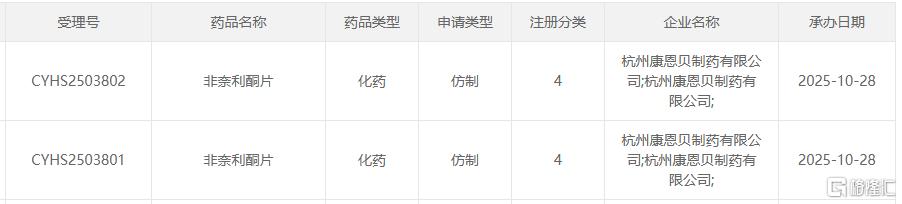
Core Insights - Hangzhou Kang En Bei Pharmaceutical's application for the generic version of Finerenone has been accepted, with 30 companies currently competing for the first generic approval [1][7][10] - Finerenone, originally developed by Bayer, is used for treating type 2 diabetes-related chronic kidney disease (CKD) and heart failure, showing strong market performance with sales exceeding 410 million yuan in the first half of 2025, a 135.98% year-on-year increase [4][10] - The original patent for Finerenone is set to expire in February 2028, with 23 companies currently filing for a type 3 patent declaration, indicating they cannot market the product until the patent expires [10][13] Company Developments - Kang En Bei Pharmaceutical has successfully obtained approvals for over 50 products, with several being the first to pass consistency evaluations, including Sulfamethoxazole and Amisulpride solutions [16] - The competition for Finerenone has intensified, with 37 companies having completed bioequivalence (BE) trials and over 20 more currently conducting BE trials [13][16] Market Dynamics - The strong sales performance of Finerenone has attracted numerous domestic pharmaceutical companies to enter the market, leading to a competitive landscape [4][7] - The ongoing patent challenges and the competitive nature of the generic drug market suggest a dynamic environment for both original and generic manufacturers [10][13]

累计研发投入约1.25亿元 复旦张江奥贝胆酸片仿制药上市申请遭否
Mei Ri Jing Ji Xin Wen· 2025-10-15 13:23
Core Viewpoint - Fudan Zhangjiang's application for the drug Ocaliva (Obeticholic Acid) has been rejected by the National Medical Products Administration due to safety concerns and lack of sufficient evidence to support its approval as a generic drug [1][4]. Group 1: Company Updates - Fudan Zhangjiang's subsidiary, Taizhou Fudan Zhangjiang Pharmaceutical Co., received a notification of non-approval for its drug application for Obeticholic Acid, which is intended for treating primary biliary cholangitis (PBC) [1]. - The company has invested approximately 125 million yuan in the development of Obeticholic Acid [1]. - The rejection of the drug application is not expected to have a significant impact on the company's current financial status [1]. Group 2: Industry Context - Obeticholic Acid, originally developed by Intercept Pharmaceuticals, was first approved by the FDA in May 2016 and subsequently received conditional approval in Europe [2]. - The global sales of Obeticholic Acid showed steady growth from 2016 to 2021, reaching approximately $363 million in 2021 before stabilizing around $300 million in subsequent years [2]. - Safety concerns regarding Obeticholic Acid have led to multiple warnings and restrictions, including its classification under a "black box warning" by the FDA due to reports of severe liver damage and increased risk of liver transplant and death [3]. - The European Medicines Agency recommended the withdrawal of Obeticholic Acid's marketing authorization in 2023, and Intercept Pharmaceuticals voluntarily withdrew the drug from the U.S. market in September 2023 [3]. - There are currently no approved Obeticholic Acid products in China, and the safety risks associated with the original drug have created uncertainty for domestic generic drug prospects [4]. - Other domestic companies, including Hengrui Medicine and Zai Lab, are also facing setbacks in their applications for Obeticholic Acid generics, with some projects being halted after significant investments [5].
