
药品监管

Search documents
省药监局系统实施“三高一新”举措 锻造专业化药品监管“铁军”
Xin Lang Cai Jing· 2026-02-26 16:38
Group 1 - The core idea of the article emphasizes the importance of talent development in the pharmaceutical regulatory sector during the "14th Five-Year Plan" period, highlighting the implementation of the "Three Highs and One New" initiative to build a professional regulatory talent team [1][2] - The provincial drug regulatory authority has integrated talent development into the "14th Five-Year Plan for Drug Safety Development in Anhui Province," reinforcing policy guidance and institutional support [1] - A total of 118 civil servants and professional technical personnel have been recruited, along with 7 high-level talents, to optimize the talent structure [1] Group 2 - The establishment of a systematic training platform has led to the creation of 8 provincial training bases and 37 regional training bases in the Yangtze River Delta, enhancing regulatory capabilities [2] - The authority has initiated various measures to foster a talent-friendly environment, including the establishment of the "Provincial Drug Regulatory Science Research Center" and the implementation of a new evaluation mechanism for drug inspectors [2] - A total of 6,344 expert visits have been made to assist enterprises, resolving 5,868 issues, thereby promoting a new paradigm of talent development through industry-technology interaction [2]
“小单位”如何实现“大作为”?一支药监新军的“十四五”答卷
Xin Lang Cai Jing· 2026-02-17 13:15
Core Viewpoint - The establishment of the Qingyang Law Enforcement Inspection Bureau represents a significant step towards enhancing drug safety and regulatory efficiency in the Gansu province, evolving from integration to a more cohesive and demonstrative regulatory approach [1][2]. Group 1: Organizational Development - The Qingyang Law Enforcement Inspection Bureau was created to address the challenges of limited personnel and extensive regulatory tasks, aiming for a significant impact despite being a small unit [2]. - The leadership has implemented a "Four No Distinctions" principle in personnel selection, focusing solely on capability and contribution, which has fostered a collaborative and resilient team [2]. Group 2: Regulatory Framework - The bureau has developed a systematic approach to drug regulation, moving away from traditional methods to a structured framework that emphasizes training, thorough preparation, and a closed-loop process for inspections [4]. - A collaborative mechanism has been established with local market regulatory bodies to enhance information sharing and create a comprehensive regulatory network across cities and counties [4]. Group 3: Performance and Impact - The bureau has conducted over ten special inspections during the "14th Five-Year Plan" period, identifying and rectifying more than a thousand risk issues, and has handled 26 legal cases, including seven with penalties exceeding 100,000 yuan [5]. - The implementation of a "risk + credit" dual evaluation system has significantly improved the compliance levels of local pharmaceutical companies [5]. Group 4: Service Orientation - The bureau emphasizes a service-oriented approach to law enforcement, providing tailored support to enterprises and ensuring 100% compliance with quality control systems [5]. - Initiatives have led to the approval of 13 new products by a local pharmaceutical company, accounting for 72% of the province's new approvals during the "14th Five-Year Plan" [5]. Group 5: Recognition and Future Outlook - The bureau's regulatory practices have received recognition from various media outlets, highlighting its journey from inception to excellence [7]. - Future plans include strengthening regulatory effectiveness, promoting corporate responsibility, and enhancing community involvement in drug safety [7].
药品监管守安全护民生
Xin Lang Cai Jing· 2026-02-15 23:23
Group 1 - The article highlights the ongoing efforts of the local market regulatory authorities in Huzhou to enhance drug safety governance and protect public health, with a focus on rigorous inspections of pharmacies and clinics as the Spring Festival approaches [1] - Huzhou has achieved a public satisfaction rate of 92% regarding drug safety, ranking second in the province for three consecutive years, reflecting the effectiveness of its regulatory measures [1] - The regulatory framework includes a comprehensive mechanism for monitoring, early warning, and feedback, emphasizing proactive problem-solving rather than reactive penalties [1] Group 2 - A portable eye pressure meter developed in Huzhou received certification in just 43 days, setting a record for the fastest approval in the province, thanks to improved collaboration between local regulatory bodies and higher authorities [2] - The market regulatory department plans to enhance risk prevention mechanisms and focus on the governance of small businesses while prioritizing key industries like biomedicine to optimize the business environment [2] - Continuous efforts will be made to solidify the foundation for drug safety and high-quality industrial development in the region [2]
综合版征稿启事
Xin Lang Cai Jing· 2026-02-10 00:32
Group 1 - The article focuses on the new dynamics, initiatives, and achievements of drug regulatory departments in China, aiming to create a platform for experience exchange and showcase results across the national drug supervision landscape [1] - It emphasizes the importance of regulatory measures in promoting the development of the pharmaceutical industry, encouraging submissions that detail successful practices and outcomes [5] - The article outlines the need for clear and structured submissions, with a word count requirement of 2000-2500 words for detailed descriptions of regulatory practices [3][7] Group 2 - The article calls for contributions that highlight the enforcement of quality and safety responsibilities by drug regulatory departments, detailing specific practices and their effectiveness [5] - It encourages the selection of distinctive practices and the inclusion of concrete examples to illustrate implementation and results [6] - The submission guidelines also specify a word count of 2000-2500 words for these contributions [7] Group 3 - The article invites exploratory articles addressing challenges and hot topics in drug regulation, focusing on specific areas to analyze current situations, identify issues, and propose suggestions for enhancing regulatory effectiveness [9] - It requires submissions to be clear and in-depth, with a word count of 1500-2500 words [10] Group 4 - The article includes a section for photo news that showcases the dynamics of drug regulatory work, including safety supervision, industry support, and public awareness activities [11] - It specifies that photos should be at least 1MB in size and must feature clear themes and clean visuals [12] Group 5 - The call for submissions is ongoing, with specific instructions regarding the use of AI tools in the writing process and the requirement to indicate the submission category in the email title [13]
辽宁召开药品监督管理工作会议
Xin Lang Cai Jing· 2026-02-10 00:31
Core Insights - The meeting highlighted the importance of drug regulation in ensuring public health and the strategic role of the pharmaceutical industry in national security and economic development [2][3] Summary by Sections Past Achievements - The Liaoning Provincial Drug Administration has implemented the "Four Strictest" requirements, enhancing regulatory quality and efficiency, and fostering innovation in the pharmaceutical industry [1] - Significant improvements were noted, including six breakthroughs in drug regulation, six major enhancements, and six positive transformations, leading to increased satisfaction among enterprises and the public [1] Current Focus - The year marks the beginning of the "15th Five-Year Plan," which is crucial for accelerating comprehensive revitalization and deepening reforms in drug regulation [2] - The meeting emphasized the need for a balanced approach to development and safety, efficiency and fairness, and regulation and service [2] Key Tasks - Eight key tasks were outlined, including strengthening party leadership in drug regulation, deepening regulatory reforms, enhancing the drug safety responsibility system, and supporting high-quality development of the pharmaceutical industry [3]
【省药监局】陕西强化“两品一械”监管
Shan Xi Ri Bao· 2026-02-05 00:30
Core Insights - In 2025, Shaanxi aims to enhance law enforcement collaboration across provincial and municipal levels, targeting 2,678 cases related to "two products and one device" (drugs, cosmetics, and medical devices) and transferring 56 cases to judicial authorities [1] Group 1: Regulatory Focus - Shaanxi's regulatory efforts have concentrated on high-risk enterprises, high-risk products, and critical production processes, ensuring compliance with drug quality management standards [1] - The province has implemented a "rectification follow-up" mechanism to track the compliance of enterprises with corrective actions [1] Group 2: Online Sales Regulation - To address challenges posed by online drug sales, Shaanxi has strengthened integrated supervision of online and offline sales, emphasizing corporate responsibility [1] - The province is focusing on cracking down on illegal online drug sales, including unqualified sales and prescription drugs sold without prescriptions [1] Group 3: Regulatory Efficiency - Shaanxi is promoting service-oriented law enforcement in drug regulation, allowing for leniency in minor violations through a "first violation not penalized" list [1] - The province is also piloting reforms to optimize the review and approval process for supplementary drug applications [1] Group 4: Future Initiatives - Shaanxi plans to enhance high-level regulation throughout the drug lifecycle, continuing initiatives such as the "clean source" action in drug operations and a three-year improvement plan for cosmetic production quality management systems [2]
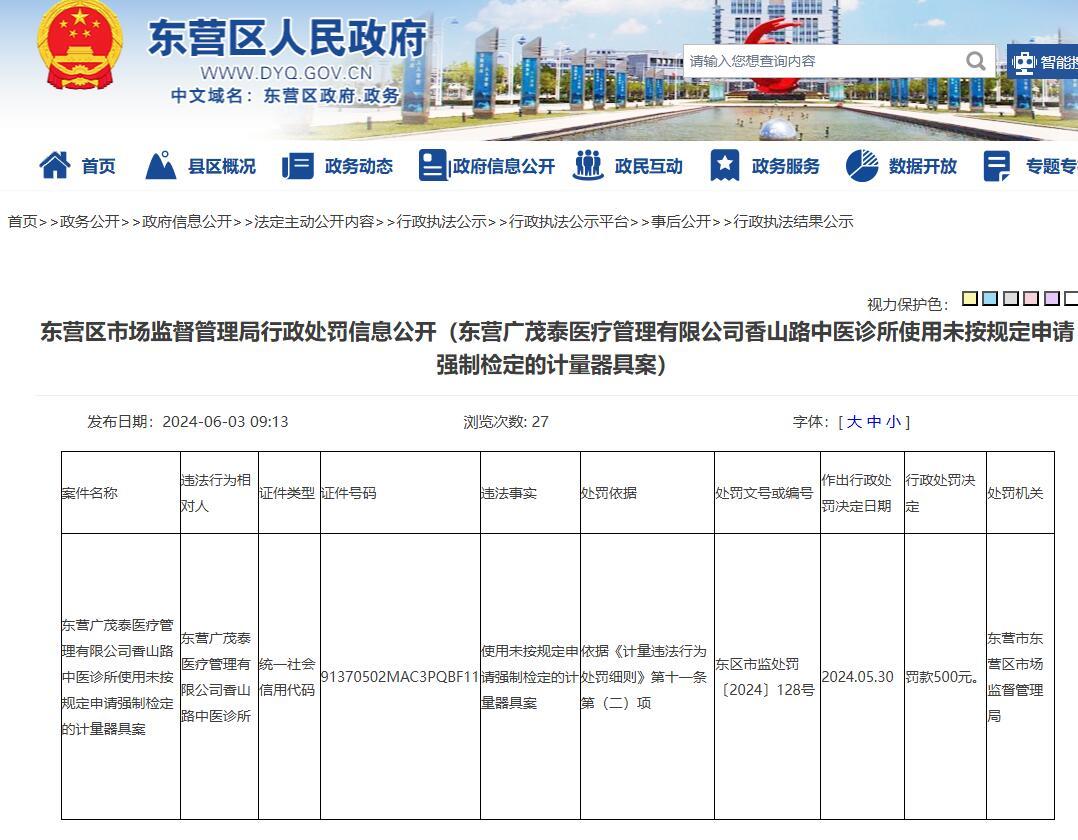
因销售劣药东营广茂泰医疗管理有限公司香山路中医诊所被行政处罚
Qi Lu Wan Bao· 2026-01-30 06:43
Group 1 - The core issue involves the administrative penalty imposed on Dongying Guangmaotai Medical Management Co., Ltd. for selling substandard drugs [1][3] - The violation was confirmed by the Dongying District Market Supervision Administration, which acted under Article 117, Paragraph 1 of the Drug Administration Law of the People's Republic of China [3] - The specific penalties include the confiscation of illegal gains amounting to 180 yuan and a fine of 10,000 yuan [3]

肖伟:深化改革 强化监管 切实保障药品高水平安全
Xin Lang Cai Jing· 2026-01-27 12:39
Core Viewpoint - The newly released "Regulations on the Implementation of the Drug Administration Law of the People's Republic of China" aims to strengthen drug regulation in response to the rapid development of the pharmaceutical industry, ensuring high-quality health needs while enhancing regulatory requirements [1][8]. Group 1: Reform and Optimization of Drug Regulation - The regulations provide a system guarantee for a clear responsibility, innovation-driven, and healthy competition in drug regulation, stimulating industry vitality and promoting high-quality development in the pharmaceutical sector [1][2]. - The regulations support the development of new industry formats, allowing for segmented production of drugs to meet urgent clinical needs and public health emergencies, thereby enhancing production capacity and ensuring drug availability [2]. - The regulations optimize the listing process for innovative drugs, allowing commercial-scale batches to be sold after obtaining approval documents, which accelerates the availability of innovative treatments to patients and reduces operational costs for companies [3]. Group 2: Quality Management and Safety Assurance - The regulations establish a comprehensive regulatory system for prescription drugs, ensuring safe medication practices by holding medical institutions and pharmaceutical companies accountable for prescription management [6]. - The regulations standardize online drug sales, requiring third-party platforms to establish quality management systems and clarify responsibilities, thus balancing convenience and safety in drug distribution [7]. - The regulations enhance the management of drug use in medical institutions, mandating strict protocols for drug procurement, storage, and reporting of adverse reactions to safeguard patient health [7]. Group 3: Development of Traditional Chinese Medicine - The regulations promote the standardized cultivation and breeding of traditional Chinese medicinal materials, addressing quality stability issues and supporting the sustainable development of the industry [4]. - The regulations encourage the implementation of quality management standards for traditional Chinese medicinal materials, providing legal support for their comprehensive development [4]. Group 4: Overall Impact - The revision of the regulations is expected to drive structural optimization and upgrading in the pharmaceutical industry, ensuring high-level safety and significantly impacting the health-first development strategy and the promotion of high-quality growth in the pharmaceutical sector [8].
新版药品管理实施条例发布:允许创新药分段生产,加速好药上市
Hua Er Jie Jian Wen· 2026-01-27 10:30
Core Viewpoint - The revised "Regulations on the Implementation of the Drug Administration Law of the People's Republic of China" aims to enhance drug innovation, streamline approval processes, and strengthen regulatory oversight, effective from May 15, 2026 [1][3][4]. Group 1: Drug Development and Registration - The new regulations support drug development and innovation guided by clinical value, encouraging the creation of new drugs and their clinical promotion [1][4]. - A fast-track registration process for new drugs has been established, along with clear procedures for re-registration and mechanisms for converting prescription drugs to over-the-counter status [1][4]. - The regulations introduce market exclusivity periods for pediatric and rare disease medications, as well as data protection for drugs with novel chemical components [1][6]. Group 2: Drug Production Management - The regulations enforce stricter management of drug production, emphasizing the responsibilities of drug marketing authorization holders during contract manufacturing [1][4]. - Specific management requirements for the production and sale of traditional Chinese medicine (TCM) products have been clarified [1][4]. Group 3: Drug Distribution and Usage - The regulations enhance the management of online drug sales, holding third-party platforms accountable for the quality of drugs sold [1][8]. - Medical institutions are required to improve their pharmaceutical management to ensure drug quality during usage [1][4]. Group 4: Drug Safety Supervision - The regulations specify measures for drug safety supervision and inspection, detailing the process for quality checks and the rights of parties to request re-examinations of inspection results [2][4]. - Strict legal responsibilities for violations have been established to ensure compliance [2]. Group 5: Intellectual Property Protection - The revised regulations strengthen the protection of drug intellectual property, introducing a data protection system and market exclusivity periods for innovative drugs [6]. - Pediatric drugs are granted a market exclusivity period of up to 2 years, while rare disease drugs can receive up to 7 years of exclusivity [6]. Group 6: Online Drug Sales Regulation - The regulations clarify the responsibilities of online drug trading platforms, requiring them to establish dedicated management systems and ensure compliance with sales qualifications [8][9]. - The regulations also encourage the implementation of quality management standards for TCM production [8][9]. Group 7: Production Flexibility - The regulations allow for segmented contract manufacturing of drugs, which is particularly beneficial for innovative drugs requiring specialized production processes [10][11]. - A pilot program for segmented production will begin in 2024, focusing on innovative biological products and urgently needed clinical products [10][11].
新修订《中华人民共和国药品管理法实施条例》将于5月15日起施行(附全文)
Xin Hua She· 2026-01-27 09:56
Group 1 - The revised "Regulations on the Implementation of the Drug Administration Law of the People's Republic of China" will take effect on May 15, 2026, and consists of 9 chapters and 89 articles [1] - The regulations aim to enhance drug research and registration systems, supporting clinical value-oriented drug development and innovation, and encouraging new drug research and clinical promotion [1][6] - A fast-track registration process for drugs has been established, along with clear re-registration procedures and mechanisms for converting prescription drugs to over-the-counter drugs [1][26] Group 2 - Drug production management will be strengthened, with clear responsibilities for drug marketing authorization holders during contract manufacturing [2] - The regulations specify management requirements for traditional Chinese medicine (TCM) decoction pieces and formula granules [2] Group 3 - Drug safety supervision will be strictly enforced, with detailed measures for quality inspection and legal responsibilities for violations [3] Group 4 - The regulations support the development and innovation of drugs for children and rare diseases, providing market exclusivity periods of up to 2 years and 7 years, respectively, for qualifying products [26][28] - Data protection for drugs containing new chemical entities will be implemented, preventing unauthorized commercial use of undisclosed trial data for up to 6 years [29]