
被动权益基金

Search documents
盘点2025年四季度被动权益基金:主要宽基指数有所分化 华夏占有率最高 易方达、华泰柏瑞等管理规模均超千亿
Xin Lang Cai Jing· 2026-01-27 09:01
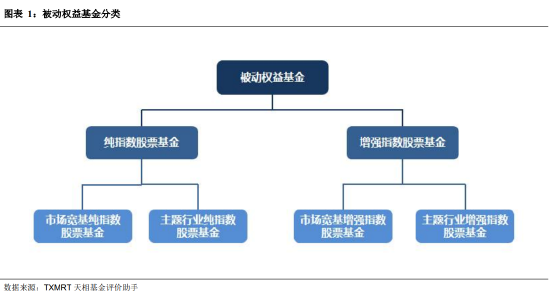
Core Viewpoint - The report highlights the performance and trends of passive equity funds in the fourth quarter of 2025, indicating a growth in total market size and a mixed performance across various indices, with a focus on the implications for future investment strategies in AI applications, commercial aerospace, and nuclear fusion. Group 1: Market Overview - As of the end of Q4 2025, the total market size of passive equity funds reached 4.77 trillion yuan, an increase of 3.49% from the previous quarter [1][5][43] - The size of pure index stock funds was 4.52 trillion yuan, while enhanced index stock funds accounted for 0.25 billion yuan, reflecting increases of 3.26% and 7.78% respectively [1][5][43] - The total number of passive equity funds was 2,065, with 1,594 being pure index stock funds and 471 enhanced index stock funds, showing growth from the previous quarter's total of 1,926 [5][47] Group 2: New Fund Issuance - In Q4 2025, the total new issuance of passive equity funds was approximately 816.80 billion yuan, with 183 new funds launched, a decrease of 75 from the previous quarter [1][7][50] - The issuance scale for pure index stock funds was 576.75 billion yuan with 134 funds, while enhanced index stock funds raised 240.05 billion yuan with 49 funds [1][7][50] Group 3: Market Performance - The performance of major indices in Q4 2025 showed divergence, with the Shanghai Composite Index rising by 2.22%, while the CSI 300 Index fell by 0.23% and the ChiNext Composite Index dropped by 0.73% [2][44] - The Tianxiang pure index stock fund index decreased by 2.01%, whereas the Tianxiang enhanced index stock fund index increased by 0.99% [2][44][52] Group 4: Fund Flows - The overall market for passive equity funds remained stable, with subscription volumes at 14,151.39 billion units and redemption volumes at 12,523.91 billion units, resulting in a net subscription of 1,627.49 billion units, which increased compared to the previous quarter [2][24][66] - The trading volume in the secondary market for passive equity funds reached 73,207.50 billion units, predominantly driven by pure index stock funds, which accounted for 72,984.02 billion units of the total [2][28][70] Group 5: Sector Analysis - The top five sectors held by passive equity funds included electronics, non-bank financials, power equipment, food and beverage, and telecommunications, with a combined holding ratio of 86.18% [2][33][75] - The holding ratios for these sectors showed fluctuations over the quarters, with electronics holding 17.24% by the end of Q4 2025 [2][34][76] Group 6: Fund Management Companies - As of Q4 2025, major fund management companies in the passive equity fund market included Huaxia Fund, with a management scale of approximately 794.2 billion yuan, holding the highest market share of 16.65% [2][35][79] - Other notable companies included E Fund, Huatai-PB Fund, and Southern Fund, all managing over 100 billion yuan, indicating a stable market structure with no significant changes in rankings [2][35][79]

市场有效性研究与主、被动基金配置建议:中盘蓝筹风起,主动权益基金优势凸显
Orient Securities· 2026-01-06 14:28
1. Report's Industry Investment Rating No industry investment rating information is provided in the report. 2. Core Viewpoints of the Report - The improvement of A-share market efficiency provides a solid foundation for the development of passive investment, with the scale of passive equity funds in the domestic public fund market exceeding 50% in 2025 [5]. - The effectiveness of the A-share market is lower than that of Hong Kong and US stocks, and the effectiveness of small-cap and technology stock indices is weaker than that of large-cap stock indices. The effectiveness of the A-share market shows an overall upward trend [5]. - There is a significant negative correlation between the excess return of active funds and index effectiveness. As the difficulty of obtaining Alpha increases, the demand for diversified Beta and Smart Beta on the equity side increases, highlighting the importance of asset allocation [5]. - There is a balance point between the scale ratios of active and passive funds. In the choice of funds, it is recommended to allocate ETFs in the large-cap style market, select active equity funds in the mid-cap style market, and choose quantitative funds for small-cap style allocation [5]. 3. Summary by Relevant Catalogs 3.1 A-share Equity Fund Market: Passive Investment Proportion Exceeds 50% - In 2025, the scale of domestic passive equity funds exceeded that of active equity funds for the first time, and this trend continues. The reasons include the difficulty of obtaining sustainable excess returns from active funds, the improvement of A-share market efficiency, and the development of domestic investment advisory services [9]. 3.2 Rise in Passive Investment Proportion Due to Market Efficiency Improvement - As market efficiency improves, it becomes more difficult to obtain Alpha, leading to the rise of Beta investment. Passive investment includes pure passive investment and factor-based passive investment (Smart Beta) [14]. - There is a balance point between active and passive funds, and the scale ratio of passive investment will not increase indefinitely. Ideal asset allocation should be an organic combination based on the market cycle, asset categories, and strategy capacity [15]. 3.3 Market Efficiency and Testing Methods 3.3.1 Origin and Connotation of the Efficient Market Theory - The study of market efficiency can be traced back to 1889, and Eugene Fama formally defined and improved the efficient market theory, dividing market efficiency into three levels: weak, semi-strong, and strong [18][19][20]. 3.3.2 Testing Methods for the Efficient Market Theory - **Weak Form Tests**: By testing whether the price sequence residual is white noise, it can be determined whether the stock price is likely to follow a random walk, which is used to judge market efficiency. The Ljung - Box test is commonly used for white noise testing [21][25][27]. - **Semi - Strong Form Tests**: Economists generally use the event study method to test the reaction speed of stock prices to public information [29]. - **Strong Form Tests**: This tests whether investors can obtain excess returns using insider information. It studies the returns of professional investors or insiders [30][31]. 3.4 Exploration of Market Efficiency in A-share, Hong Kong, and US Stocks - Since 2013, the efficiency of A-share has been slightly lower than that of Hong Kong and US stocks, and the efficiency of small-cap and technology stock indices is weaker than that of large-cap stock indices. After 2018, the efficiency of the A-share market has increased rapidly [34][38][40]. - There is a significant negative correlation between the excess return of active funds and index efficiency. As market efficiency improves, the difficulty of obtaining Alpha in A-shares increases [43]. 3.5 Fund Investment Choices under the Background of Improved Market Efficiency 3.5.1 ETF: Emphasizing Multi-Asset ETFs and Equity Smart Beta - As the demand for diversified Beta increases, the importance of asset allocation becomes prominent. ETFs are becoming increasingly important in the strategic position of asset allocation, and the proportion of ETFs in the holdings of public FOFs continues to rise, with diversified demand [47][50]. - Strategy ETFs (Smart Beta factor ETFs) show relatively independent trends, providing a source of differentiated Beta in the equity market and playing an important role in asset allocation [52]. - Industry ETFs are mostly market - capitalization weighted, with large-cap stocks contributing more to returns. Since it is difficult to obtain excess returns from large-cap stocks, investment is recommended to be based on long - term allocation [55][56]. 3.5.2 Active Equity and Quantitative Investment: Obtaining Alpha Returns from Small and Mid - Cap Stocks - Active equity funds are more exposed to mid - cap stocks. The trading environment of mid - cap stocks is more friendly to actively managed funds, with lower pricing efficiency and lower difficulty in obtaining excess returns compared to large - cap stocks, and relatively sufficient liquidity [61][62]. - Quantitative funds may be a better choice for investing in small - cap stocks. Quantitative strategies can improve the objectivity and winning rate of decision - making, and have advantages in terms of stock coverage and trading execution [69][70][71].