规则话语权

Search documents
江山如画丨为机器人“体检”的国家级实验室,为何落户这座制造之城?
Zhong Guo Xin Wen Wang· 2025-12-12 08:23
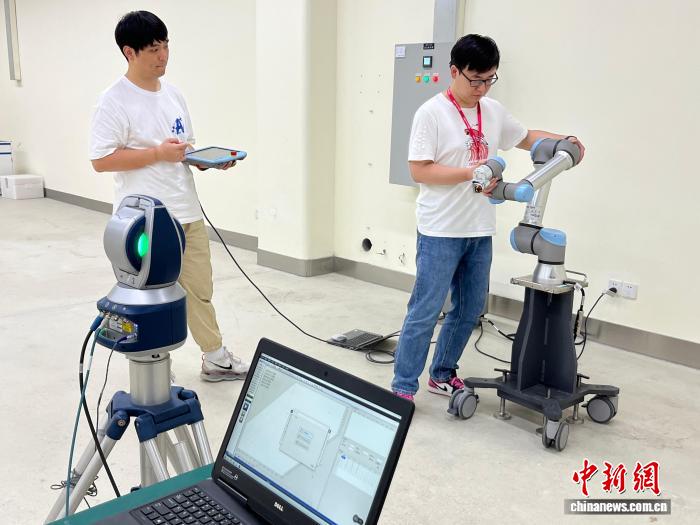
Core Insights - The establishment of the National Intelligent Industrial Robot Industry Measurement and Testing Center in Changzhou aims to enhance the quality and reliability of industrial robots through precise measurement and testing [2][5]. Group 1: Background and Development - The National Intelligent Industrial Robot Industry Measurement and Testing Center is being built in Changzhou, approved by the State Administration for Market Regulation, and is nearing completion [2]. - Changzhou has a robust manufacturing ecosystem, covering 37 out of 41 national industrial categories, with over 2,200 enterprises and an industry scale exceeding 30 billion yuan [2]. - One in four industrial robots produced in China is related to Changzhou, highlighting the city's significant role in the robotics industry [2]. Group 2: Technical Support and Services - The center has already completed over 10 technical consultations for local companies, addressing issues such as abnormal vibrations and overheating in robot joints [2]. - The center has obtained over 500 testing qualifications related to robots and established more than 60 measurement standards, serving over 500 enterprises and testing more than 2,000 robots [5]. Group 3: Industry Impact and Future Directions - The center acts as an "enabler" and "guardian" for industry development, aiming to quantify and validate technological advancements in robotics [5]. - Changzhou's industrial base has led to the establishment of other high-level service platforms, such as the first national "New Energy Battery Technical Trade Measures Research and Evaluation Base," which addresses complex international regulations [5]. - The competition in advanced manufacturing is shifting from traditional metrics like capacity and cost to new dimensions focused on technical standards, quality reputation, and regulatory influence [6].


中方罕见对美主动重拳出击,这是在向世界释放四个明确信号!
Sou Hu Cai Jing· 2025-09-16 02:09
Group 1 - China has initiated two significant investigations against the US chip industry, focusing on anti-dumping and discrimination practices, marking a shift to a more proactive legal approach [1][3] - The anti-discrimination investigation is based on China's Foreign Trade Law, aiming to systematically review US practices that are deemed discriminatory, indicating a move towards legal accountability rather than emotional responses [3][10] - The anti-dumping investigation targets specific segments of the chip industry, particularly analog and interface chips, which are crucial for various sectors including automotive and consumer electronics, potentially disrupting US supply chains [3][6] Group 2 - China holds a dominant position in the rare earth market, supplying over 70% of US imports, and controls critical processing stages, which could significantly impact US military and technological capabilities [6][10] - The US is attempting to develop its own rare earth projects, but faces challenges in terms of technology, capital, and time, making immediate replacement unlikely [6][10] - China's advancements in its own chip supply chain, such as Yangtze Memory Technologies achieving mass production of 232-layer NAND flash memory, indicate a growing self-sufficiency in mature chip technology [6][10] Group 3 - The pressure from China's actions is expected to first impact US chip companies, leading to increased compliance costs and potential shifts in supply chain strategies [8][10] - US allies, including Japan and Europe, may also face dilemmas due to their reliance on the Chinese market, complicating their positions in the geopolitical landscape [8][10] - The current situation emphasizes the need for global companies to engage in geographical hedging and localize their operations to mitigate risks associated with US-China tensions [8][10]