规模定律(Scaling Laws)

Search documents
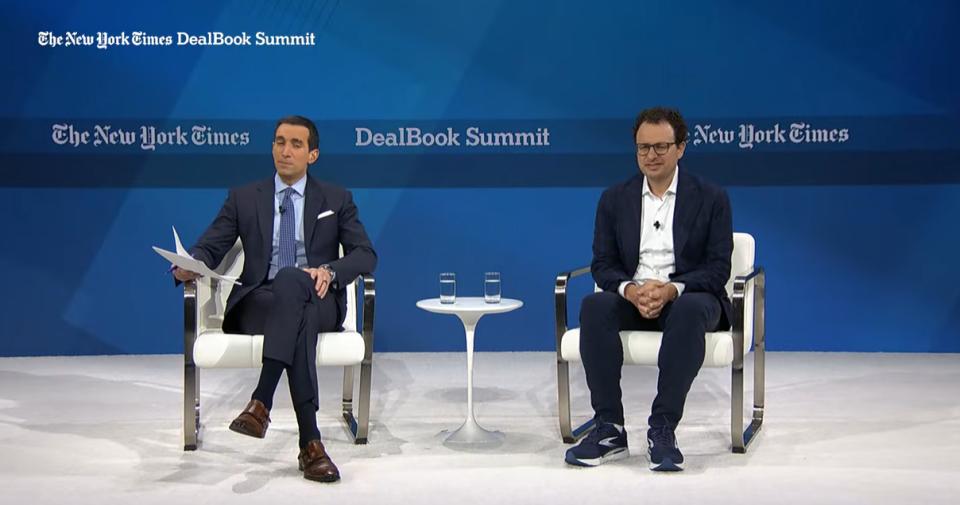
Anthropic CEO最新专访:暗讽奥特曼花钱太猛,孤注一掷式豪赌或导致OpenAI破产
3 6 Ke· 2025-12-04 09:28
Core Insights - Anthropic's CEO, Dario Amodei, expresses a dual perspective on the AI industry, being both optimistic about technological advancements and cautious about the industry's current challenges [2][5][6] - Anthropic has achieved a remarkable revenue growth of 10 times annually for three consecutive years, with projections for 2024 to reach between $8 billion and $10 billion [6][10] - The AI industry is facing a significant dilemma due to the mismatch between the uncertain economic value growth and the long-term investment required for data center construction [6][10] Group 1: Industry Outlook - Amodei identifies himself as the "number one optimist" in the AI sector, believing that scaling laws will continue to drive technological breakthroughs [2][5] - The CEO warns that companies like OpenAI, which adopt aggressive "YOLO" strategies, may face severe consequences, including potential bankruptcy [6][7] - Anthropic differentiates itself by focusing on the enterprise market, avoiding the intense competition seen in the consumer space between companies like OpenAI and Google [2][14] Group 2: Financial Considerations - Anthropic's revenue trajectory shows a consistent 10-fold increase, with expectations for 2023 to reach between $8 billion and $10 billion, and a cautious estimate for 2024 of $20 billion to $30 billion [6][10] - The company aims to achieve break-even by 2028, while managing risks through efficient training and a healthy profit margin [11] - Amodei discusses the potential pitfalls of "circular financing" in the industry, where companies may overextend based on inflated revenue expectations [12][13] Group 3: Competitive Strategy - Anthropic's strategy focuses on optimizing models for enterprise needs, allowing it to avoid the "red alert" competition seen in consumer markets [14] - The company emphasizes the importance of building a deep understanding of industry-specific applications to create a sustainable competitive advantage [15] - Amodei believes that achieving AGI does not require revolutionary breakthroughs but can be approached through incremental improvements and scaling existing technologies [15][16]

GPT-5“让人失望”,AI“撞墙”了吗?
华尔街见闻· 2025-08-18 10:44
Core Viewpoint - The release of OpenAI's GPT-5 has not met expectations, leading to disappointment and raising questions about the current limits of generative AI technology, despite ongoing enthusiasm in capital markets for practical applications of AI [1][2][3]. Group 1: Performance and Expectations - Users have reported low-level errors in GPT-5, such as incorrect labeling of the U.S. map, and expressed dissatisfaction with its performance compared to previous models [2][3]. - CEO Sam Altman acknowledged the release was "bumpy," attributing issues to a malfunctioning "automatic switcher" that caused the system to call a weaker model [3][4]. - The optimism surrounding AGI has not materialized with GPT-5, leading to a reassessment of its capabilities and the competitive landscape, as rivals like Google and Anthropic have narrowed the gap with OpenAI [4][6]. Group 2: Scaling Laws and Limitations - The core logic supporting large language models, known as "scaling laws," is approaching its limits, with data exhaustion and physical/economic constraints on computational power being significant challenges [6][8]. - The training of GPT-5 reportedly utilized hundreds of thousands of next-generation Nvidia processors, highlighting the immense energy consumption required for such models [6]. Group 3: Market Dynamics and Investment Trends - Despite concerns about technological stagnation, investment in AI startups and infrastructure remains robust, with AI accounting for 33% of global venture capital this year [7][10]. - The focus of the AI race is shifting from achieving AGI to practical productization, with companies like OpenAI deploying engineers to assist clients in integrating AI models [8][9]. - Investors are increasingly valuing the strong growth of products like ChatGPT, which has generated an annual recurring revenue of $12 billion for OpenAI, rather than the distant promise of AGI [10][11].