
财务造假综合惩防

Search documents
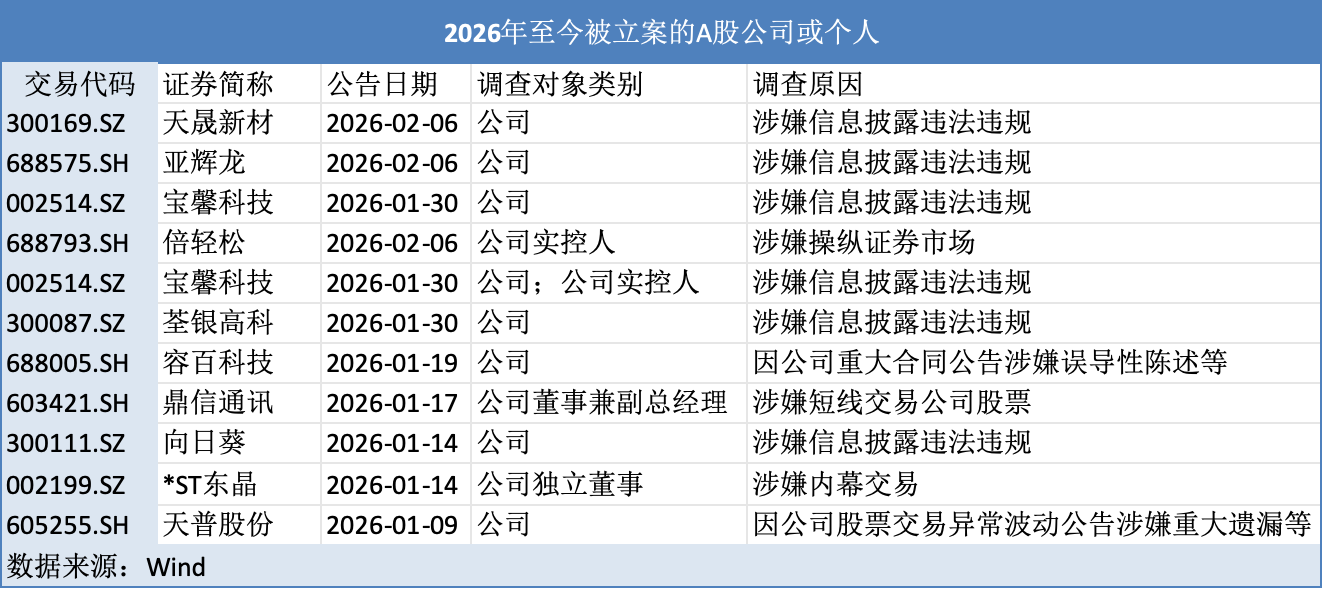
监管持续发威,一夜之间4家A股公司被立案或处罚
Di Yi Cai Jing Zi Xun· 2026-02-08 12:22
Core Viewpoint - The regulatory scrutiny on listed companies in China's A-share market has intensified, with multiple companies facing investigations and penalties for violations related to information disclosure and financial misconduct [2][10]. Group 1: Recent Investigations and Penalties - Two A-share companies, Tian Sheng New Materials and Yahui Long, were recently announced to be under investigation for suspected information disclosure violations [2][6]. - ST Funi was fined 6.5 million yuan for financial fraud involving collusion with a third-party company, which led to inflated profits of approximately 35.8 million yuan in 2020 [3][4]. - Rongbai Technology was fined 9.5 million yuan for misleading statements regarding a major contract, with the investigation concluding within a month [5][6]. Group 2: Overview of Violations - A total of eight A-share companies and four individuals have been investigated since the beginning of 2026, with the majority facing issues related to information disclosure violations [6][7]. - Specific cases include Baoxin Technology and its actual controller being investigated for information disclosure violations, and the independent director of *ST Dongjing being investigated for insider trading [7][8]. Group 3: Regulatory Environment - The regulatory environment has become increasingly stringent, with a significant number of companies being penalized for financial misconduct in 2025, particularly in the area of information disclosure violations [10][12]. - The China Securities Regulatory Commission (CSRC) has emphasized the need for a comprehensive system to combat financial fraud, indicating a shift towards proactive governance rather than reactive measures [12][13].





一夜之间4家A股公司被立案或处罚!监管持续发威,年初至今多家公司被查
Di Yi Cai Jing· 2026-02-08 10:44
Core Viewpoint - The regulatory scrutiny on A-share companies has intensified, with multiple companies being investigated and penalized for violations related to information disclosure and financial misconduct since 2026 [1][15]. Group 1: Recent Investigations and Penalties - Eight A-share companies and four related individuals have been investigated since 2026, with recent cases including Tian Sheng New Materials and Aihui Long, both facing allegations of information disclosure violations [1][9]. - ST Fuhua was fined 6.5 million yuan for financial fraud involving collusion with a third-party company, which led to inflated profits of approximately 35.8 million yuan in 2020 [3][4]. - Rongbai Technology was fined a total of 9.5 million yuan for misleading statements regarding a major contract with Ningde Times, which was deemed to lack accurate reflection of the actual terms [6][7]. Group 2: Specific Cases and Financial Impact - ST Fuhua's financial misconduct resulted in a reported revenue of 740 million yuan in 2020, a year-on-year increase of 169.36%, but the company still recorded a net loss when excluding the inflated profits [5][4]. - The inflated profits from ST Fuhua's subsidiary accounted for 120.18% of the total profit disclosed for that period, indicating severe discrepancies in financial reporting [4]. - The investigation into Rongbai Technology revealed that the announced sales figures were based on estimates and lacked contractual guarantees, leading to regulatory action [6][8]. Group 3: Broader Regulatory Trends - The regulatory environment has become increasingly stringent, with a notable increase in investigations into financial misconduct and information disclosure violations among A-share companies [15][19]. - In 2025, a total of 87 A-share companies were investigated, with over 40% being ST companies, highlighting a trend of heightened scrutiny in the market [16]. - The China Securities Regulatory Commission (CSRC) has emphasized a comprehensive approach to tackling financial fraud, involving collaboration with judicial authorities to enhance enforcement and accountability [18][19].
宁夏证监局全链条强化财务造假综合惩防
Shang Hai Zheng Quan Bao· 2026-02-03 18:19
Core Viewpoint - The Ningxia Securities Regulatory Bureau has implemented a comprehensive prevention and punishment system against financial fraud in listed companies, emphasizing a "zero tolerance" approach towards severe violations and fraudsters [1][2]. Group 1: Risk Prevention and Monitoring - Since 2025, the Ningxia Securities Regulatory Bureau has strengthened risk prevention, on-site inspections, and collaborative monitoring to build a comprehensive system against financial fraud [1]. - The bureau has conducted 35 meetings with independent directors and auditors from key listed companies, involving over 170 individuals, to enhance audit procedures and quality control [2]. - In 2025, the bureau imposed fines totaling 14.65 million yuan on one fraudulent company and its executives, and referred four individuals to law enforcement for their roles in financial fraud [2]. Group 2: Collaboration and Information Sharing - To expand sources of illegal clues and establish a cooperative governance framework, the bureau has formed a major information-sharing and law enforcement collaboration mechanism with 18 entities [3]. - The bureau has signed memorandums with various cities to improve the quality of financial disclosures by listed companies [3]. Group 3: Governance and Internal Control - The Ningxia Securities Regulatory Bureau has outlined three key measures to eliminate the motives for financial fraud: enhancing internal control mechanisms, strictly adhering to accounting standards, and ensuring high-quality information disclosure [4]. - Companies are required to implement effective internal control systems to prevent compliance from being merely formal and to enforce accountability for false financial reporting [4]. Group 4: Audit Oversight - The bureau has emphasized the importance of audit firms in identifying and preventing fraud, urging them to refuse to prepare false financial statements and to reduce dependency on single clients [5]. - Auditors are expected to maintain professional skepticism and resist undue pressure from clients, particularly regarding high-risk signals such as fictitious revenue and significant accounting errors [5].
严监管清除市场“害群之马” 促发展引入更多“源头活水”
Jin Rong Shi Bao· 2026-01-20 01:39
Core Viewpoint - The China Securities Regulatory Commission (CSRC) emphasizes the dual approach of "strict regulation" and "promoting development" to enhance the effectiveness and deterrence of regulatory enforcement in the capital market [1][2]. Regulatory Enforcement - In 2025, the CSRC intensified its regulatory efforts, handling 701 cases of securities and futures violations with fines totaling 15.47 billion yuan, reflecting a significant increase in enforcement effectiveness [1][2]. - The regulatory focus includes a comprehensive system to combat financial fraud and illegal activities in private equity funds, with 437 administrative penalties issued primarily for information disclosure violations, insider trading, and market manipulation [2]. - The CSRC's approach includes a full-chain enforcement mechanism, ensuring accountability not only for primary offenders but also for accomplices, with increased penalties for financial fraud cases [2]. Major Violations and Delisting - In 2025, 12 listed companies faced mandatory delisting due to severe violations, primarily involving systemic financial fraud and fraudulent issuance [3]. - The CSRC implemented the "Basic Rules for Administrative Penalty Discretion" to standardize and enhance the transparency of penalty decisions, allowing for more precise and differentiated penalties based on the nature and severity of violations [3]. Promoting Development - The CSRC aims to improve the quality of listed companies by enhancing information disclosure regulations, increasing the efficiency of mergers and acquisitions, and encouraging cash dividends and share buybacks to boost investor returns [5][6]. - In 2025, A-share listed companies achieved a record cash dividend of 2.55 trillion yuan, double the scale of IPOs and refinancing during the same period, indicating a positive trend in corporate governance and shareholder returns [6]. - The CSRC is focused on strengthening corporate governance, enhancing operational standards, and promoting high-quality development through comprehensive regulatory measures [6].
会同证监会深化资本市场法治建设,最高检表态从严惩治财务造假
Huan Qiu Wang· 2026-01-20 00:54
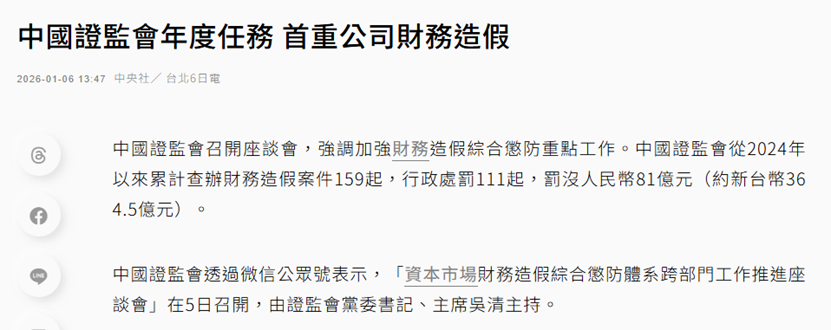
Core Viewpoint - The Supreme People's Procuratorate of China has emphasized the importance of utilizing legal power to support high-quality development, focusing on maintaining economic and financial security, and strictly punishing serious economic crimes to foster a law-based business environment [1][2]. Group 1: Regulatory Actions - The China Securities Regulatory Commission (CSRC) has intensified efforts to combat financial fraud since the issuance of guidelines on July 5, 2024, aimed at enhancing the comprehensive prevention and punishment of financial fraud in the capital market [1][2]. - In 2024, the CSRC has handled a total of 159 financial fraud cases, with 111 administrative penalties imposed, amounting to a total fine of 8.1 billion RMB [2][3]. - The CSRC has pursued accountability for major shareholders and actual controllers in 43 cases, while also punishing third parties involved in fraud as administrative accomplices [3]. Group 2: Market Impact - Eighteen companies involved in severe financial fraud have faced significant legal consequences, including mandatory delisting due to major violations [3]. - The CSRC has initiated investigations into 91 companies that have already been delisted to prevent them from evading responsibility [3]. - The ongoing efforts by the CSRC aim to enhance the quality and investment value of listed companies, thereby effectively protecting the legitimate rights and interests of investors [3].
筑牢不敢假、不能假、不想假防线
Sou Hu Cai Jing· 2026-01-10 23:19
Core Viewpoint - The Chinese capital market is intensifying efforts to combat financial fraud, with multiple departments collaborating to establish a comprehensive prevention and punishment system, signaling a strong regulatory stance against fraudulent activities [2][3]. Group 1: Regulatory Actions - Since July 2024, the China Securities Regulatory Commission (CSRC) has handled 159 financial fraud cases, imposing fines totaling 8.1 billion yuan, and has held major shareholders and actual controllers accountable in 43 cases [3][4]. - The regulatory approach has shifted from a single agency (CSRC) to a collaborative effort involving 12 departments, enhancing the overall enforcement capability [4]. - The comprehensive punishment and prevention system has evolved from post-incident penalties to a full-chain governance model that includes preemptive measures, ongoing supervision, and post-incident punishment [4][5]. Group 2: Accountability and Governance - The accountability framework has expanded from solely focusing on listed companies to include major shareholders, actual controllers, intermediary institutions, and third-party collaborators, addressing the low cost of illegal activities and high cost of rights protection for investors [4][5]. - The regulatory bodies are emphasizing a multi-faceted approach to accountability, ensuring that both primary offenders and accomplices are held responsible, thereby promoting fairness in the market [5][6]. - The role of intermediary institutions is being reinforced, with a shift in their responsibility from merely serving listed companies to protecting the interests of investors and maintaining market integrity [5][6]. Group 3: Preventive Measures - The construction of a comprehensive prevention and punishment system is entering a critical phase, focusing on enhancing legal frameworks and improving regulatory collaboration across administrative, criminal, and civil domains [6][7]. - There is a push for internal controls within listed companies and a call for the activation of independent directors to ensure that investors have rights and powers to supervise and voice concerns [6][7]. - The future direction includes leveraging technology, such as big data and artificial intelligence, to improve the detection and early intervention of fraudulent activities, thereby creating a more robust regulatory environment [7].

最高检:持续加大对财务造假犯罪的刑事追责力度
Zheng Quan Ri Bao Wang· 2026-01-10 04:05
Core Viewpoint - The Chinese judicial system is intensifying efforts to combat financial fraud, with a significant increase in prosecutions and a comprehensive multi-departmental approach to prevent and punish such crimes [1][2]. Group 1: Prosecution and Legal Actions - From 2024 to November 2025, a total of 191 individuals were prosecuted for financial fraud, with 102 prosecutions occurring from January to November 2025, representing a 21% year-on-year increase [1][2]. - The Supreme People's Procuratorate has placed 43 major financial fraud cases under special supervision, indicating a focused effort on high-profile cases [1][2]. Group 2: Multi-Departmental Collaboration - A meeting was held on January 5, 2025, involving multiple government departments, including the Supreme People's Court and the China Securities Regulatory Commission, to enhance the comprehensive prevention and punishment system for financial fraud [1]. - Since the issuance of the "Comprehensive Prevention and Punishment Opinions" on July 5, 2024, a multi-faceted accountability system has been established, integrating administrative enforcement, criminal punishment, civil recovery, and integrity constraints [1][2]. Group 3: Legal Framework and Case Management - The Supreme People's Procuratorate is actively involved in the construction of a comprehensive accountability system, ensuring that cases of financial fraud are handled with high quality and efficiency [2]. - The establishment of case standards and the issuance of guidelines for handling securities and futures violations have been prioritized to improve the legal framework surrounding financial fraud cases [2]. Group 4: Future Directions - The prosecutorial authority plans to continue increasing criminal accountability for financial fraud, enhance case handling norms, and strengthen inter-departmental cooperation to better protect investors' rights and support the high-quality development of the capital market [3].
财务造假综合惩防体系不断深化 法治护航资本市场健康发展
Xin Lang Cai Jing· 2026-01-09 22:52
Core Viewpoint - The Chinese regulatory authorities are enhancing the comprehensive prevention and punishment system for financial fraud in the capital market, with a focus on strengthening collaboration among various departments to ensure effective enforcement and accountability [1][2][3]. Group 1: Regulatory Developments - The China Securities Regulatory Commission (CSRC) held a meeting on January 5, 2024, with representatives from multiple government departments to discuss the advancement of the comprehensive prevention and punishment system for financial fraud [1]. - Since the issuance of the "Comprehensive Prevention and Punishment Opinions" on July 5, 2024, a multi-faceted accountability system has been established, integrating administrative enforcement, criminal punishment, civil recovery, and integrity constraints [1]. Group 2: Prosecution Statistics - From 2024 to November 2025, a total of 191 individuals were prosecuted for financial fraud, with 102 prosecutions occurring between January and November 2025, representing a 21% year-on-year increase [2]. - Major financial fraud cases, including those involving Jinzhou Port, Jintongling, Meishang Ecology, and Zijing Storage, have been publicly prosecuted, demonstrating a strong deterrent effect against financial fraud [2]. Group 3: Future Directions - The prosecutorial authorities plan to continue implementing Xi Jinping's legal thought and directives regarding the capital market, increasing criminal accountability for financial fraud, and enhancing collaboration among departments [3]. - There will be a focus on improving case handling standards and exploring the integration of civil and criminal accountability to better protect investors' rights and support the high-quality development of the capital market [3].
三家会计师事务所同日被监管 资本市场“看门人”为何失守?
Jing Ji Guan Cha Wang· 2026-01-08 06:44
Core Viewpoint - The China Securities Regulatory Commission (CSRC) has intensified its crackdown on financial fraud, having investigated 159 cases and imposed administrative penalties totaling 8.1 billion yuan in 2024, emphasizing the need to hold intermediary institutions accountable for their roles in financial misconduct [1][2][7]. Group 1: Regulatory Actions - The Shenzhen Securities Regulatory Bureau issued warning letters to three accounting firms for various auditing deficiencies, including errors in consolidation scope, ineffective confirmation procedures, and lack of sufficient audit evidence [1][2][3]. - The regulatory measures were implemented shortly after a CSRC meeting aimed at enhancing the comprehensive prevention and punishment system for financial fraud, indicating a coordinated effort to improve audit quality and accountability [2][6]. Group 2: Audit Quality Issues - The issues identified in the three accounting firms highlight critical weaknesses in auditing practices, such as formalistic audit procedures and inadequate risk assessment, which could lead to significant audit risks being overlooked [3][4]. - Specific failures included the inability of Lixin CPA to obtain sufficient evidence for complex transactions, Dahuang CPA's neglect of internal controls, and Beijing Zhongtian Huamao CPA's misjudgment regarding the consolidation scope of financial statements [3][4][5]. Group 3: Legal and Regulatory Framework - The violations by the accounting firms were linked to specific provisions in the Chinese CPA auditing standards, emphasizing the importance of maintaining professional skepticism and obtaining adequate audit evidence [5]. - The actions taken by the Shenzhen Securities Regulatory Bureau reflect a legal framework that holds accounting firms accountable for their responsibilities as gatekeepers in the financial reporting process [5][8]. Group 4: Industry Implications - The regulatory crackdown signals a shift from mere compliance to effective oversight in the auditing industry, aiming to enhance the quality of financial disclosures and restore market confidence [6][8]. - The ongoing pressure on auditors to fulfill their substantive responsibilities is crucial for improving the overall integrity of the capital market and ensuring efficient resource allocation [8].
“三管齐下”惩防财务造假
Zheng Quan Ri Bao· 2026-01-07 17:21
Core Viewpoint - The China Securities Regulatory Commission (CSRC) has convened a meeting to advance a comprehensive system for preventing and punishing financial fraud in the capital market, highlighting the achievements since the release of the 2024 guidelines and outlining future directions for deepening these efforts [1] Group 1: Long-term Mechanism Construction - The construction of a normalized and long-term mechanism is essential to establish a robust defense against financial fraud, which is characterized by strong profit-driven motives and high concealment [2] - Since 2024, the CSRC has handled 159 financial fraud cases, imposed 111 administrative penalties totaling 8.1 billion yuan, and investigated 91 delisted companies, demonstrating the continuity and depth of the comprehensive prevention and punishment work [2] - The future focus will be on enhancing internal governance, solidifying the responsibilities of intermediaries, and improving financial information disclosure systems to create an ecosystem where financial fraud is deterred [2] Group 2: Systematic Thinking and Comprehensive Measures - Financial fraud often involves long chains and multiple parties, necessitating a comprehensive approach rather than single regulatory measures [3] - The meeting emphasized the need for a problem-oriented and systematic approach to effectively combat financial fraud, targeting both the main perpetrators and those providing assistance [3] - Future efforts will enhance the synergy and penetration of comprehensive measures, improving the connection between administrative enforcement, criminal punishment, and civil compensation to significantly increase the costs of illegal activities [3] Group 3: Innovation-Driven Policy Implementation - The effectiveness of systems relies on execution, and innovation is key to enhancing execution efficiency [4] - Utilizing technologies such as big data and artificial intelligence will improve the identification of hidden and new forms of financial fraud [4] - Innovations in investor protection mechanisms, such as representative lawsuits and advance compensation, will lower the costs of investor rights protection and improve the efficiency of rights relief [4] - The integration of innovative measures will ensure that the comprehensive prevention and punishment system is not only strict but also intelligent [4]