
货币互换额度

Search documents
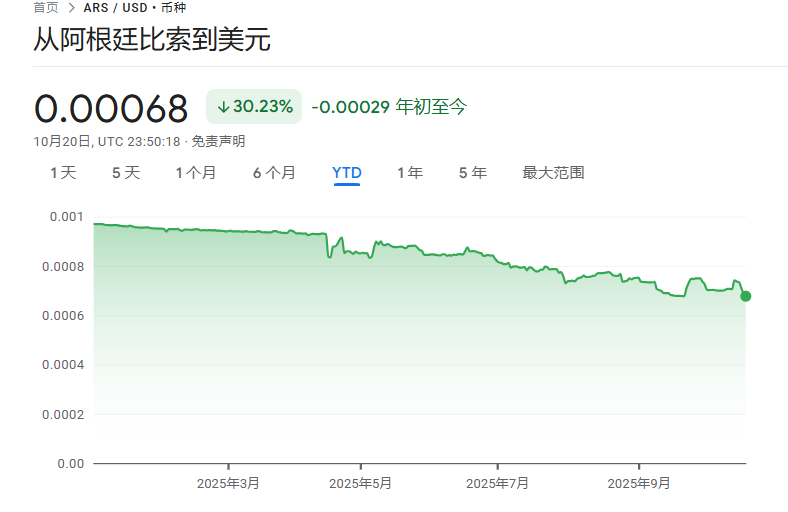
尽管美国三次干预,阿根廷比索仍然创下新低
Hua Er Jie Jian Wen· 2025-10-21 00:19
Core Viewpoint - The Argentine peso continues to decline, reaching a historic low despite multiple interventions by the U.S. Treasury, driven by investor concerns over the upcoming midterm elections on October 26 [1][3][4]. Group 1: U.S. Intervention and Market Response - The U.S. Treasury has intervened in the market by purchasing approximately $400 million worth of pesos since October 9, although this figure has not been confirmed by either government [4]. - A $20 billion currency swap arrangement was announced between the U.S. and Argentina, with discussions of potentially increasing this to $40 billion [5]. - Despite these measures, confidence in the peso has collapsed, leading to a significant demand for dollars as investors anticipate a sharp devaluation post-election [5][6]. Group 2: Political Uncertainty and Market Dynamics - The market turmoil began after President Milei's party faced setbacks in key local elections, raising concerns about his ability to implement reforms [6]. - Investors are closely watching the upcoming midterm elections, fearing that Milei may not secure enough support for his reform agenda, which has translated into a sell-off of the national currency [6][7]. - The demand for dollars remains strong and is expected to persist until the election results clarify the future of exchange rate policies [7]. Group 3: Foreign Exchange Reserves and Devaluation Expectations - Argentina's central bank is facing dwindling hard currency reserves, with net reserves estimated to be below $5 billion [8]. - The low reserve levels have heightened fears that the Milei government may be forced to abandon the current exchange rate regime, leading to a significant devaluation of the peso [8]. - Offshore market indicators, such as non-deliverable forward (NDF) contracts, suggest that the market is pricing in a rapid depreciation of the peso beyond the official trading range, with predictions that the exchange rate could fall below 1600 pesos per dollar [8].

贝森特宣布美国财政部干预阿根廷外汇市场,称敲定200亿美元互换额度框架
Sou Hu Cai Jing· 2025-10-09 19:29
Group 1 - The U.S. Treasury intervened in the Argentine foreign exchange market on October 9 [1] - U.S. Treasury Secretary Basent discussed Argentina's strong economic fundamentals and finalized a $20 billion currency swap framework [1] - President Trump and Argentine President Milei are scheduled to meet on October 14 [1] Group 2 - The Argentine peso appreciated by 0.7% against the U.S. dollar, reversing an earlier decline of 2.7% on October 9 [1]
欧洲央行副行长:欧美1.15对通胀目标而言并非重大阻碍
news flash· 2025-06-16 05:16
Core Viewpoint - The European Central Bank (ECB) Vice President, Luis de Guindos, stated that the current euro to dollar exchange rate of 1.15 does not pose a significant obstacle to achieving the inflation target [1] Group 1: Inflation and Economic Growth - The current appreciation of the euro is not rapid and the volatility is not extreme, indicating a stable economic environment [1] - The risks associated with inflation are balanced, with limited risks of falling below the target, as the inflation rate is very close to the target [1] - The ECB believes that tariffs will simultaneously reduce both economic growth and inflation levels in the medium term [1] Group 2: Market Perception and Policy - The market fully understands the communication following policy decisions, reflecting confidence in the ECB's approach [1] - The ECB is confident that the Federal Reserve will maintain currency swap lines, indicating a collaborative monetary policy stance [1] - The discussion regarding the repatriation of gold reserves from New York has not been addressed, suggesting a focus on current monetary policy rather than asset management [1]