贴息操作

Search documents
基金销售结算新机制出台!理财“贴息玩法”如何被堵?一图看懂
Sou Hu Cai Jing· 2025-11-26 11:30
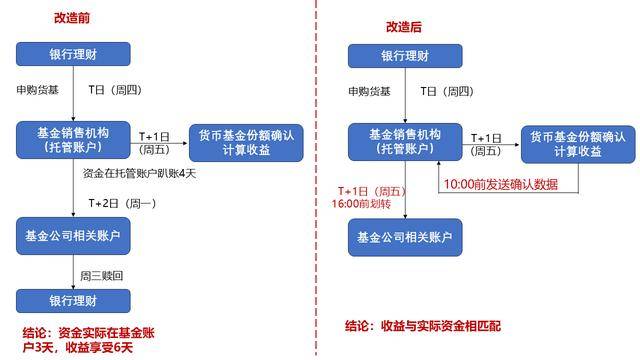
Core Viewpoint - The regulatory authority has issued a new notice to optimize the fund sales settlement mechanism, aiming to enhance the efficiency of fund subscription fund transfers and reduce the time funds are in transit [1][8]. Group 1: Regulatory Changes - The notice specifies that for off-site money market funds, fund managers must send confirmation and clearing data to sales institutions by 10:00 on the subscription confirmation day, and sales institutions must transfer confirmed subscription funds to the fund's registration account by 16:00 on the same day [1][8]. - This optimization addresses the previously controversial "money fund enhancement" loophole, which had been exploited by some bank wealth management products [1][8]. Group 2: Impact on Bank Wealth Management - The "money enhancement" strategy, which allowed clients to receive additional returns through third-party sales institutions, is significantly impacted by the new regulations [3][6]. - The previous method involved a timing strategy where funds would be held in a third-party bank's account for several days, allowing for interest accumulation that was then partially returned to the wealth management company, effectively increasing returns beyond the actual fund performance [4][5][6]. Group 3: Stakeholder Effects - The optimization of the fund sales settlement mechanism reduces the operational space for bank wealth management's "interest subsidy" practices, which had previously benefited multiple parties at the expense of ordinary fund investors [6][8]. - The new regulations are expected to promote compliance and transparency in investment strategies, moving away from gray operations that previously existed [8]. Group 4: Fund Market Data - As of September 2025, the scale of money market funds reached 14.67 trillion, accounting for 40% of public funds [9]. - By the end of 2023, bank wealth management investments in public funds amounted to 0.61 trillion, representing 2.1% of the total, with a peak allocation of 1.38 trillion (4.2%) reached by the second quarter of 2024 [12].