资产定价权

Search documents
上币周期进化论:昨日的风,飞不了今天的筝
Xin Lang Cai Jing· 2026-02-22 12:46
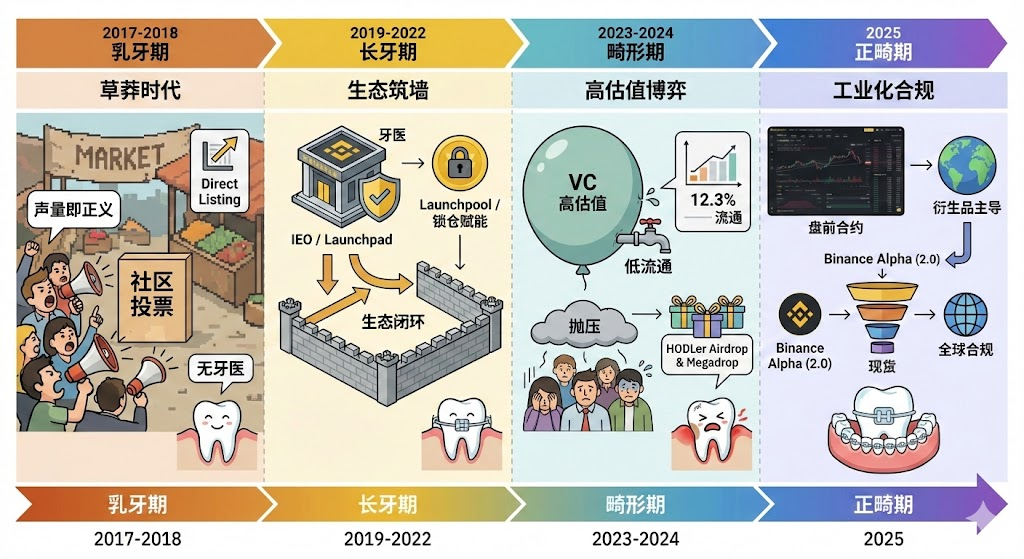
Core Viewpoint - The evolution of the cryptocurrency listing process is likened to orthodontics, transitioning from a chaotic state in 2017 to an industrialized model by 2025, with each token distribution method reflecting structural corrections in the industry [1] Group 1: Stages of Listing Evolution - The listing process is divided into four stages: Baby Teeth, Growing Teeth, Deformed, and Orthodontics, with the core focus being on who holds the asset pricing power [4][7] - The first stage (2017-2018) saw pricing power in the hands of "shouters" and grassroots communities, leading to a noisy market where bad assets drove out good ones [4][7] - The second stage (2019-2022) marked a shift to exchanges regaining pricing power through IEOs and Launchpads, acting as gatekeepers and investment banks [4][10] - The third stage (2023-2024) experienced a collapse of VC pricing power, resulting in low liquidity for retail investors and forced exchanges to intervene [5][15] - The fourth stage (2025) anticipates a market driven by ETF flows and corporate earnings, with pricing power shifting to more mature financial mechanisms [20][21] Group 2: Historical Context and Logic - The first stage (2017-2018) was characterized by a lack of regulation, where exchanges had high decision-making freedom and community voting determined liquidity [9][10] - The second stage (2019-2022) focused on credit repair and ecosystem building, with exchanges conducting thorough due diligence to ensure project credibility [12][13] - The third stage (2023-2024) faced challenges from high valuations and low circulation, leading to significant potential selling pressure in the market [18][19] - The fourth stage (2025) is expected to see the cryptocurrency market industrialize, with a total market value exceeding $4 trillion and perpetual contracts dominating trading volume [20][21] Group 3: Evolution of Listing Fees - The evolution of listing fees reflects a power shift in the industry, transitioning from "paying for access" to "spending wealth for liquidity" [29][30] - In the first stage (2017-2018), listing fees were often opaque and varied widely, with exchanges benefiting directly from these fees [29][30] - The second stage (2019-2022) saw a shift to ecosystem sharing, where projects allocated tokens to platform users instead of paying direct fees [30][31] - The third stage (2023-2024) introduced mandatory token allocations to counter VC monopolization, with exchanges enforcing distribution to users [31][32] - By 2025, the listing fee structure is expected to reflect a "wealth-destroying dowry" model, where projects must allocate significant portions of their tokens to gain access to top-tier platforms [33][34][37]

中美抢资产定价权!稀土卡脖黄金暴涨,暗战升级进入白热化
Sou Hu Cai Jing· 2025-10-20 10:21
Group 1 - The core issue revolves around the competition for "asset pricing power" between China and the United States, with gold and silver prices rising alongside the stability of the US stock market [2][4][5] - The US stock market's resilience is largely supported by the "AI narrative," which has inflated tech stock valuations despite weakening economic indicators [4][5] - Gold prices are linked to the US Federal Reserve's monetary policy, with recent surges driven by fears of the Fed losing its independence and the potential devaluation of the dollar [7][20] Group 2 - China's control over rare earth elements is significant not for their immediate value but for their critical role in the semiconductor supply chain, which could disrupt US tech valuations [9][11][16] - The semiconductor industry is highly sensitive to supply chain disruptions, and rare earths are essential materials that cannot be easily substituted [11][13] - China's recent rare earth regulations introduce uncertainty into the supply chain, impacting US tech companies' valuations due to the unpredictability of supply [13][16] Group 3 - The US is responding to China's actions by potentially increasing monetary supply to maintain financial asset pricing power, which could lead to inflation [18][20] - The US government's budget impasse allows for increased debt issuance, which may further complicate the Federal Reserve's ability to manage monetary policy independently [18][20] - China's recent shipping fee regulations target US inflation indirectly, as increased costs will ultimately affect American consumers and could hinder the US's monetary strategies [23][26] Group 4 - China's strategy is to leverage its control over physical assets like rare earths and shipping to challenge US financial asset pricing power [29][41] - The competition is fundamentally a race against time, with China aiming to stabilize its debt and transition its economy within five years while the US seeks to disrupt this process [32][37] - The ongoing struggle for pricing power will shape the economic landscape over the next decade, with both nations vying for dominance in asset valuation [39][41]