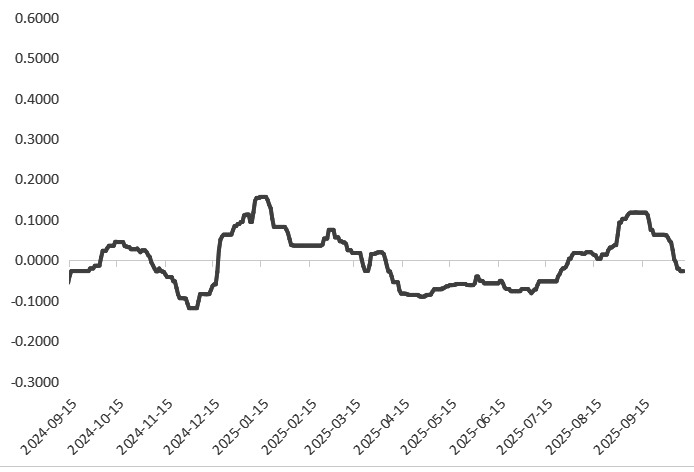
资产欠配

Search documents
期债修复窗口开启
Qi Huo Ri Bao· 2025-10-14 20:00
Core Viewpoint - The bond futures market has experienced fluctuations driven by policy expectations and risk aversion, with significant performance in the 10-year and 30-year bonds [1] Group 1: Market Dynamics - Since September, the bond futures market has gone through a cycle of "volatile decline → rebound driven by policy expectations → increase driven by risk aversion" [1] - The 30-year bond futures contract hit a six-month low on September 24, while the 10-year bond futures fluctuated around 107.7 yuan [1] - After the National Day holiday, a relaxed funding environment helped the bond market recover, with the 10-year bond yield dropping by 3.2 basis points to 1.743%, marking a new low for the period [1] Group 2: Trade Tensions Impact - The escalation of trade tensions has introduced new shocks to the market, with "TACO trading" being the main theme prior to late September [2] - Historical patterns indicate that trade tensions affect the real economy primarily through inventory cycles, with U.S. importers stockpiling goods before new tariffs take effect [2] - The Nasdaq Composite Index's price-to-earnings ratio has increased from 24 times in April to 31 times currently, suggesting a higher likelihood of market volatility [2] Group 3: Domestic Asset Allocation - The logic of under-allocation in domestic assets continues, with expectations of seasonal declines in credit issuance as the "golden September and silver October" peak season passes [3] - The insurance industry is projected to generate over 3 trillion yuan in new premiums by 2025, creating a rigid allocation gap for long-term bonds [3] - The expectation of the inclusion of Chinese government bonds in global indices may lead to a cessation of foreign capital reduction, prompting increased allocation to government and local bonds, particularly 30-year and 50-year bonds [3] Group 4: Monetary Policy Outlook - The central bank is expected to maintain a moderately loose monetary policy, with a projected 0.5 percentage point reserve requirement ratio cut in the fourth quarter to support economic growth [3] - The central bank will utilize open market operations and other tools to ensure ample liquidity, with the DR007 rate likely to remain between 1.5% and 1.6% [3] - A downward testing of the 10-year bond yield towards 1.70% is possible if credit expansion remains weak, with the policy mix potentially shifting to a "loose + hedging" model [3]