资产流动

Search documents
构筑数字文化新生态:iBox的融合创新与产业赋能之路
Jin Tou Wang· 2026-01-22 06:36
Core Viewpoint - The integration of traditional culture with the digital age is creating unprecedented vitality and value, driven by the domestic cultural digital asset platform iBox, which acts as an integrator and enabler of digital transformation in the cultural industry [1][2]. Group 1: iBox's Role and Technology - iBox is not merely a technology user or content transporter; it leverages blockchain and other digital technologies to create a transparent and traceable cultural digital asset service system, addressing the challenges of value realization in the digital world [1][2]. - By providing immutable rights confirmation and storage through blockchain technology, iBox assigns a unique digital identity and credible ownership record to each cultural digital asset, establishing a foundation of user trust [1][2]. Group 2: Collaborative Ecosystem - iBox has built a highly open and multi-win ecological cooperation network, collaborating with cultural state-owned enterprises and platforms like JD.com to ensure deep cultural content and industry development standards [2][3]. - The partnership with JD.com exemplifies a classic integration of "platform + technology + culture," allowing cultural treasures like the Dehua porcelain "Guanyin" to reach a vast audience digitally, showcasing the potential of cultural digital consumption [2][3]. Group 3: Impact and Recognition - The ecosystem-driven innovation model of iBox significantly expands the boundaries of cultural expression and industry value, collaborating with hundreds of well-known IPs to stimulate new digital cultural consumption [3][4]. - iBox's non-heritage digitalization case has received recognition from various levels, including being featured in "Cultural Digitalization New Scenarios and Cases" and reported by CCTV, highlighting its social value in cultural inheritance and innovative dissemination [3][4]. Group 4: Future Directions - iBox is responding to and shaping the future of the industry by advocating for a shift towards "virtual and real integration, asset flow, and ecological collaboration," positioning itself as a pioneer in the digital cultural industry [3][4]. - The core logic of iBox's path is to build a solid development foundation with credible technology and gather industry synergy through an open ecosystem, promoting a more regulated, transparent, and vibrant digital cultural industry [4].
Heritage (HGBL) - 2025 Q3 - Earnings Call Transcript
2025-11-06 23:00
Financial Data and Key Metrics Changes - The company reported EBITDA of $1.4 million for Q3 2025, a decrease from $1.9 million in the prior year period [3][10] - Consolidated operating income was $1.3 million in Q3 2025, down from $1.5 million in Q3 2024 [7] - Net income for Q3 2025 was approximately $600,000 or $0.02 per diluted share, compared to $1.1 million or $0.03 per diluted share in Q3 2024 [10] - Adjusted EBITDA decreased to $1.6 million from $1.9 million year-over-year [10] - Stockholders' equity increased to $66.5 million as of September 30, 2025, compared to $65.2 million at the end of 2024 [11] Business Line Data and Key Metrics Changes - The industrial assets division reported operating income of approximately $900,000 in Q3 2025, up from approximately $700,000 in the prior year [8] - The financial assets division reported operating income of $1.6 million in Q3 2025, down from $1.8 million in Q3 2024 [8] - The ALT segment improved operating income to approximately $400,000 in Q3 2025 from approximately $200,000 in Q3 2024 [8] Market Data and Key Metrics Changes - The company noted a healthy amount of auctions, primarily smaller-scale activities, as larger companies opted to delay significant transactions due to economic uncertainty [9] - Consumer debt remains high, but credit performance metrics suggest market stabilization [10] - Regional banks are facing increased scrutiny over loan quality, which may lead to higher charge-offs and non-performing loan volumes [10] Company Strategy and Development Direction - The company is focused on M&A as a critical component of its long-term strategy, with a sharpened focus on accretive transactions [11][12] - The CEO emphasized a tactical execution phase for M&A, identifying companies that can plug gaps and create long-term shareholder value [5][13] - The company is nearing completion of a new facility in San Diego, which supports its next growth phase [9] Management Comments on Operating Environment and Future Outlook - Management expressed optimism about future opportunities, particularly in light of increasing distressed assets reported by regional banks [4][10] - The company is prepared to capture market share as opportunities arise, with a strong balance sheet and cash position [11][12] - Management acknowledged the challenges of a wait-and-see economy but highlighted successful smaller transactions that contributed to profitability [4][18] Other Important Information - The company authorized a new share repurchase program allowing for the repurchase of up to $7.5 million in common stock over the next three years [12] - The only remaining debt on the balance sheet is a mortgage for the new headquarters, with a capacity on the line of credit at zero balance [20] Q&A Session Summary Question: Capital allocation strategy regarding M&A versus stock buybacks - Management indicated that while the stock is undervalued, the focus remains on M&A transactions that will drive growth, but they are prepared to buy back stock if necessary [16] Question: Activity in the industrial assets division - Management noted that many companies are in a hold-on mode, releasing surplus assets but delaying significant decisions due to economic uncertainty [18] Question: Update on Heritage Capital portfolio - Management reported progress in aligning with senior lenders and executing a plan to work down the portfolio, with positive initial results [28]

外国需求将减弱,高盛预测美元还要跌
凤凰网财经· 2025-06-25 13:06
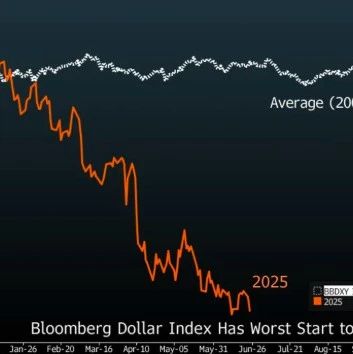
Core Viewpoint - The article discusses the significant decline of the US dollar in the first half of 2025, highlighting its worst performance in decades, driven by various factors including geopolitical uncertainties and changing investor behaviors [2][4]. Group 1: Dollar Decline - The Bloomberg Dollar Index has dropped over 8% this year, marking the worst start to a year on record, while the ICE Dollar Index has seen a decline of approximately 9%, potentially the worst performance since 1986 [2]. - Richard Chambers from Goldman Sachs anticipates that the dollar's weakness will continue as foreign investors increase their currency hedging [4][5]. Group 2: Foreign Demand and Investment Trends - Analysts suggest that the significant drop in the dollar index is largely due to uncertainties stemming from US policies, particularly those of President Trump, which have shaken investor confidence [6]. - Although there are no clear signs of a mass withdrawal from the US bond market by foreign investors, Chambers predicts a decrease in foreign demand, particularly as European investors may prefer to invest domestically [6][7]. Group 3: Currency Swap Indicators - A recent indicator in the foreign exchange market, the cross-currency basis swap, has shown a notable shift, signaling a decrease in demand for the dollar [8][11]. - Analysts from Morgan Stanley and Goldman Sachs have observed that the willingness of investors to purchase dollar-denominated assets is declining, while interest in euro and yen-denominated assets is increasing [11][12].