
资源战略升级

Search documents
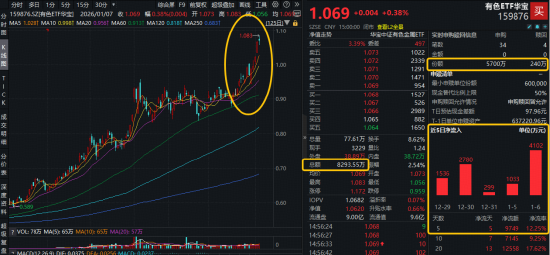
涨了又涨!四大逻辑共振,有色ETF华宝(159876)盘中上探1.6%续创新高!全天获资金净申购5460万份!
Xin Lang Cai Jing· 2026-01-07 11:37
Group 1 - The core viewpoint of the news is that the non-ferrous metal sector is experiencing a strong upward trend, with the Huabao Non-Ferrous ETF (159876) showing significant gains and attracting substantial capital inflows [1][8] - On January 7, the Huabao Non-Ferrous ETF reached a peak intraday increase of over 1.6%, closing with a gain of 0.38% and a total trading volume of 82.93 million yuan, reflecting a 14% increase in volume compared to the previous day [1][8] - The ETF has seen a net subscription of 54.6 million units on the same day, continuing a trend of net inflows totaling 97.49 million yuan over the past five days [1][8] Group 2 - The current rally in the non-ferrous metal market is attributed to four main factors: rigid supply constraints, explosive demand for new production capabilities, global liquidity easing, and strategic resource upgrades [2][9] - Macroeconomic indicators suggest that the Federal Reserve may lower interest rates by over 100 basis points this year, which could create a favorable environment for the non-ferrous market [2][9] - The Chinese government is considering tightening export license reviews for medium and heavy rare earth items, which could impact supply dynamics [2][9] Group 3 - As of January 6, several leading companies in the non-ferrous metal sector, including Chifeng Jilong Gold Mining and Zijin Mining, have forecasted double-digit growth in net profits for 2025, with Zijin Mining expected to achieve a net profit of 51 to 52 billion yuan, representing a year-on-year increase of 59% to 62% [2][9] - The market outlook for the first quarter of 2026 is optimistic, driven by a combination of easing credit policies and seasonal demand ahead of the Lunar New Year [3][10] - The prices of key metals such as copper and nickel have reached record highs, indicating strong demand and market confidence [2][3]

突发特讯!7亿吨!甘肃平凉矿藏大发现:是资源红利还是经济转型新引擎?
Sou Hu Cai Jing· 2025-11-06 13:41
Core Insights - The discovery of a 700 million ton magnesite deposit in Gansu's Tongren District marks a significant breakthrough in resource exploration in Northwest China, indicating a shift from passive resource development to proactive strategic planning in China's resource strategy [1][3]. Resource Endowment: A Geological Miracle - The Turnmatai deposit features five layered ore bodies with an average MgO content of 20.67%, surpassing domestic averages and nearing global top-tier standards [3]. - The deposit's favorable conditions, including shallow burial depth and stable thickness, allow for open-pit mining, reducing costs by over 40% compared to traditional underground mining [3][5]. - In addition to the 700 million tons of magnesite, there are 300 million tons of construction-grade dolomite, leading to a resource utilization rate exceeding 90% [5]. Economic Implications: Transforming Resource Dividends into Industrial Advantages - The 700 million tons of ore could support a 1 million ton per year magnesium metal project for 70 years, potentially reshaping the industrial raw material supply chain in Northwest and nationwide [6]. - The production from the deposit could lower domestic magnesium prices by 15%-20%, impacting the pricing power of overseas mining companies [6][8]. Strategic Significance: Geopolitical Implications of Resource Security - The deposit serves as a strategic insurance for China's magnesium industry, especially as the country has increased its dependence on imports from Australia and Turkey [9]. - The timing of the discovery coincides with the US Geological Survey's upgrade of China's magnesium resource risk level, highlighting Western concerns over China's resource control [11]. Ecological Controversies: Balancing Development and Environmental Protection - The mining area is located in an ecologically sensitive region, raising concerns about potential environmental impacts such as soil erosion and dust pollution [12]. - The proposed mining plan includes advanced techniques for ecological protection, such as layered stripping and gradient backfilling, with strict requirements for ecological restoration [14]. Global Perspective: China's Role in Resource Restructuring - The discovery aligns with global shifts in resource dynamics, as countries reinforce resource nationalism, impacting international supply chains [15][17]. - China's ability to respond to resource challenges and reshape rules in the resource sector is emphasized, showcasing a transition from passive to proactive strategies [17]. Conclusion: The Next Phase of Resource Revolution - The discovery of the 700 million tons of ore is seen as the beginning of a new era in China's resource strategy, moving towards comprehensive control over the entire industrial chain [18][20]. - The success of this resource revolution will depend on balancing development intensity with ecological capacity and enhancing China's voice in global resource governance [20].
