全球流动性宽松

Search documents
洪灝:最新观点——2026大概率会诞生一个伟大的泡沫
Xin Lang Cai Jing· 2026-02-27 02:31
Group 1 - The Federal Reserve is likely to continue lowering interest rates in January [2][56] - Current short-term liquidity in the US is tightening, with repo rates exceeding the benchmark rate, prompting the Fed to expand its balance sheet and lower rates [3][14][15] - Forward inflation expectations in the US are unlikely to decline; if the Fed persists in lowering rates amid high inflation expectations, it will weaken the dollar's credibility and drive up precious metal prices [4][57] Group 2 - Gold is currently valued around $4500 per ounce, which is considered a fair valuation based on trend lines [5][73] - In the new credit system, gold serves as the "anchor" for all valuations, and the price target for gold is linked to the depth of its "cup" formation [6][21][75] - Silver has not yet reached its peak, and the price target for silver is also expected to rise significantly [6][78] Group 3 - Global liquidity conditions are continuously improving, with liquidity indicators leading fundamental changes by 6-12 months [6][88] - The year 2026 is anticipated to be at the peak of a long-term stock market return cycle, likely resulting in a significant market bubble, which presents an opportunity for investors [8][42][45] - In a liquidity-rich environment, various asset classes, including industrial commodities, gold, silver, and Chinese tech stocks, are expected to perform well [9][55][106]


超长春节假期持股还是持币?市场对经济“开门红”预期增强
Nan Fang Du Shi Bao· 2026-02-11 09:32
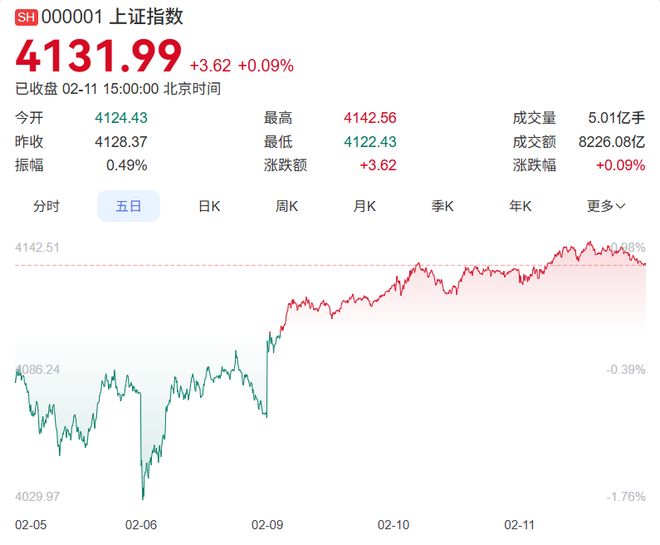
Market Performance - The three major indices showed mixed results, with the Shanghai Composite Index rising by 0.09%, while the Shenzhen Component Index and the ChiNext Index fell by 0.35% and 1.08% respectively [1] - Trading volume decreased, with the total turnover of the Shanghai and Shenzhen markets falling below 2 trillion yuan, a reduction of 121.3 billion yuan compared to the previous trading day [1] Investment Sentiment - Many institutions recommend holding stocks during the upcoming long nine-day Spring Festival holiday, citing historical trends where trading activity typically declines before the holiday but rebounds significantly afterward [3] - Historical data indicates that the average trading volume in the week following the Spring Festival increases by 22.3% compared to the week before, with an 81% probability of the Shanghai Composite Index rising by an average of 1.8% in the week prior to the holiday [3] Private Equity Insights - A survey by Private Equity Network shows that 62.16% of private equity firms prefer to hold heavy or full positions during the holiday, believing that market fluctuations will not alter structural opportunities [3] - 69.23% of private equity firms are optimistic about the post-holiday market, expecting stabilization and a potential upward trend [4] Market Outlook - Tianfeng Securities suggests that the spring market may strengthen this year due to favorable policy expectations and trends in capital allocation towards equity assets [5] - China Galaxy Securities anticipates that after the holiday, market focus will shift back to growth sectors with clear performance catalysts, predicting a more moderate and stable upward trend in the market [5]
有色板块“炸锅”!“超级牛股”飙涨,公募基金却“躲着走”?
Hua Xia Shi Bao· 2026-02-04 09:17
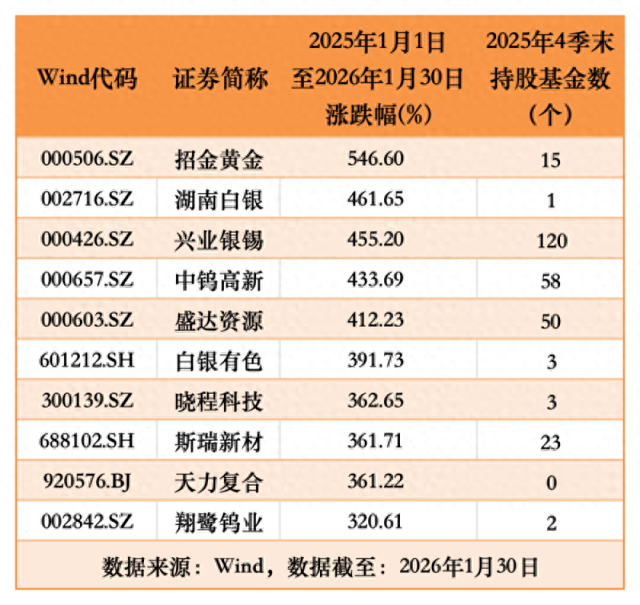
Core Insights - The article highlights a paradox in the non-ferrous metals sector where despite a significant bull market, very few public funds have captured the top-performing stocks [1][2] - The analysis indicates that institutional investors are generally avoiding stocks with historical governance issues or high uncertainty, even if market expectations are strong [2][3] Group 1: Stock Performance and Fund Holdings - Some non-ferrous metal stocks have seen remarkable price increases, with Zhaojin Gold rising over 540% and Xiaocheng Technology increasing over 362% since 2025 [2] - As of the end of 2025, Zhaojin Gold was held by only 15 funds, Xiaocheng Technology by 3 funds, and Hunan Silver by just 1 fund, indicating a lack of institutional interest in these high-performing stocks [2][4] Group 2: Institutional Investment Behavior - Public funds are constrained by strict compliance frameworks and risk management systems, leading to cautious investment decisions regarding companies with historical flaws or high operational uncertainty [3][4] - The preference for larger, more stable companies is evident, as only 17 non-ferrous stocks are held by over 100 funds, primarily those with market capitalizations exceeding 50 billion [4][5] Group 3: Market Trends and Future Outlook - The current non-ferrous metal market is supported by a multi-dimensional logic, including global liquidity easing and anticipated continued monetary and fiscal stimulus [6][8] - Supply constraints and new demand from sectors like AI and energy transition are focal points for institutional investors, with copper, gold, and aluminum identified as key investment directions [8][9]






贵FOMO贵贵贵
Zi Jin Tian Feng Qi Huo· 2026-02-03 07:58
Report Industry Investment Rating - Not provided in the content Core Viewpoints - Last week, influenced by the reaffirmation of the strong - dollar stance by Baysent and the nomination of Kevin Warsh as the Fed Chair, the US dollar index strengthened, leading to a concentrated sell - off of precious metals. London spot gold fell nearly 20%, and silver dropped by as much as 40%. Global major stock markets were also under pressure [3]. - The sharp correction of precious metals is due to the structural fragility accumulated during the previous rapid - rise phase. However, the logic of global liquidity easing may not reverse, and the "depreciation trade" macro - theme is not likely to enter a head - wind period easily. The Fed Chair nominee's operation space on the balance sheet is restricted by fiscal realities, and shrinking the balance sheet may increase debt pressure, which may not be bearish for gold in the long - term [3]. - The current market panic may provide an opportunity for rational investors. After the panic subsides and the market structure stabilizes, investors can consider gradually deploying to seize the allocation opportunities [3]. Summary by Directory Overseas Main Interest Rates - The pricing of interest rate cuts remained stable last week. The money market still factored in the possibility of two 25 - bps interest rate cuts this year, despite the nomination of Kevin Warsh. His historical views are considered hawkish, but the market's pricing of him did not change substantially. He is expected to cut interest rates in the early stage of his tenure [5][7]. Yield Curve - Last week, the yields of US Treasury bonds at different maturities diverged. The 30 - year UST yield rose 4.8 bps to 4.87%, the 10 - year UST yield rose 1.43 bps to 4.24%, and the 2 - year UST yield fell 6.5 bps to 3.5%. The yield curve steepened, which is related to the market's digestion of Kevin Warsh's possible appointment [16]. Fed Reserves - The usage of ONRRP last week was $9.63 billion, up $8.14 billion from the previous value. The Fed's reserve balance on Wednesday last week was $2.883 trillion, down $74 billion from the previous week [21]. Long - and Short - Term US Treasury Bond Yield Positions - As of January 27, the positions of long - and short - term US Treasury bond yields were differentiated. The non - commercial net short positions of 2 - year UST futures increased by 6,123 lots to 1,218,999 lots, and the non - commercial net short positions of 10 - year UST futures increased by 70,511 lots to 726,151 lots. As of the week of January 26, the sentiment of JPM Treasury net - long investors was 5, slightly up from the previous week [25]. US Real Interest Rates - The yields of 5 - year and 10 - year TIPS diverged. The 5 - year TIPS yield closed at 1.26%, down 10 bps from the previous week, and the 10 - year TIPS yield closed at 1.9%, down 2 bps from the previous week [32]. US Dollar Index and Liquidity - Last week, the US dollar index and the gold price moved in the same direction. Gold fell 2%, and the US dollar index fell 0.4% to 97, with their rolling correlation decreasing. The US dollar depreciated 0.6% against the yen, 0.2% against the euro, and 0.3% against the pound [40]. - As of January 27, the total position of the US dollar index increased. The non - commercial long positions increased by 1,942 contracts to 18,000 contracts, and the non - commercial short positions decreased by 71 contracts to 22,000 contracts. The long - side power was dominant. In terms of position ratio, the non - commercial long - position ratio was 57%, up from the previous week, and the short - position ratio was 70%, down from the previous week [44]. - Last week, the 3 - month Basis Swap of the yen and the euro increased month - on - month, and the financing cost of offshore US dollar liquidity decreased [47]. Inflation High - Frequency Indicators - Last week, the copper - to - gold ratio rose to 2.67. The decline in copper prices was less than that of gold, indicating a marginal increase in global aggregate demand momentum [54]. Price Ratios and Volatility - The gold - to - silver ratio oscillated higher because the decline of gold was greater than that of silver last week; the gold - to - copper ratio decreased because the decline of gold was greater than that of copper; the gold - to - oil ratio decreased month - on - month because crude oil rose and gold fell last week [63]. - From the perspective of rolling correlation, the correlation between gold and crude oil increased, while the correlation between gold and the US dollar index and copper decreased [70][71]. - Last week, silver showed extreme internal - external premium, and the domestic buying was strong [76]. Inventory and Positions - In terms of inventory, last week, the COMEX gold inventory was 35.749 million ounces, a month - on - month decrease of 396,000 ounces, and the COMEX silver inventory was 405.887 million ounces, a month - on - month decrease of 10.538 million ounces. The SHFE gold inventory was about 103 tons, with no month - on - month change, and the SHFE silver inventory decreased by 111.2 tons to 462.6 tons [81]. - The SPDR gold ETF position increased by 0.57 tons to 1,087.1 tons, and the current position scale is near the lower median of the past 10 years; the SLV silver ETF position decreased by 566.6 tons to 15,523.4 tons, and it is currently at a medium - to - high level [87]. - The total COMEX gold position decreased by 39,541 lots to 488,000 lots. The non - commercial long positions decreased by 43,672 lots to 252,000 lots, and the short positions decreased by 4,298 lots to 48,000 lots, indicating an increase in the short - side power of gold allocation. In terms of position ratio, the non - commercial long - position ratio decreased to around 52%, and the non - commercial short - position ratio increased to around 10% [92]. - The total COMEX silver position increased by 4,617 lots to 157,000 lots. The non - commercial long positions increased by 510 lots to 44,000 lots, and the short positions increased by 2,021 lots to 19,000 lots, indicating an increase in the short - side power of silver allocation. In terms of position ratio, the non - commercial long - position ratio decreased to around 27.8%, and the non - commercial short - position ratio increased to around 12.6% [98]. Deferred Fees and Lease Rates - Information about gold and silver T + D deferred fee directions and implied lease rates is not summarized due to lack of detailed data analysis content.
南向资金开年净流入逾580亿元 机构看好港股中长期配置机会
Shang Hai Zheng Quan Bao· 2026-02-01 18:22
Group 1 - The Hong Kong stock market faced pressure in Q4 2025 but showed significant strength entering 2026, with net inflows from southbound funds exceeding 58 billion yuan [1] - In 2025, cumulative net inflows from southbound funds reached 1.3 trillion yuan, the highest since the launch of the Shanghai-Hong Kong and Shenzhen-Hong Kong Stock Connect programs [1] - As of January 29, 2026, the Hang Seng Index had risen by 9.12% year-to-date, ranking among the top global indices [1] Group 2 - Morgan Stanley's fund manager noted that the valuation of core technology assets in the Hong Kong stock market has improved following a value reassessment in 2025, indicating high cost-effectiveness for investment [2] - The outlook for 2026 is cautiously optimistic, with expectations of further recovery in corporate earnings driven by macro policies and liquidity improvements [2] - The Hong Kong stock market is still considered undervalued compared to U.S. and Japanese markets, presenting significant potential for valuation recovery [2] Group 3 - HSBC Jintrust Fund anticipates a positive performance for the Hong Kong stock market in 2026, supported by reduced overseas uncertainties and expected recovery in corporate earnings [3] - The overall earnings growth for the Hong Kong market is projected to achieve high single-digit growth in 2026, with the Hang Seng Technology sector potentially reaching double-digit growth [3] - The Hong Kong market demonstrates strong attractiveness in terms of both valuation and earnings growth compared to global markets [3]
每日钉一下(2024年9月以来A股港股涨幅领先全球,原因是啥?)
银行螺丝钉· 2026-01-30 13:45
Group 1 - The core viewpoint of the article emphasizes the importance of diversifying investments across both RMB and foreign currency assets, as well as between equity and bond assets, highlighting the role of US dollar bonds in this strategy [2] - Since September 2024, A-shares and Hong Kong stocks have outperformed global markets, with increases of 50%-60%, nearly doubling the gains of global stock indices during the same period [5] - The primary drivers behind this performance are the decline in US dollar interest rates and exchange rates, which have led to increased global liquidity, benefiting the valuation of risk assets [6] Group 2 - The significant valuation increases in A-shares and Hong Kong stocks are attributed to the broader trend of liquidity easing globally, which has also positively impacted stock markets in many smaller countries, including South Korea, Japan, and parts of Europe and South America [6] - Various financial institutions anticipate that the US will remain in a rate-cutting cycle until 2026, with uncertainty regarding the situation in 2027 [6]

中银香港:美联储年中降息的机会相对较高,预期金价中长期趋势向上
Ge Long Hui A P P· 2026-01-29 14:48
Group 1 - The core viewpoint of the article indicates that the Federal Reserve's outlook on the U.S. economy is slightly optimistic, leading to no immediate plans for short-term interest rate cuts, with future cuts depending on economic data performance [1] - The expectation is that, given the current employment situation in the U.S. and the gradual decline in inflation, there is still room for interest rate cuts, with a relatively high chance of cuts occurring mid-year [1] - The global stock market is anticipated to perform well in the medium to long term due to easing global liquidity as most major central banks are in a rate-cutting cycle amid declining global inflation [1] Group 2 - Regarding gold, the article highlights that demand driven by global central bank purchases and risk-hedging factors provides long-term allocation value, with expectations for gold prices to trend upward in the medium to long term, potentially reaching new highs, although volatility is expected to increase significantly [1]

有色金属行情为何这么“燃”?
Zheng Quan Ri Bao· 2026-01-28 16:09
Group 1 - The current uptrend in the non-ferrous metals market is driven by three main forces: macroeconomic environment, supply-demand dynamics, and industrial transformation [1][2] - Global liquidity easing is identified as the core macro driver, with the release of liquidity pushing the US dollar index down, enhancing the purchasing power of non-dollar holders and providing valuation support for metal prices [1] - In China, the People's Bank of China has implemented liquidity optimization measures, including increasing reverse repos and adjusting interest rates on structural tools, which alleviates financial pressure on the industry and supports demand for metals like copper, aluminum, and lithium [1] Group 2 - The structural reconfiguration of global supply and demand in the non-ferrous metals sector is a key fundamental support for price increases, with declining mining capital investment and reduced exploration activities leading to slower capacity release [2] - New demand sources are emerging from sectors such as AI data centers, commercial aerospace, and national grid upgrades, with significant increases in copper consumption projected for 2026 [2] - The strategic value of non-ferrous metals is being re-evaluated, as new materials like rare earth magnets and high-temperature alloys become critical for high-end manufacturing and national defense, enhancing their importance beyond traditional commodities [2] Group 3 - The three core drivers supporting the non-ferrous metals market are expected to continue exerting influence, suggesting sustained resilience in the sector [3] - However, there are warnings about potential short-term corrections due to excessive price increases and uncertainties related to global economic recovery and geopolitical changes [3] - Market participants are encouraged to focus on supply-demand fundamentals and industry development trends rather than chasing short-term gains [3]
市场主流观点汇总2026/1/27-20260128
Guo Tou Qi Huo· 2026-01-28 13:19
1. Report Summary - The report aims to objectively reflect the research views of futures and securities companies on various commodity varieties, track hot varieties, analyze market investment sentiment, and summarize investment driving logics [2] - The strategy views and investment logics in the report are based on publicly - released research reports of institutions in the current week. Closing price data is from last Friday, and weekly changes are compared with the previous Friday's closing price [2] 2. Market Data 2.1 Commodities - Silver closed at 24965.00 with a 11.04% weekly increase; PTA at 5448.00 with an 8.57% increase; Gold at 1115.64 with a 7.74% increase; Ethylene glycol at 3997.00 with a 5.30% increase; Palm oil at 8910.00 with a 2.72% increase; Methanol at 2298.00 with a 2.64% increase; PVC at 4921.00 with a 2.46% increase; Aluminum at 24290.00 with a 1.53% increase; Polysilicon at 50720.00 with a 1.04% increase; Soybean meal at 2751.00 with a 0.88% increase; Corn at 2300.00 with a 0.83% increase; Crude oil at 441.90 with a 0.71% increase; Copper at 101340.00 with a 0.57% increase [3] - Rebar closed at 3142.00 with a - 0.66% change; Coking coal at 1157.00 with a - 1.20% change; Iron ore at 795.00 with a - 2.09% change; Live pigs at 11565.00 with a - 3.46% change; Glass at 1064.00 with a - 3.54% change [3] 2.2 A - shares - CSI 500 closed at 8590.17 with a 4.34% weekly increase; CSI 300 at 4702.50 with a - 0.62% change; SSE 50 at 3032.19 with a - 1.54% change [3] 2.3 Overseas Stock Markets - NASDAQ Composite closed at 23501.24 with a - 0.06% change; Nikkei 225 at 53846.87 with a - 0.17% change; S&P 500 at 6915.61 with a - 0.35% change; Hang Seng Index at 26749.51 with a - 0.36% change; FTSE 100 at 10143.44 with a - 0.90% change; France CAC40 at 8143.05 with a - 1.40% change [3] 2.4 Bonds - China's 5 - year treasury bond yield was 1.60 with a - 1.01bp change; 10 - year at 1.83 with a - 1.12bp change; 2 - year at 1.39 with a - 1.19bp change [3] 2.5 Foreign Exchange - Euro - US dollar exchange rate was 1.18 with a 1.97% increase; US dollar central parity rate was 6.99 with a - 0.21% change; US dollar index was 97.51 with a - 1.88% change [3] 3. Commodity Views Summary 3.1 Macro - finance Sector 3.1.1 Stock Index Futures - Strategy views: 3 out of 7 institutions are bullish, 0 are bearish, and 4 expect a sideways trend [4] - Bullish logics: Global liquidity is loose; Small and medium - cap indexes receive capital inflows; The central bank maintains a moderately loose monetary policy; China's GDP in 2025 grew by 5% year - on - year [4] - Bearish logics: Regulators signal to cool market sentiment; Near - month contracts of stock index futures have a large premium; Market differentiation intensifies; Corporate profit recovery expectations are not strong [4] 3.1.2 Treasury Bond Futures - Strategy views: 1 out of 7 institutions is bullish, 2 are bearish, and 4 expect a sideways trend [4] - Bullish logics: Risk - aversion sentiment rises; Domestic demand is insufficient; Allocation funds enter the market; The central bank maintains a loose liquidity environment [4] - Bearish logics: Concerns about long - term bond supply remain; The stock - bond seesaw effect may divert funds; The rebound of treasury bonds has partially realized positive factors; The "re - inflation" expectation has improved [4] 3.2 Energy Sector (Crude Oil) - Strategy views: 3 out of 8 institutions are bullish, 2 are bearish, and 3 expect a sideways trend [5] - Bullish logics: US military deployment in the Middle East; Disruption at Kazakhstan's Tengiz oilfield; Geopolitical events; Cold snap in Europe and America [5] - Bearish logics: Venezuela's export shift; Potential quick reversal of risk premium; High production from non - OPEC countries; High OECD oil inventories [5] 3.3 Agricultural Products Sector (Palm Oil) - Strategy views: 2 out of 7 institutions are bullish, 0 are bearish, and 5 expect a sideways trend [5] - Bullish logics: India's peak consumption season; Higher crude oil prices; Decreased production in Malaysia; Reduced domestic port inventory [5] - Bearish logics: High inventory in Malaysia; High domestic inventory; Indonesia's suspension of the B50 plan; Disadvantages in substitution [5] 3.4 Non - ferrous Metals Sector (Aluminum) - Strategy views: 2 out of 7 institutions are bullish, 0 are bearish, and 5 expect a sideways trend [6] - Bullish logics: Overseas supply disruptions; Capital inflows; Long - term demand expectations; Policy support [6] - Bearish logics: Rising domestic daily production; High prices suppressing demand; Seasonal consumption decline; Reduced speculative buying [6] 3.5 Chemical Industry Sector (PTA) - Strategy views: 1 out of 7 institutions is bullish, 0 are bearish, and 6 expect a sideways trend [6] - Bullish logics: Capital inflows; Low inventory pressure of polyester products; Expected improvement in supply - demand and profit [6] - Bearish logics: Reduced production by polyester factories; High processing fees; Low profits of polyester products; Expected inventory build - up [6] 3.6 Precious Metals (Gold) - Strategy views: 3 out of 7 institutions are bullish, 0 are bearish, and 4 expect a sideways trend [7] - Bullish logics: Geopolitical risks; Central bank gold purchases; Expectations of a dovish Fed pause; Potential capital inflow into ETFs [7] - Bearish logics: Strong US economy; Technical overbought pressure; Potential "hawkish pause" signal from the Fed [7] 3.7 Black Sector (Coking Coal) - Strategy views: 1 out of 7 institutions is bullish, 1 is bearish, and 5 expect a sideways trend [7] - Bullish logics: Winter storage demand; Expected supply contraction; Import disruptions; Overall market sentiment [7] - Bearish logics: Fast import of Mongolian coal; Weak demand from steel enterprises; Declining blast furnace operating rate; Lack of new upward drivers [7]
机构研究周报:全球流动性宽松,人民币资产吸引力上升
Wind万得· 2026-01-25 22:43
Core Insights - The article discusses the potential impact of the US and Japan bond turmoil on global liquidity and the attractiveness of Chinese assets, suggesting that the US Federal Reserve may initiate Yield Curve Control (YCC) [5][6] - It highlights the expectation of a reversal from deflation in 2026, with a positive Producer Price Index (PPI) leading to a recovery in asset prices and cyclical sectors [6] Group 1: Fund Holdings and Market Trends - Zhongji Xuchuang has become the largest holding for public funds, surpassing Ningde Times, with significant investments in core sectors like electronic components and power equipment [3] - By the end of 2025, the total market size of public funds is expected to approach 37 trillion yuan, setting a new historical high [3] - Public funds have increased their allocation to A-shares, which now account for 72.18% of their asset allocation, reflecting a continued upward trend [3] Group 2: Equity Market Insights - The attractiveness of RMB assets is rising due to expectations of a weaker dollar, which may enhance the appeal of Chinese markets, particularly A-shares and Hong Kong stocks [5] - The anticipated end of deflation in 2026 is expected to boost asset prices, with a focus on cyclical sectors such as non-ferrous metals, chemicals, and insurance [6] - A shift in market style is suggested, with high-valuation tech stocks potentially facing pressure as the narrative around deflation concludes [6] Group 3: Industry Research - The technology sector is experiencing rapid development, with a focus on collaborative growth across various segments, including computing power and applications [10] - Investment opportunities in the new energy sector, particularly in storage and lithium battery industries, are highlighted, with a significant increase in demand expected [12] - The article emphasizes the importance of selecting individual stocks in a favorable market environment, particularly in the context of the "anti-involution" policy promoting healthy economic development [9]