资管信托新规

Search documents
机构行为专题二:从资管信托新规,看银行理财变局
China Post Securities· 2025-11-21 05:18
1. Report Industry Investment Rating No relevant content provided. 2. Core Viewpoints of the Report - The report analyzes the current situation of the cooperation between wealth management and trusts and the impact of the new asset management trust regulations. Wealth management's external investment has been increasing, with trusts being one of the most important cooperation institutions. However, the new regulations may bring certain impacts to the cooperation between wealth management and trusts, including challenges to traditional trust investment paths and potential difficulties in non - standard investment [3][4][5]. 3. Summary by Directory 1. Historical Status Quo: Scale and Mechanism of Wealth Management's Trust Holdings - **Scale and Proportion**: Since the implementation of the new asset management regulations in 2022, wealth management subsidiaries have significantly increased their external investment. By the end of Q2 2025, the proportion of external investment in wealth management exceeded 50%. In the top ten holdings of wealth management, the scale of trust holdings has risen rapidly, reaching 2.65 trillion yuan by the end of Q3 2025, accounting for over 70% [3][12][15]. - **Smoothing Mechanism**: Trusts can provide five typical models to achieve income smoothing, including increasing the proportion of non - market - value - fluctuating assets, self - built valuation models, net - value smoothing services, closing - price valuation, and T - 1 valuation, meeting the low - volatility and stable requirements of wealth management institutions [16]. - **Income Enhancement**: Trusts are important partners for wealth management in non - standard investment due to their rich experience and resources in non - standard investment in real estate, industrial and commercial enterprises, and urban investment. In 2024, the number of collective trusts issued by trust companies and invested in basic industries, industrial and commercial enterprises, and real estate exceeded those invested in the securities market. The average yields of these fields are also higher than that of the securities market. Additionally, wealth management can leverage the human and intellectual resources of trust companies to improve their product management and operation levels [24][26]. 2. New Asset Management Trust Regulations: Impact on Traditional Trust Investment Paths and the Cooperation Model between Wealth Management and Trusts - **New Regulation Review**: The new regulations reform trust business rules through measures such as penetration verification, limiting customization, reducing nesting, and enhancing net - value management. Key points include clear penetration review principles, concentration requirements, restrictions on the investment direction of nested products, and higher net - value management requirements [4][28]. - **Concentration Limit**: The 80% concentration limit in the new regulations has sparked much debate. The core controversy lies in whether different wealth management products managed by the same wealth management company are considered affiliated parties. If the regulations are strictly enforced, it may reshape the current mainstream cooperation model of wealth management investing in trusts. Referring to the insurance industry, strict implementation of similar regulations led to a continuous decline in insurance funds' investment in trusts. Similarly, strict implementation of the new asset management trust regulations may also have a significant impact on the cooperation between wealth management and trusts [34][37][38]. - **Non - Standard Investment**: Wealth management's investment in non - standard assets through trusts is facing a trade - off between income and risk. On one hand, wealth management institutions' product yields are under downward pressure, and they have a demand for non - standard investment to increase income. On the other hand, the risk of non - standard trust products has been increasing in recent years. After the implementation of the new regulations, the continuation of existing non - standard products and the issuance of new non - standard trusts may become more difficult. If the regulations are strictly enforced, it may also impact medium - and low - grade bonds, and wealth management may increase the allocation of cash and high - grade credit bonds [39][43][45].
32万亿信托业迎新规!三条“红线”开启资管信托真私募时代
Bei Jing Shang Bao· 2025-11-02 13:28
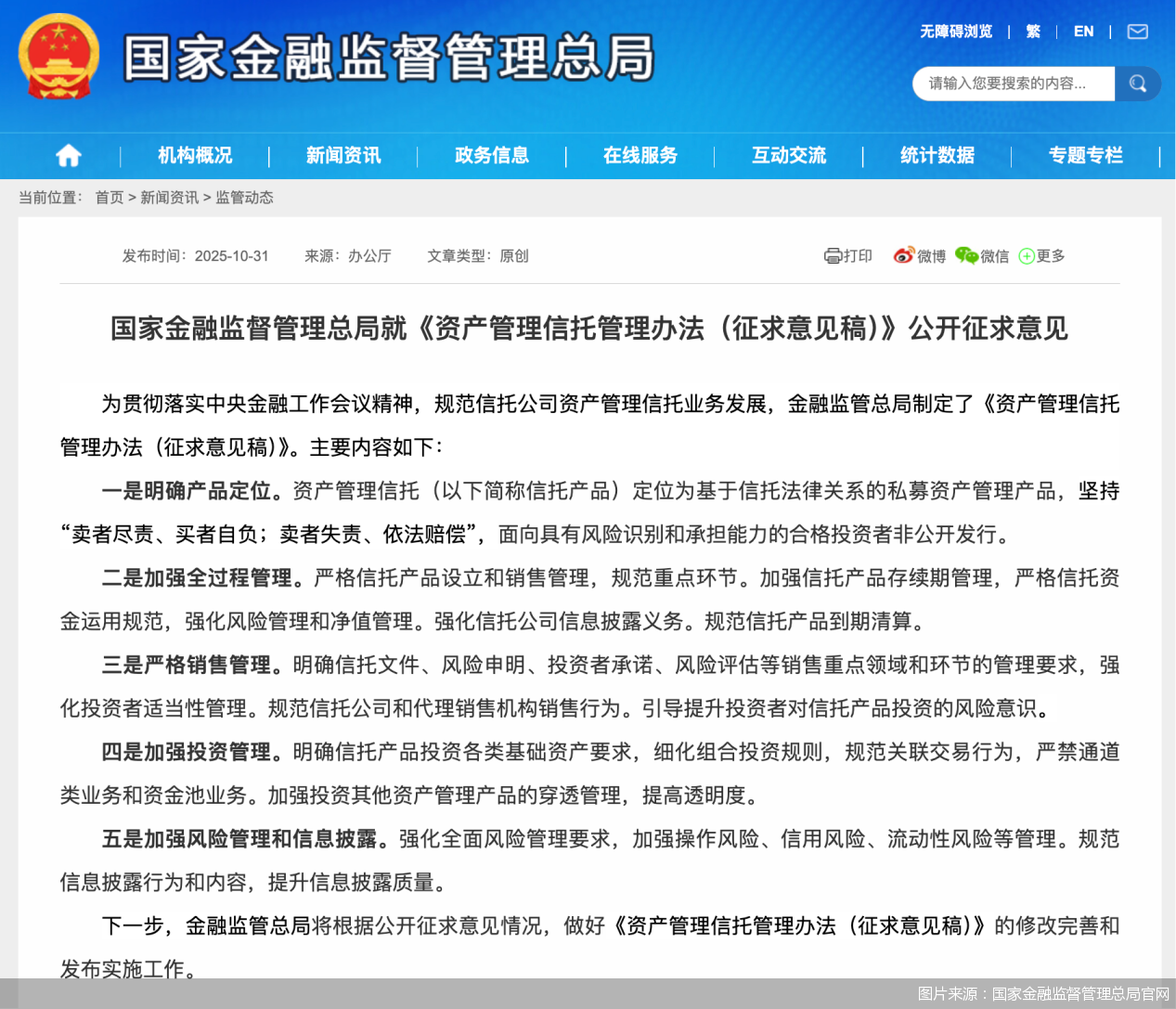
Core Viewpoint - The introduction of the new regulatory framework for asset management trusts marks a significant shift in the trust industry, emphasizing a transition from a financing intermediary to a true asset management institution, enhancing compliance and operational standards [1][11][12]. Group 1: Regulatory Framework - The National Financial Regulatory Administration has released a draft for the "Asset Management Trust Management Measures," which is open for public feedback until December 1, 2025 [1]. - The new measures require trust companies to strengthen comprehensive management and clearly define regulations for key business areas such as channel services, fund pools, and related transactions [5][6]. - The measures establish three key "red lines" for asset management trusts: adherence to the essence of asset management, maintaining a private placement position, and setting a minimum net asset requirement of 3 million yuan for investors [1][10]. Group 2: Operational Management - The draft consists of five chapters and eighty-five articles, detailing the establishment, modification, and termination of asset management trust products, as well as standards for qualified investors and risk assessment [5]. - Trust companies are mandated to enhance the management of asset management trust products throughout their lifecycle, including strict regulations on product establishment, sales, and risk management [5][8]. - The measures prohibit trust companies from promising investors against capital loss or minimum returns, and from engaging in certain high-risk financing activities [7][10]. Group 3: Investor Standards - Asset management trusts are defined as private asset management products based on trust law, with strict investor qualifications and a cap of 200 investors per product [9][10]. - Qualified individual investors must meet specific criteria, such as having a family financial net worth of at least 3 million yuan or an average annual income of 400,000 yuan over the past three years [10]. - The tightening of investor standards is seen as a crucial step in transforming the trust industry, focusing on high-net-worth clients and reducing disputes [10][11]. Group 4: Industry Impact - The new measures are expected to accelerate the elimination of weaker players in the industry, pushing trust companies to invest in research, risk control, and financial technology to build core competitiveness [8][11]. - The regulatory changes are anticipated to lead to a significant transformation in the trust industry, moving from traditional financing roles to investment and service-oriented functions [11][12]. - The overall trust asset management scale is projected to exceed 30 trillion yuan, with asset management trusts becoming a dominant force in driving industry growth [13].