赛道化

Search documents
基金经理,路越走越窄了
虎嗅APP· 2026-01-12 00:10
Core Viewpoint - The article discusses the contrasting performance and investor preferences between actively managed equity funds and ETFs in the context of a strong stock market in 2025, highlighting the challenges faced by active fund managers despite some impressive returns [4][5][6]. Group 1: Performance of Active Equity Funds - In 2025, the average annual return of actively managed equity funds reached 31.14%, a significant improvement compared to the previous four years [5]. - Over 70 funds achieved annual returns exceeding 100%, with the top-performing fund, managed by Ren Jie, yielding 233.69%, surpassing the previous record set by Wang Yawei in 2007 [5][6]. - Despite these gains, investor confidence in active equity funds remains low, as evidenced by a 5.7% quarter-over-quarter decline in overall fund shares in Q3 2025 [5][6]. Group 2: ETF Growth and Investor Preferences - ETFs saw a substantial growth of over 2 trillion yuan in 2025, reaching a total size of 6 trillion yuan, with stock ETFs alone accounting for 3.8 trillion yuan [6]. - The preference for ETFs over actively managed funds is evident, as even high-performing active funds did not attract significant inflows, with some funds having less than 10 million yuan in size despite impressive returns [6][7]. - The article emphasizes that the growth in active equity fund sizes is primarily due to net asset value increases rather than new subscriptions from investors [5][6]. Group 3: Investment Strategies and Market Dynamics - Active fund managers are increasingly focusing on niche sectors, particularly in technology and AI, to differentiate themselves from ETFs [9][14]. - The concentration of top-performing funds in specific sectors, such as communication and AI, has led to a high degree of overlap in holdings, making it difficult for investors to distinguish between different funds [16][19]. - The article notes that while active managers have the potential for higher returns through deep research and sector focus, many struggle to maintain consistent performance over time [32][33]. Group 4: Challenges Faced by Active Fund Managers - Many active fund managers face challenges in outperforming ETFs, particularly in sectors where ETFs have strong performance, such as communication [17][18]. - The article highlights that the strategies employed by many active managers are becoming increasingly homogenized, leading to a lack of differentiation in performance [16][19]. - The potential for active managers to capture excess returns is limited by their inability to adapt quickly to changing market conditions, particularly when sectors experience downturns [25][26].


得窄基者得天下?行业主题基金成规模赢家
券商中国· 2025-11-09 10:40
Core Viewpoint - The narrow-based products are becoming the main driving force for the growth of public funds, driven by the segmented demands of investors [1][2]. Group 1: Market Trends - The public fund industry is entering a tool-oriented era, where narrow-based products with distinct styles and specific industry scenarios are key to marketing strategies [2]. - Despite a slight overall redemption in public fund shares, narrow-based products have seen significant growth, indicating a shift in investor preference towards these products [3][4]. Group 2: Performance of Narrow-based Products - Narrow-based products have countered the shrinkage of wide-based ETFs, with significant net subscriptions observed in various narrow-based ETFs during the third quarter [4]. - Specific examples include the Satellite ETF with over 10 times net subscriptions, the Robot ETF with nearly 5 times, and the New Energy Battery ETF with about 8 times [4]. Group 3: Active Equity Funds - Active equity funds are also aligning with narrow-based strategies, with themes like innovative drugs, digital economy, and artificial intelligence leading performance rankings [5][6]. - The top 10 active equity funds are all industry-themed, showcasing a trend towards sector-focused investment strategies [5]. Group 4: Tool-oriented Product Development - The arrival of the tool-oriented era in public funds has led to a consensus that "whoever masters narrow-based products will dominate" [8]. - Fund companies are increasingly focusing on tool-oriented products that cater to specific investor needs, enhancing their competitive edge [8][9]. - The development of tool-oriented products is seen as a response to the challenges of extracting excess returns in an efficient market [9].

多家中小公募,业绩突出!
Zhong Guo Ji Jin Bao· 2025-09-29 06:31
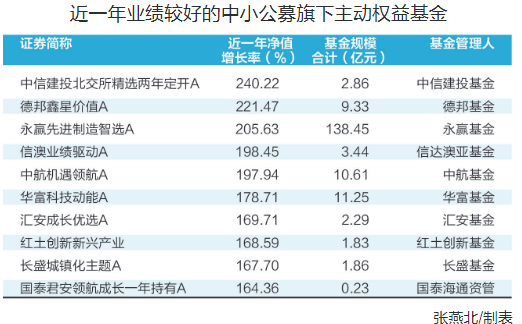
Core Insights - The performance of actively managed equity funds has significantly rebounded, particularly among small and medium-sized public funds, marking a shift from the dominance of larger funds in the market [1][2] - The resurgence in performance is attributed to a combination of market trends and competitive dynamics within the industry, with smaller funds demonstrating agility in adjusting their portfolios to capture market opportunities [6][9] Performance Highlights - Since September 24 of the previous year, the average net asset value growth rate for actively managed equity funds reached 40.77%, with 245 funds doubling their net value [2] - Among these "doubling funds," 133 are from small and medium-sized public funds, accounting for 54.3% of the total [2][6] - The top-performing funds include CITIC Securities' North Exchange Selected Two-Year Open A with a growth rate of 240.22%, and Debon Xin Xing Value A with a 221.47% increase [3] Competitive Landscape - A total of 245 "doubling funds" are managed by 77 different fund companies, with notable contributions from firms like Caitong Fund and E Fund [6] - The competitive advantage of smaller funds lies in their ability to quickly adjust their holdings and focus on high-growth sectors, unlike larger firms that face constraints due to their size [6][9] Investment Strategies - The trend towards "track-based" and "high-sharp" investment strategies among small public funds has become more pronounced, allowing for clearer style positioning and better performance predictability [8] - However, there is a caution against "betting-style" investments that may arise from focusing solely on specific sectors without adequate diversification [7][9] Future Outlook - The macroeconomic environment is expected to maintain a weak recovery, with a likelihood of continued focus on technology-driven growth in the stock market [9] - If there is an unexpected recovery in infrastructure, consumption, and investment sectors, larger equity funds may also see performance opportunities [9] - Long-term value creation and strengthening research capabilities remain essential for sustainable growth across both small and large fund management firms [9]
多家中小公募,业绩突出!
中国基金报· 2025-09-29 06:26
Core Viewpoint - The performance of actively managed equity funds has significantly rebounded, with small and medium-sized public funds showing remarkable improvement, marking a shift from the dominance of larger funds in the market [2][4]. Group 1: Market Performance - Since September 24 of last year, major A-share indices have risen sharply, leading to an average net value growth rate of 40.77% for actively managed equity funds, with 245 funds doubling their net value [4]. - Among the "doubling funds," 133 are from small and medium-sized public funds, accounting for 54.3% of the total [4]. Group 2: Fund Performance Highlights - The top-performing funds include: - CITIC Securities North Exchange Selection Two-Year Open A with a growth rate of 240.22% - Debon Xin Xing Value A at 221.47% - Yongying Advanced Manufacturing Smart Selection A at 205.63% - Other notable funds include Xin Ao Performance Driven A and Zhonghang Opportunity Navigation A, both exceeding 197% growth [5]. Group 3: Industry Dynamics - The success of small and medium-sized public funds is attributed to their ability to quickly adapt to market opportunities due to their smaller scale, allowing for more flexible portfolio adjustments compared to larger firms [6]. - The structural market conditions have favored small-cap stocks, which have seen significant price increases, benefiting smaller funds that can concentrate their holdings in these areas [6]. Group 4: Investment Strategies - The trend towards "track-oriented" and "high sharpness" strategies among small and medium-sized public funds has become more pronounced, allowing for clearer investment style positioning and potentially higher alpha returns for investors [8]. - However, there is a caution against "betting-style" investments that focus solely on specific sectors without a diversified approach [9]. Group 5: Future Outlook - The macroeconomic environment is expected to maintain a weak recovery, with liquidity remaining relatively abundant, suggesting that the stock market will likely continue to favor technology growth styles [9]. - If there is an unexpected recovery in infrastructure, consumption, and investment sectors by mid-next year, larger equity funds may also see performance opportunities [9]. Group 6: Long-term Perspective - The recent performance surge of small and medium-sized public funds is viewed as a temporary outcome of specific market conditions, emphasizing the importance of long-term value creation and robust research capabilities for sustainable growth [9].